Sewer Line Excavation and Replacement in Anaheim
Key Takeaways: The Yearly Root Cleaning Is Telling You Something
- An Anaheim line that has to be cleared of roots every year is not a maintenance schedule, it is an opening in the pipe that keeps letting them back in.
- Roots do not force their way through sound pipe. They follow moisture and vapor to a joint or crack that is already leaking, then widen it.
- A camera inspection is what separates an Anaheim line that can keep being cleaned from one that has lost enough wall or alignment to need replacing.
- Removing the tree does not repair the pipe. The opening that let the roots in is still there, and other roots will find it.
- Pipe bursting and lining are conditional on depth, on the material and condition of the existing run, and on having room to work at both ends.
- Utility locating happens before any excavation and is not optional, because gas, electric, water and telecom share the ground a sewer lateral runs through.
- The work is permitted and inspected, and Roto-Rooter handles that process. Roto-Rooter is fully licensed and insured.
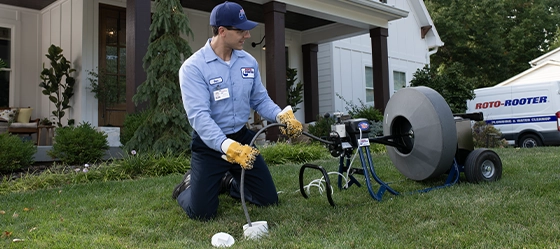
A root does not break into a sewer lateral by force. It grows toward water, and in a Southern California summer that supplies almost none of it for months at a stretch, the reliably damp ground under an Anaheim lot is wherever something is leaking. A hairline crack or a joint that has opened a fraction of an inch gives off enough moisture and vapor to be worth growing toward, and once a fine root is inside a warm, wet pipe it thickens into a mass that catches everything moving past it. The damage is the sequence, not the moment: the pipe leaked first, the roots answered.
Cutting Roots Back Is Not the Same as Ending Them
Cable work and jetting both clear a root mass properly, and for a line that is otherwise sound that is exactly the right answer on an Anaheim lot. What neither can do is close the opening the roots came through. The plant is still there, the crack is still there, and in a yard where irrigation keeps the surface green while the deeper soil dries out, the pipe stays the most attractive water source in the yard.
So the useful question is not how bad the roots are today. It is how much pipe is left around them. A joint that has shifted enough to admit a root has shifted, and a clay section that has cracked will keep cracking under the same load. When the annual clearing turns into two visits a year, and then into a call every few months, the line has stopped being a cleaning problem.
What Ends the Cleaning Conversation
An inspection puts a camera through the whole Anaheim run and records what is there. Roots entering at a single joint on an otherwise sound line is a repairable finding. Roots at several joints means several openings. A collapsed section has no bore left to work with. A belly, where a length has sagged into a dip, holds water permanently and will refill after every cleaning because the fall is wrong rather than the pipe being dirty.
Wall loss is the finding people underestimate. Older clay and cast iron thin from the inside over decades, and a run that has been cabled repeatedly through a root-damaged section can end up structurally marginal even where it has not failed outright. That is a judgment made from footage, not from the kitchen sink, which is why a sewer line replacement should never be recommended before an inspection has happened.
Serving the entire Anaheim metro area, Including:
Counties in the Anaheim Area
Open Cut, Pipe Bursting and What the Line Will Allow
An open cut across an Anaheim lot follows the run with a trench, takes the failed pipe out, puts new pipe in, then backfill and compaction. It works whatever condition the old line is in, and what it costs the property is whatever sits on the surface above it.
Trenchless reduces that surface damage substantially. Pipe bursting pulls a new line along the old path while breaking the original outward, working from a pit at each end rather than a trench along the whole length, and cured-in-place lining forms a new wall inside the existing pipe. Neither is available on demand. A run that has collapsed gives the equipment nothing to follow, heavy root damage can rule lining out, and a property with no working room at one end removes the access both methods require. Anybody who commits to trenchless before seeing the footage is committing to something they cannot know yet.
Where the Private Pipe Ends
In general terms the lateral from the building to the municipal main is the property owner's and the main is the municipality's. Where exactly responsibility changes hands, at the property line, at the sidewalk, or at the connection, is set locally and is not uniform across California. Confirm it with your municipality rather than assuming, because it decides who pays for which length of pipe. Roto-Rooter works on the property owner's side of that boundary in Anaheim and does not take on municipal main work.
The Paperwork a Yearly Cleaning Never Needed
Sewer excavation in Anaheim is permitted work, it is inspected against the California Plumbing Code, and Roto-Rooter handles that process rather than leaving it with the homeowner. You will notice this page does not say what a permit costs or how long an approval takes. That is deliberate. Both vary by jurisdiction and by the scope of the job, and a figure published on a page turns into a promise nobody authorized. Your on-site estimate covers it against the work actually being done.
The Parkway Strip, the Lawn and the Driveway
Straight talk beats reassurance here. A trench across an Anaheim front yard disturbs the ground along its whole length, and where the run passes under a driveway, a walkway or a concrete slab, that surface has to be opened and will still be visible when the work is finished. Where the excavation lands in the parkway strip near a mature tree, roots are cut, and that has consequences for the tree that are worth discussing before the work starts rather than afterward.
Backfill and compaction are part of the job, and compaction is not a formality: soil dropped back loose keeps settling for months and leaves a trough tracing the trench across the yard. Final surface restoration, meaning turf, paving or hardscape, is scoped on site and written into the agreement instead of being assumed either way. Ask for that to be spelled out before anything is signed.
If the Line Closes One More Time First
An Anaheim line in this condition rarely holds together until the appointment. When it backs up in the meantime, Anaheim emergency plumbing help can get flow restored so the household keeps running, which is a holding measure and does not change the finding on the footage. For everything else Roto-Rooter handles in this market, start with Anaheim plumbers.
Put a Camera In Before Booking a Dig
Roto-Rooter has been clearing and repairing sewer lines since 1935 and is fully licensed and insured. Call 657-231-4190 or schedule online to get the Anaheim line inspected. Roto-Rooter provides on-site estimates before any work begins, so the scope and the footage arrive together and the decision is yours to make from evidence. That is the plumbing peace of mind this kind of repair should come with, and Roto-Rooter answers 24/7, 365 days a year.

Marks on the Ground Before Anything Opens It
Full-Grown Trees Over an Older Generation of Clay

SPECIAL FINANCING AVAILABLE
We have partnered with Synchrony Bank to offer financing options to make your plumbing repair expenses as convenient and stress-free as possible.