Hydro Jetting in Atlanta
Key Takeaways: Red Clay, Deep Roots and the Flat End of a Sloped Run
- A line that keeps closing in the same place is not unlucky. On rolling ground the solids ride the steep part of the run and drop out where it levels off, and that is where the buildup collects year after year.
- Cabling a line like that treats the plug and not the deposit. The cable bores an opening, flow returns, and the flat stretch keeps loading at the rate it always did.
- Hydro jetting works the full circumference of the pipe with high-pressure water, so the material sitting on the wall leaves the sewer line instead of being punched through.
- Tree roots drive more of this work in Atlanta than mineral scale does. A hardwood canopy over jointed clay laterals is the local condition, and a cutter head clears the mass while jetting takes the hair still gripping the seam.
- Red clay shrinks and swells with the season, which moves joints. That makes the condition of the pipe a real question rather than a formality, and a video camera inspection is how it gets answered.
- A collapsed run, a badly offset joint or a wall thinned by corrosion is not a jetting candidate. Descaling or cleaning a pipe in that state is not work anyone should sell.
- Roto-Rooter is fully licensed and insured and works across Georgia 24/7, 365 days a year.
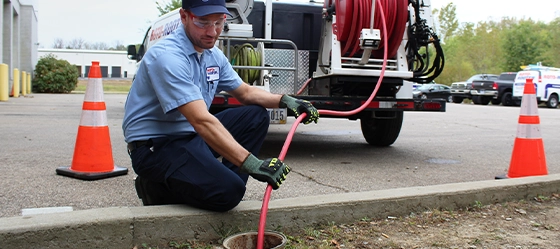
Water moves only as well as the flattest part of its run allows. That is the whole story of a lot of drainage in Atlanta, where the ground rolls and a lateral leaving a house can drop hard for thirty feet and then run nearly level the rest of the way to the main. Solids ride the steep stretch without trouble. They settle out at the bottom, in the same few feet of pipe, every time. Which is why so many houses here have a backup that recurs in the same spot and a plumbing history that reads like a subscription.
Why Hydro Jetting Follows a Root Cut
Roots arrive at a joint as a mass and get cut out as one. A cutter head on a cable does that job well: it takes the bulk, the line opens, and the water runs again the same afternoon. What stays behind is the fine hair still anchored in the seam and the sludge and grease that had built up against the mass while it was there. Both are on the wall, both are out of the cable's reach, and both give the next season's growth something to hold onto.
Jetting is the second half of that job. The nozzle throws high-pressure water outward and back against the pipe wall while the hose is pulled through the run, so the cleaning covers the entire circumference rather than the bored path down the middle. Grease that hardened along the crown lifts. Sludge settled in the level stretch is carried out instead of shoved further down. Scale in older cast iron closer to the house is cut back toward the bore it started with, which is the descaling side of the work. And the root hair at the seam is stripped rather than trimmed. Clearing a blockage is what ends tonight; taking the pipe back to its wall end to end is what changes next spring.
What Red Clay Does to a Joint, and Why the Camera Looks First
Georgia clay does not sit still. It takes on water in a wet stretch and gives it back in a dry one, and it changes volume doing so, which means the ground holding a lateral moves a little every year. On a jointed clay run that shows up as seams pulled slightly apart or dropped out of line, and an offset joint is both an invitation to roots and a reason a hose can catch. So the pipe's condition is a genuine question in Atlanta rather than a box to tick.
A video camera inspection answers it before anything else happens. The footage names what is on the wall, because grease, root hair and scale each imply different work, and it grades the pipe itself for whether it can be cleaned against at all. The camera then goes back down when the job is finished, because a before-and-after on the same run is the only honest way to show a wall is clear, and it leaves the household with a recorded baseline to measure against later instead of starting from nothing.
Serving the entire Atlanta metro area, Including:
Counties in the Atlanta Metro Area
The Point Where Jetting Stops Being the Answer
High-pressure water cleans a pipe. It does not straighten one, patch one or put one back together, and a company that treats it as an answer to everything eventually sells somebody a cleaning on a line that needed a repair. Three findings end the conversation. A collapsed section has no bore left to work with. A joint that has dropped or pulled far enough out of line will snag a hose, and the fault under it is structural. A wall thinned by long corrosion may not hold pressure, and that is a thing to learn from footage rather than from a flooded crawl space.
When any of those turn up, the honest answer is that cleaning is the wrong purchase and the discussion moves to repair options, priced separately and starting from footage that already exists. Ground movement in Georgia clay makes offset joints a more frequent finding here than a homeowner expects, so it is worth knowing in advance that a camera sometimes ends a booking rather than confirming it. If a fixture is backing up right now, flow comes first: start with emergency plumbing help in Atlanta and keep the footage from that visit for the cleaning decision.
How Long Does a Cleaned Line Stay Clear in Atlanta?
It follows from what filled it. A line cleaned of grease stays clear as long as the kitchen above it behaves, which for a household can be years. A line cleaned of root hair stays clear until the same roots come back through the same seam, and with a long growing season and a canopy overhead that is a schedule rather than a cure. Cleaning removes what the roots brought and restores the bore; it does not close the opening they used, and the after footage is what tells you which of those two conversations you are actually in.
Kitchens on the Corridor, and Why They Set an Interval
A house lateral and a restaurant line differ in diameter, in loading rate and in what an hour of downtime costs. A residential run in Atlanta that has been properly cleaned can go a long time before it needs attention again. A kitchen putting cooking waste through the same pipe every service is working against a rate it can measure, which is why operators along the busier corridors take the condition found at the first inspection as a baseline and set a schedule from it rather than waiting for a failure on a Saturday night.
Roto-Rooter covers both sides of that here. For grease management, scheduled maintenance and the rest of what the local crews handle, the Atlanta market page is the place to start.
Request a Camera Inspection in Atlanta
Roto-Rooter has worked in sewer lines since 1935, is fully licensed and insured, and answers across Georgia 24/7, 365 days a year. Call 404-815-9051 or schedule online to get a camera into the line and find out whether the problem is on the wall or in the pipe. Roto-Rooter provides on-site estimates before any work begins, so nothing starts in Atlanta until the scope is on the table and you have agreed to it.

Where Jetting Pays Off on a Sloped Run
Hardwood Canopy Over Clay Laterals

SPECIAL FINANCING AVAILABLE
We have partnered with Synchrony Bank to offer financing options to make your plumbing repair expenses as convenient and stress-free as possible.