Sewer and Water Line Excavation in Aurora
Key Takeaways: Frost Depth, Claystone and What They Do to a Trench
- Frost drives the line down. A sewer or water run in Aurora was laid beneath the depth winter reaches, and the hole needed to get back to it is larger than almost anyone pictures.
- Nothing is dug on a description. The line goes on camera first, and the footage is what separates a blockage somebody can remove from a pipe that has stopped holding its shape.
- Claystone swells when it is wet and pulls back when it dries. A lateral assembled from short lengths gives at the joints long before it gives anywhere else, which is why stepped and separated joints are what shows up on Aurora footage.
- Bursting and lining are conditions, not upgrades. What the old pipe is made of, how far gone it is, how deep it runs and whether both ends can be reached all decide whether either is even on the table.
- Locates come before the machine. Gas, electric, water and telecom share the corridor a lateral uses, and across Aurora's irrigated subdivisions so do sprinkler mains that were never drawn on anything.
- The point where a private lateral becomes the public main is a local ruling rather than a national one, so it is worth confirming with the city before anyone assumes who owns the failure.
- A trench filled without proper compaction tells on itself. On semi-arid Colorado ground that gets watered every summer, the giveaway is a sunken ribbon of greener grass following the dig.
- Permitting and inspection ride with the job and Roto-Rooter carries them. Roto-Rooter is fully licensed and insured.
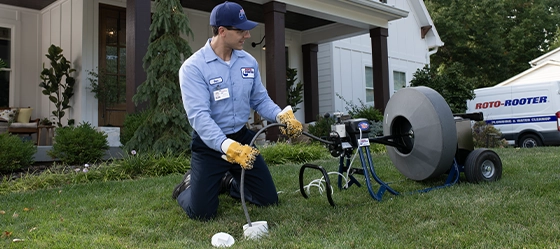
Depth is the first thing worth understanding about digging up a pipe in Aurora, and it is almost never where the conversation starts. Winter frost reaches well down into Colorado's Front Range soil, so water and sewer runs were set beneath it when the house went in and they have been sitting there ever since. Everything that follows on this page, the size of the opening, the equipment that has to reach the bottom of it, and whether there is any way to avoid opening the ground at all, comes back to that one fact.
Is This a Cleaning Problem or a Structural One?
Symptoms are not a diagnosis. A drain that backs up again, several fixtures losing speed at the same time, a patch of ground staying wet over the run: all of that points at the main line and none of it says what is wrong with the main line. A camera survey is the step that turns the first list into the second. Aurora spreads across three counties and several eras of construction, so an identical set of symptoms can easily sit above completely different pipe.
Four things on the screen close the door on cleaning. Where a section has lost its shape there is no longer a channel for a cable to travel through. Where one length has stepped sideways of the next, the mismatch leaves an edge that keeps hold of whatever comes past it. Where a run has sagged and now stands full of water, cleaning empties it and gravity refills it. And where roots have arrived at a break, the roots are the evidence rather than the fault: cut them out and the opening admits the next set.
Open Cut and Pipe Bursting at Front Range Trench Depths
The open cut is the method with nothing clever about it. Ground is opened along the line, the failed pipe comes out, new pipe goes in behind it, then the hole is filled and compacted. It works whatever the footage shows. What depth changes is not whether it works but how much of the surface it takes. A deep trench cannot stand as a narrow slot with vertical sides, so it is either stepped back at the top or held with shoring, and the opening at ground level ends up considerably wider than the pipe underneath it. The spoil pile grows with the hole, and so does the machine, and so does the ground the machine has to stand on.
Trenchless work exists to keep that footprint small. Bursting drives a head along the existing line, splitting it outward into the soil and drawing the replacement in behind, worked from pits sunk at each end instead of from a trench along the whole length. Lining forms a new wall inside the pipe already in the ground. Neither is available on demand. Both want an existing run in good enough condition to follow, both want two ends that can be reached, and here both want pits that go down as far as the line itself does. Depth is what makes trenchless worth asking about on a Colorado lot and it is also what can rule it out, so across Aurora the ground keeps the last word and the footage is where the answer comes from.
Serving Aurora and surrounding communities, Including:
Counties in the Aurora Area
How Deep Does a Sewer Line Excavation Have to Go Here?
Far enough to reach a pipe that was set under the frost when the house was built, which in Aurora is deeper than most people picture. The number belongs to your address rather than to a web page, and the camera survey and the utility locate settle it together before any scope gets written. What is worth knowing ahead of that visit is what the depth spends: a wider opening at ground level, support to hold the walls where they belong, a spoil pile that has to live somewhere on the property for the duration, and equipment sized to reach the bottom.
Depth is also why the whole length gets read before anyone settles on a partial repair. One bad joint in a run that is otherwise sound is a real answer and a far smaller day. Three separations and a sag is a different picture, and patching a short section of that means coming back into deep ground later for the rest of it. On Aurora's Front Range claystone the wear tends to spread itself evenly along a lateral instead of concentrating at one point, and that is exactly the pattern worth ruling out before a partial repair gets chosen.
What Else Is Buried at Excavation Depth
Nothing is opened until the locates are marked, and that is an obligation rather than a courtesy. A lateral shares its corridor with gas, electric, water and telecom, and the deeper the trench the more of them it crosses on the way down. Across Aurora's irrigated subdivisions there is a second set nobody thinks about: sprinkler mains, valve boxes and the sleeves run under drives and walks, none of which appear on any utility record. Those get found during the locate and designed around. A crew willing to lose the marking step in order to gain a day is a crew proposing to gamble with a gas main.
The Permit, the Inspection and What Is Deliberately Not on This Page
Excavation of this kind is permitted and inspected, and Roto-Rooter carries the paperwork instead of handing it back to the household. What you will not find here is a permit figure, an approval window or a count of days on site. All three move between Colorado jurisdictions and with the scope of the individual dig, and anything printed on a page hardens into a promise nobody agreed to. The on-site estimate answers them against the actual job, which is the only honest place to answer them.
The Boundary Your Municipality Sets
Somewhere between the house and the street the pipe stops being yours. The usual split is that the lateral is private and the main is public, but the exact handover point, at the boundary, at the curb, or at the tap itself, is a local decision, and Aurora's answer is the city's to give rather than ours. It is worth a phone call before anybody assumes, because that point decides who carries the repair.
Roto-Rooter's work stops in the same place your responsibility does. A plumbing company does not open the public main, so if the footage points past the connection the conversation moves to the city rather than to a contractor.
Backfill, Compaction and a Lawn That Gets Watered Anyway
It is better to be honest about the surface than comforting about it. Ground along an open cut is disturbed for the full length of the trench, and any driveway, walk or patio the run passes beneath has to come up. It will still be visible when the work is finished. Bursting and lining hold that damage down to the two access pits, which is the strongest practical argument for asking whether they apply, and those pits are full-depth excavations in their own right.
Filling and compacting the hole is part of the job and it deserves more attention than it usually gets. A deep trench swallows a great deal of loose material, and material returned without proper compaction keeps settling long after the crew has gone. On an irrigated Colorado lawn the result is easy to spot: a sunken ribbon following the dig, holding water and growing different grass. Restoring the finished surface itself, turf, paving or hardscape, gets scoped at the property and agreed before work starts, so ask what is covered and get the answer in writing.
Water Still Has to Go Somewhere Tonight
A failing line does not pause because an appointment exists. If it backs up before the crew arrives, emergency plumbing help in Aurora can get flow back well enough for the household to keep functioning. That buys time and nothing more, and the footage still says what it said. Everything else Roto-Rooter handles locally starts from the Aurora plumbers page.
Call for a Camera Inspection Before Anyone Plans a Trench
Roto-Rooter has worked on buried lines since 1935 and is fully licensed and insured. Call 303-202-3010 or schedule online to put a camera in the line. Roto-Rooter provides on-site estimates before any work begins, which means the footage and the scope reach you at the same moment and the decision is yours to make from evidence. For a repair that goes this far down, that is where plumbing peace of mind actually comes from, and Roto-Rooter answers 24/7, 365 days a year.

The Findings That Point at the Ground Rather Than the Grease
Deep Frost, Dry Air and Claystone That Changes Volume
