Sewer and Water Line Excavation in Aurora
Key Takeaways: Groundwater, Glacial Till and What They Change About an Excavation
- Water is the local variable. Ground in the Fox River valley holds it close to the surface, so a hole dug to reach a failed line in Aurora rarely stays dry for long.
- The camera settles the question before a shovel moves. On wet ground the useful finding is frequently clear water coming into an Aurora line rather than waste struggling to get out of it.
- Groundwater entering at an open joint brings fine material with it, and that material settles wherever the run has dropped, which is why the same stretch closes up again after every wet spell.
- Saturated till needs holding. Ground that stands up honestly when it is dry loses its cohesion once it is full of water, so shoring and a pump in the bottom of the hole are part of the plan rather than a response to a bad morning.
- Material dropped into standing water does not compact, it displaces, and a trench backfilled that way keeps settling for months, which on Illinois clay means through the following spring.
- The trenchless options stay conditional here for reasons of their own. Bursting needs access pits sunk and held in the same wet ground, and water entering the host pipe has a say in whether a liner can cure.
- Gas, electric, water and telecom are located before anything opens, and in an older Illinois river town the corridor also holds abandoned services that no record admits to.
- Permits and inspection travel with the job and Roto-Rooter handles them. Roto-Rooter is fully licensed and insured.
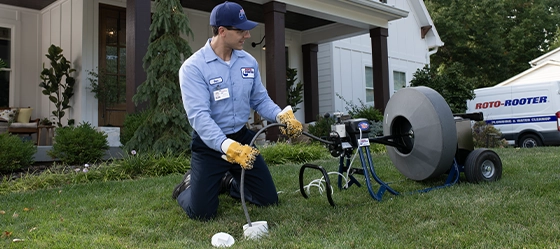
There is a finding on Aurora sewer footage that catches homeowners off guard: clear water running into the pipe from outside, at a joint that has no business being open. It is not what anybody expects to see on a line that has been backing up into the house, and it is one of the more useful things a camera can show on this ground, because it moves the fault out of the household's habits and into the pipe wall.
When Groundwater Is What the Camera Finds
A description of the trouble is rarely enough here, because two completely different faults produce the same week. Groundwater that gets into a lateral does not arrive alone; it carries fine silt and sand in with it, and that material drops out wherever the run has sagged. The result is a stoppage that follows the weather rather than the kitchen, and across Aurora it is one of the commoner reasons a line gets cleaned twice in a season and fails in the same spot both times.
Some findings can be cleaned around and some cannot. A joint that has opened, a length that has dropped below the grade either side of it, a run that has lost its shape, and a fracture with roots already through it are all faults in the pipe itself, and a cable running through them leaves every one of them exactly as it was. The tell is repetition. A line that fails, gets cleaned, works, then fails again in the same spot is describing its own condition, and a camera inspection is how that description gets read.
Does Pipe Bursting Work in Saturated Till?
It can. The head will pull through and the till will take the old pipe as it is displaced outward, which on a lot where the run passes under a drive or a mature planting is worth a great deal. The constraint in Aurora is not the pipe, it is the two holes at either end. Each access pit has to be sunk to the depth of the line, and a pit in saturated ground has to be supported and kept clear of water for as long as the work takes. The footprint is still far smaller than an open cut, and it is not as small as the same job would be on dry ground.
Lining, the other trenchless route, has its own conversation with the water. A cured liner forms a new wall inside the host pipe, and water arriving through the very joints that made the line a candidate has a say in whether the host is in a fit state to take one. The open cut, meanwhile, is the method that does not care what the footage says: ground opened along the run, the old pipe out, new pipe bedded, then backfill and compaction. What it asks for on Illinois till is a wider supported hole with a pump working in the bottom of it. None of the three is chosen from a preference. The footage and the water pick between them.
Serving Aurora and surrounding communities, Including:
Counties in the Aurora Area
What a Sewer Line Excavation Looks Like in Wet Ground
The pipe is usually the straightforward part. An excavation in Aurora has to keep the hole open and keep it workable at the same time, and those are two separate jobs. Till that stands up honestly while it is dry loses cohesion once it is saturated, so the walls get shoring rather than a slope, and a pump runs in the bottom of the trench to hold the water down while the new pipe is bedded and connected. Spoil comes out heavier and wetter than it went in, and it has to live somewhere on the property until it goes back.
This is also why a partial repair gets weighed rather than assumed. Opening one short length is a smaller day than replacing a whole run, and it is the right answer where the camera shows a single fault in pipe that is otherwise sound. Where the footage shows several open joints along the same lateral, a second trench later means a second round of shoring, pumping and compaction in the same wet Aurora ground, and that arithmetic changes the answer.
The Locate Comes First, and It Is Not Optional
Utility locating is the first thing that happens and the only thing that happens until it is finished. Gas, electric, water and telecom all get marked before anything opens, every time, with no exceptions worth discussing. Aurora has been building and rebuilding along the same corridors for generations, which adds a complication of its own: services that were abandoned in place rather than lifted out, which appear on no drawing and are discovered either by the locate or by the bucket. The first of those is a morning. The second is an incident, and on a gas main it is a serious one.
Backfill That Has to Be Compacted in a Wet Hole
Putting the ground back is where a wet excavation is won or lost. Material dropped into standing water does not compact, it displaces, and saturated clay returned to a trench keeps consolidating for months once the water finally drains out of it, and an Illinois winter of freeze and thaw keeps working on it after that. The trench line settles, and the settlement turns up later as a soft strip across a lawn or a crack across a drive that was sound the day the crew left. Handling it means keeping the hole pumped down while the fill goes in and compacting in layers instead of in one pass.
The surface deserves a straight answer too. Ground along the trench is disturbed for its whole length, and where the run crosses a drive, a walk or a public sidewalk in Aurora, that surface has to be cut and lifted. It will show afterwards. Backfill and compaction come with the work; restoring turf, paving or hardscape to a finished state is scoped at the property and agreed before anything starts, so it is worth asking exactly where that line falls before an estimate is signed.
Permits, Inspection and the Line You Do Not Own
Work of this kind is permitted and inspected, and Roto-Rooter handles that process rather than leaving it with the customer. You will find no fee, no approval window and no count of days on site anywhere on this page, because all three move with the jurisdiction and with the individual scope, and a figure published here would become a commitment nobody made. The on-site estimate settles them against the actual job.
Where your pipe stops being your pipe is a separate question with the same kind of answer. Typically the lateral belongs to the property and the main belongs to the public system, but the exact handover, whether it sits at the boundary, at the curb or at the tap, differs between Illinois jurisdictions and is worth confirming with the authority that serves your address in Aurora. Roto-Rooter works the private side of it. Public main work belongs to the municipality and not to a plumbing company.
Running the House on a Line That Is Already Failing
A lateral waiting on an excavation date does not behave better while it waits, and a wet week will not help it. If it stops altogether while the repair is being arranged, emergency plumbing help in Aurora can get the household moving again, which is a reprieve and not a repair. The Aurora plumbers page covers the rest of what Roto-Rooter does here.
Book an Inspection Before the Next Wet Spell
Roto-Rooter is fully licensed and insured and has worked on buried lines since 1935. Call 630-378-0032 or schedule online to get a camera into the line while the ground is as cooperative as it gets. Roto-Rooter provides on-site estimates before any work begins, so what you are asked to approve is a scope you have already seen the reason for. On a job that brings a machine, a pump and a hole in the yard, that is what plumbing peace of mind is made of, and Roto-Rooter answers 24/7, 365 days a year.

Findings That Come With Water Attached
Glacial Till, a Perched Water Table and a Frost Line That Runs Deep
