Sewer Line Excavation for Austin Property Owners
Key Takeaways: The Pipe Was There Before the Patio
- On a great many Austin properties the buried line is older than the things sitting on top of it, so where the run goes matters as much as what is wrong with it.
- A camera survey with a distance counter establishes the fault and its position together. No Austin dig should be planned from symptoms alone.
- A survey of the surface happens alongside it. Additions, drives, patios, pool decks and mature trees all sit in the way of a trench that would otherwise be simple.
- Trenchless is worth asking about precisely when the surface is the problem, but it is conditional rather than an upgrade. Access pits still have to be dug, and they have to be placeable.
- Where a failed length runs under something built after the pipe went in, rerouting the new line around the obstruction is sometimes the better answer than replacing it in place.
- Utility locating precedes any excavation and is not optional. Gas, electric, water and telecom share the Austin ground the sewer lateral occupies.
- The boundary between the property owner's pipe and the municipal main is set locally, so it is a question for your municipality rather than an assumption.
- Roto-Rooter is fully licensed and insured, and handles the permit and inspection process as part of the job.
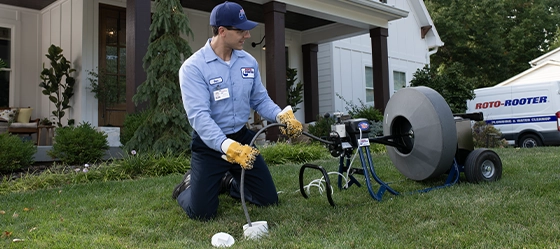
Almost nobody plans a yard around a sewer pipe. The pipe went in when the house was built, and then decades of ordinary life happened above it: a room added on the back, a garage poured, a drive widened, a patio laid, a tree planted that is now sixty feet tall. In an Austin market that has been rebuilding its older streets and spreading outward for a long time, that sequence is the norm rather than the exception, and it is why two properties with an identical fault on camera can face very different work.
The Route Matters as Much as the Damage
A camera survey is still where this starts. A head goes the full length of the private run with a distance counter turning beside the picture, and on any Austin property it answers the only question that justifies excavation: has the pipe failed, or is it merely dirty. A section that has lost its shape, a length sitting out of line with the one next to it, a stretch holding standing water that will not drain, roots growing in through a break in the wall, these are the readings that end the cleaning conversation. If the footage shows sound pipe with buildup in it, the answer is drain cleaning in Austin and the yard stays shut.
What the same survey also produces, and what people underestimate, is a map. Every finding arrives with a distance from the cleanout and a depth, so before anything is opened it is possible to say what the trench would have to cross. That is the moment an Austin job becomes specific. Thirty feet of open lawn is a straightforward trench. The same thirty feet running beneath a stamped patio, a carport slab and the root zone of a mature live oak is a different conversation entirely, and it is a conversation worth having before an estimate rather than on the morning the crew arrives.
Replacing in Place Is Not the Only Option
Open cut is the direct method: a trench along the failed length, the old pipe out, new pipe bedded to fall, then backfill and compaction. It works on any condition of pipe and it is disruptive in exact proportion to what is above the line. Trenchless methods reduce that footprint where the line will take them. Pipe bursting draws a new pipe along the existing path while breaking the original outward, working from access pits rather than a full trench along the Austin run. Lining cures a new wall inside the pipe already there. Depth, material, how far the run has collapsed and whether pits can actually be placed at both ends all decide availability, and on a crowded lot that last one is the constraint that bites.
There is a third answer that gets overlooked, and across Austin it comes up more than it does in most places. Where the failed length runs under a structure added after the pipe was laid, opening it in place may mean taking apart something nobody wants taken apart. Running the replacement on a different path, out around the obstruction to rejoin the line beyond it, is sometimes simpler, far less disruptive and better for the next twenty years than restoring the original route. It is not always possible, since fall, depth and where the connection sits all have to work. It belongs on the table, and it only gets there if somebody has looked at both the footage and the ground above it.
Serving the entire Austin metro area, Including:
Counties in the Austin Area
Working Around What Cannot Be Moved
With the fault located and the surface mapped, the rest of an Austin job is process. It is worth reading before an estimate is signed, because on an Austin property this is where the surprises would otherwise be.
Marking Utilities and Setting the Route
Utility locating comes before any excavation and is a requirement, not a courtesy. Gas, electric, water and telecom occupy the same ground a sewer lateral does, and on an Austin lot that has been built on repeatedly the record of what is buried where is rarely complete. Marks go down first, and the route is confirmed against them. Anyone offering to skip that step to save a day is offering to gamble with a gas line in your yard.
Trees, Root Zones and Hand Work
Where an Austin route passes near a mature tree, the work slows down on purpose. Excavating inside a root zone by machine is how a healthy tree becomes a dead one two seasons later, so that stretch is opened carefully and by hand where it needs to be. Sometimes the honest answer is that the trench should go somewhere else entirely. Roto-Rooter does not offer landscaping or tree work, and this page will not pretend otherwise. What can be offered is a route and a method chosen with the tree in mind rather than in spite of it.
Where the Owner's Length of Pipe Ends
The general pattern is that the property owner owns the lateral and the municipality owns the main. Exactly where one becomes the other, at the property line, at the curb, at the connection, is set locally and it is not uniform across Texas. Confirm it with your municipality rather than assuming, because it settles who is responsible for which length of pipe. Roto-Rooter works on the owner's side of that boundary. Municipal main work is not something a plumbing company takes on, and if the survey points past the boundary the next call is to the city.
Permits and Inspection, Handled for You
Sewer excavation in Austin is permitted work and it is inspected, and Roto-Rooter handles that process rather than leaving it with the property owner. What this page deliberately will not give you is a figure for a permit or a timeline for approval. Both vary by jurisdiction and by the scope of the individual job, and a number published here would turn into a promise nobody authorized. The on-site estimate covers it against the work in front of you.
Backfill, Compaction and a Straight Word About Restoration
Backfill and compaction are part of the excavation rather than tidying up afterward. Fill goes back in layers and is compacted so the trench does not settle onto the new pipe over the following months on Texas ground. Above ground, expect honesty instead of reassurance: a trench across a yard disturbs the ground along its whole length, and where the run crosses paving or a slab, that surface has to be opened and will not look untouched afterward. Trenchless shrinks the footprint where it is available, though the access pits are still excavations. Final surface restoration, meaning turf, paving or hardscape, is scoped on site and agreed before work starts rather than assumed either way. Get it written into the estimate.
If the Line Gives Out Before the Dig
A run bad enough to justify replacing does not wait for the schedule. If it backs up while the work is being arranged, emergency plumbing help in Austin can restore flow temporarily so the household keeps working. That is a holding action rather than a repair, and it changes nothing about the reading. For everything else handled locally, start at the Austin plumbing page.
Talk to Someone Who Has Seen the Line
Roto-Rooter has served Texas property owners since 1935 and is fully licensed and insured. Call 512-258-3008 or schedule online to book a camera inspection. Roto-Rooter provides on-site estimates before any work begins, so the footage, the route and the scope arrive together and the decision comes from evidence. On a job that touches this much of a property, that is the plumbing peace of mind worth insisting on, and Roto-Rooter answers 24/7, 365 days a year.

Old Runs Under New Ground
The Surface Survey That Happens Alongside the Camera

SPECIAL FINANCING AVAILABLE
We have partnered with Synchrony Bank to offer financing options to make your plumbing repair expenses as convenient and stress-free as possible.