Sewer and Water Line Excavation in Baltimore
Key Takeaways: Why the Opening Is Wider Than the Pipe
- The size of a Baltimore excavation is set by the ground and by safe working practice, not by the diameter of the pipe, which is why a small line can need a surprisingly large opening.
- Depth is the multiplier on a Baltimore lot. Past a certain point a trench face cannot simply stand vertical, so it gets sloped back, benched or shored, and each of those makes the hole wider at the top.
- Excavated material has to sit somewhere clear of the edge while the work runs, and on a small rear yard that setback is a real constraint rather than a detail.
- A camera survey still comes first. Four findings end the cleaning conversation on a Baltimore run: a collapse, a joint out of alignment, a length holding standing water, and roots entering through a break.
- Trenchless changes the footprint rather than the rules. It is conditional on depth, material, degree of collapse and access at both ends, and its access pits are still excavations with the same requirements.
- Utility locating precedes any dig and is a legal and safety obligation rather than a scheduling step.
- Where the private lateral ends and the public main begins is set locally, so the boundary is a question for your municipality rather than an assumption.
- Roto-Rooter is fully licensed and insured, handles the permit and inspection process, and provides on-site estimates before any work begins.
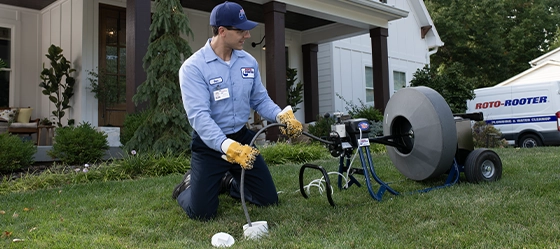
The question that arrives on the day, usually in a slightly wounded tone, is why the hole is that big for a pipe that narrow. It is a fair question with a specific answer, and on a Baltimore rear yard measured in feet rather than in yards it is worth answering before the work starts rather than while somebody is looking at the result.
What the Camera Settles Before Any Ground Is Touched
Nothing gets opened on the strength of symptoms. Repeat backups, several fixtures slowing together and wet ground over the route all say the main line leaving the building is involved without saying why, and the difference between a blockage and a failure is the difference between a short visit and an excavation. A camera survey settles it and puts a distance on the answer.
Four findings take a Baltimore run out of the cleaning category. A collapsed length has no bore left to restore. A joint that has stepped out of alignment leaves a permanent lip. A sag holds standing water, so the line reloads no matter how well it is cleaned. Roots arriving through a break are attached to an opening that will admit them again. The footage also gives the depth, which is the number that decides how big the opening has to be.
Method Changes the Footprint, Not the Requirements
An open cut on a Baltimore lot trenches along the run, lifts the failed pipe, lays the new one, then backfills and compacts. Every foot of that trench answers to the same rules about how a face is supported and where material is placed, which is why length and depth together, rather than pipe size, describe the disruption.
Pipe bursting draws a new line along the old path from access pits at each end, and lining cures a new wall inside the existing pipe. Both leave far less ground open, which on a small Baltimore lot is the whole argument for them. Neither escapes the requirements, though: an access pit at depth is supported and kept clear exactly like a trench is. And neither is universally available, because depth, pipe material, the degree of any collapse and usable access at both ends decide, and all four come off the footage.
Serving the entire Baltimore metro area, Including:
Counties in the Baltimore Metro Area
Spoil Has to Go Somewhere, and So Does the Crew
Here is the part that surprises people on a tight lot. Material coming out of a trench is bulkier than the ground it came from, it cannot be stacked against the edge of an open excavation, and it has to be somewhere while the work runs. Where a yard cannot hold it, it leaves the property and comes back, or clean fill comes in to replace it. That is scope, agreed up front, rather than a surprise on day two.
The same goes for the crew and the equipment. What can reach a Baltimore rear yard through an alley or a passage decides a good deal about how the work is done, and where nothing can reach it, hand excavation over a shorter length becomes the realistic method. Knowing that before a date is set is worth more than any reassurance about tidiness afterward.
Marking Before Measuring Anything
Gas, electric, water and telecom occupy the same ground a Baltimore lateral crosses, and every one gets located and marked before an excavation begins. It is a legal and safety obligation, it is not waived for a small yard, and nothing opens until the marks are down. In a confined working area those marks also shape where the trench can widen, which is another reason they come first.
Permitted Work and an Inspection Worth Having
The work is permitted and inspected, and Roto-Rooter carries that process as part of the job. What this page will not give is a permit fee or an approval timeline, because both vary by jurisdiction across Maryland and by the scope of the specific job, and a number published here becomes a promise nobody authorized. Your on-site estimate covers it against the real work. The inspection is worth more than the permission: it is an independent look at work that is invisible the moment it is covered.
The Far End, Where It Stops Being Your Pipe
The run from the building to the public main is generally the property owner's, and the main is generally the municipality's. Where that boundary falls, at the property line, at the curb or at the connection, is set locally and varies. Confirm it with your municipality rather than assuming, because it decides who pays for which length of pipe.
Roto-Rooter works on the property owner's side of that boundary. Municipal main work is not something a plumbing company undertakes, so a finding past the connection sends the next call to the city rather than into a scope.
What a Wider Opening Means for the Surface
A wider trench disturbs more surface, and on a small Baltimore rear yard that is most of it. Where the run passes under a paved pad, a walk or a concrete slab, that surface has to come up. Backfill and compaction are part of the work, and compaction is what stops the whole opening settling over the following months, which on a paved rear yard shows up quickly and obviously.
Final surface restoration, meaning paving, concrete, brick or planting, is scoped on the property and agreed before work begins rather than assumed either way. Ask for the boundary in writing and ask what the opening will actually measure, because the honest number given in advance is easier to live with than a generous one given on the day.
Until the Excavation Is Scheduled
A failing Maryland run does not hold still while the yard is measured. If it backs up in the meantime, emergency plumbing help in Baltimore can restore flow so the household keeps working. That is a holding action and it changes nothing the camera found. For everything else handled locally, start at the Baltimore service page.
Schedule a Survey and an Honest Look at the Yard
Roto-Rooter has served Maryland property owners since 1935 and is fully licensed and insured. Call 410-864-0435 or schedule online to get the line filmed and the working area assessed together. Roto-Rooter provides on-site estimates before any work begins, so the size of the opening is something you agree to rather than something you discover. On a small lot, knowing that in advance is the plumbing peace of mind worth having, and Roto-Rooter answers 24/7, 365 days a year.

What Sets the Size of the Opening
Attached Rows, Small Rear Yards and a Freeze Every Winter

SPECIAL FINANCING AVAILABLE
We have partnered with Synchrony Bank to offer financing options to make your plumbing repair expenses as convenient and stress-free as possible.