Sewer and Water Line Excavation in Birmingham
Key Takeaways: An Excavation Can Move the Line, Not Just Replace It
- A run that keeps failing after cleaning on an older Birmingham lot is reporting a structural problem, and sometimes the structure at fault is the path the pipe takes rather than the pipe.
- Replacing a lateral along its existing alignment is the default, not a requirement. An open cut can put the new run on a better line where conditions allow.
- Pipe bursting and lining inherit the old path by design, because both work along the pipe already in the ground. That is a genuine limitation rather than a criticism.
- A camera survey settles all of it first. Nobody should propose an excavation, or a new route, from a description of symptoms.
- Rerouting across a Birmingham yard is conditional. Available fall, the position of the connection, what already occupies the ground and what sits on the surface all have to work.
- Utility locating covers every path under consideration, because gas, electric, water and telecom share the ground an Alabama sewer lateral crosses.
- Wherever the new run goes, it still arrives at the same connection, and that is where responsibility changes hands under rules the municipality sets.
- Roto-Rooter handles the permit and inspection process and is fully licensed and insured.
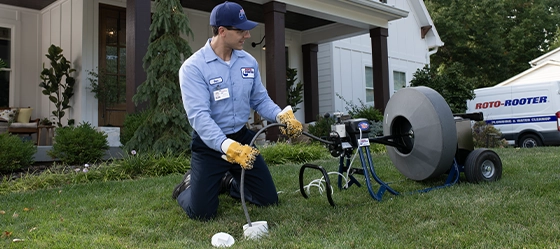
Replacing a lateral and re-laying it along the same line are two different jobs, and only one of them is automatic. The pipe under a Birmingham yard follows a path somebody chose decades ago, usually the shortest workable line between the building and the connection at the time. What was sensible then is not always sensible now, because everything above that path has changed since.
Does a New Sewer Line Have to Follow the Old One?
No, though it usually does, and there are good reasons for that. The existing route has proven fall, a known connection point and a corridor already free of other services, and following it keeps the trench short. The question is worth asking anyway, because a route that has failed twice in the same place is telling you something about the Birmingham ground it crosses rather than about the material it was made from.
Everything starts with the footage. A camera survey with distance readings records each defect as a position along the run, which is how a route problem becomes visible: damage clustered at one point across successive repairs, a section that keeps losing alignment, roots arriving in the same place. Four findings move a line out of the cleaning category wherever they sit. A collapsed length has no bore left to restore. A joint dropped out of alignment leaves a lip that catches everything moving past it. A sag holding standing water refills after every cleaning, because gravity is the problem rather than the obstruction. Roots entering through a break come back as soon as they are cut.
Open-Cut Chooses the Path, Pipe Bursting Inherits It
Open-cut is the direct method: a trench along the run, the old pipe out, new pipe in, then bedding, backfill and compaction. Because the crew is working the whole corridor from the surface, it is the only approach that can put the new line somewhere the old one was not, and the only one that can correct what sits beneath the pipe as well as the pipe itself.
Trenchless works from the pipe already in the ground and that is the trade. Pipe bursting pulls a new line along the path of the old one while breaking the original outward, from pits at each end. Cured-in-place lining forms a new pipe wall inside the existing one. Both are genuinely less invasive and neither is an upgrade tier, and both require conditions the footage has to confirm: workable depth, a host pipe intact enough to work with, a collapse that has not gone too far, and usable access at each end. What neither can do is put the run somewhere better, which matters on a property in Birmingham where the alignment is the thing at fault.
Serving the entire Birmingham metro area, Including:
Counties in the Birmingham Metro Area
What Has to Be True Before an Excavation Changes the Route
Fall comes first on rolling Birmingham ground. A gravity line needs consistent slope from the building to the connection, and a longer path uses more of the drop available, so a reroute is only possible where there is height to spend. The connection point is fixed as well, which means both ends of any new alignment are already decided and only the middle is genuinely open.
Then the practical constraints. The new corridor has to be clear of other buried services, has to run under a surface that can be opened, and has to leave the run at a workable depth along its length. Where those line up, moving the pipe away from a tree, off a fill seam, or out from under something recently built is the repair rather than a refinement of it. Where they do not, the honest answer is that the existing route is the only route, and Roto-Rooter provides on-site estimates before any work begins so that judgment is made standing on the property rather than over the phone.
Locating What Sits Under Both Possible Routes
Gas, electric, water and telecom all share the ground a sewer lateral crosses, and on a graded Alabama lot they are not reliably at the depth a record says. Locates are requested and the marks go down before anything is excavated. This is a legal and safety obligation rather than a courtesy, and anybody offering to skip it to save a day is offering to take a risk with a gas line and with your property.
Where a reroute is under consideration, both corridors get marked, not just the one. A path that looks clear on the surface can be the one with a service running along it, and that is exactly the kind of thing that has to be known before a route is chosen rather than discovered after.
Permits and Inspection When the Route Changes
The work is permitted and inspected, and Roto-Rooter handles that process as part of the job. What this page deliberately does not state is what a permit costs or how long an approval runs, because both vary by jurisdiction and by the scope of the specific work, and a figure printed here becomes a promise nobody authorized. Your on-site estimate covers it against the actual job in Birmingham.
The Connection Does Not Move
Whichever path the new run takes, it arrives at the same place. The line from the building out to the municipal main is generally the property owner's, and the main is generally the municipality's. Where that boundary falls, at the property line, at the curb, or at the connection, is set locally and varies between the municipalities around Birmingham. Confirm it before a scope is agreed rather than after, because it decides who pays for which length of pipe.
Roto-Rooter works on the property owner's side of that boundary and does not undertake municipal main work. If the survey points past it, the next call is to the city rather than to a plumbing company, and no change of route on your side will cure a defect on theirs.
What the Surface Gives Up for a Better Route
Being straight about this beats being reassuring. An open cut disturbs the ground along the whole length of the trench, and where the run passes under a drive, a walk or a patio, that surface has to be opened and it will not be invisible afterward. A new alignment can trade one of those for another, crossing lawn instead of paving in the best case and the reverse in the worst, which is a conversation to have before the route is settled rather than after.
Backfill and compaction are part of the work, and in Alabama clay that matters more than it sounds. Clay comes out of a trench in lumps, holds water, and backfill that has not been compacted properly keeps settling for months, leaving a depression along the excavation. Final surface restoration, meaning turf, paving or hardscape, is scoped on site and agreed before work starts rather than assumed. Ask what is included and get the answer before the estimate is signed.
Living With the Old Route Until the New One Is In
A line bad enough to need replacing rarely holds politely until the appointment. If it backs up in the meantime, emergency plumbing help in Birmingham can restore flow so the household keeps running, though it is a holding action and it changes nothing about what the camera found. For everything else Roto-Rooter handles across Birmingham, start at the Birmingham plumbers page.
Request an Excavation Scope That Considers Both Paths
Where the pipe should go is a question worth putting on the table, and it is answered by footage and by walking the ground rather than by assumption. Call 205-988-6487 or schedule online to book a camera survey of the full run in Birmingham. Roto-Rooter has been in the plumbing business since 1935 and is fully licensed and insured, and provides on-site estimates before any work begins, so the scope and the evidence arrive together. Somebody answers 24/7, 365 days a year, which on a repair this size is where plumbing peace of mind comes from.

Reasons a Run Ends Up in the Wrong Place
Graded Lots, Red Clay and a Canopy That Grew Around the Pipe

SPECIAL FINANCING AVAILABLE
We have partnered with Synchrony Bank to offer financing options to make your plumbing repair expenses as convenient and stress-free as possible.