Hydro Jetting in Buffalo
Key Takeaways: Why Each Rodding Buys Less Time Than the Last
- A drain opened with a cable every year or two is not on a maintenance schedule. It is on a countdown, because the interval between visits shortens as the wall the cable is boring through gets rougher.
- Hydro jetting scours the full circumference of the pipe back to the wall, so what leaves the line is the coating itself rather than a channel punched through it.
- A video camera inspection goes down first. It shows whether the pipe is sound enough to take high-pressure water and what has been collecting on the wall, and the same camera afterward shows whether the wall is genuinely clear.
- Grease, mineral scale and tree roots each leave a different signature on that footage, and which one you have changes what the work should be.
- Descaling carries real weight in Buffalo, where a great deal of the pipe under the housing stock is cast iron old enough to have surrendered measurable bore to corrosion.
- Some lines are not candidates. A collapsed run, a badly offset joint or a wall already thinned needs a repair conversation instead, and any company that puts a hose in one anyway has stopped working in your interest.
- Roto-Rooter is fully licensed and insured, and answers in Buffalo 24/7, 365 days a year.
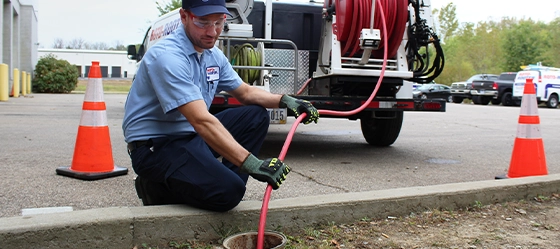
There are sewer lines under Buffalo that have been opened with a cable once a season for longer than the current owner has lived in the house. Nobody thinks of that as a problem, because each visit works. The part worth knowing is that the interval is not stable. It shortens, and it shortens for a mechanical reason rather than a mysterious one.
A Rough Wall Holds On to Everything
A cable is a boring and cutting tool. It drives an opening through whatever is blocking the pipe and gets water moving again, which is the right answer when a Buffalo kitchen is backing up in February. What it cannot do is take the grease, sludge or hardened deposit off the pipe wall on either side of that opening. The coating stays and the channel closes at the same rate it formed the first time.
On old cast iron there is a second effect that compounds the first. The head rides against the wall as it turns, and a wall that has already lost its smooth factory surface to corrosion comes out of each pass a little more scored than it went in. Grease and soap residue key into that texture the way frost keys into a rough sidewalk. The rougher the wall, the faster the next layer sets, which is why a line that used to go three years between visits starts asking for attention every spring.
Hydro Jetting a Line That Has Been Rodded for Decades
The hose carries a nozzle that throws water backward against the pipe wall at high pressure while it is drawn through the line. The result is a scour across the whole circumference instead of a hole through the middle. Hardened grease along the crown comes off. Sludge sitting in a flat run is flushed out rather than shoved further along. Mineral scale in cast iron is cut back toward the original bore, which is the descaling half of the job. Root hair left at a joint after a cutter head is stripped away with everything caught on it.
That is the difference between clearing a clog and cleaning a pipe, and it is why Roto-Rooter treats end-to-end cleaning as the standard rather than an upgrade. Opening the line is the emergency. Taking the wall back to something near its original diameter is what resets the clock. On Buffalo pipe of that vintage the gain is usually larger than people expect.
Serving the entire Buffalo metro area, Including:
Counties in the Buffalo Metro Area
When a Rough Wall Is the Least of It
High-pressure water cleans, and cleaning assumes the pipe can take the work. Three findings rule it out. A collapsed section has no bore left to restore. A badly offset joint, where one length has shifted out of line with the next, catches the hose and signals a structural fault the cleaning would not address anyway. A wall already thin from long corrosion may not survive, and in old cast iron that is a real possibility rather than a formality.
In any of those cases the honest answer is that cleaning is not the fix, and saying so is the point of looking first. What follows is a conversation about repair, priced and scoped off the footage the camera already produced. If you want to see the rest of what the Buffalo team handles, start at Buffalo plumbers.
A Kitchen Rebuilds the Coating Every Day
A house lateral and a kitchen line in a working restaurant differ in diameter, in daily volume and in what happens when they fail. A residential run that has been properly cleaned can go years before it needs attention again, depending entirely on what caused the buildup. A Buffalo kitchen putting cooking waste through the same pipe every service is working against a known accumulation rate, which is why operators in New York generally move to a planned interval rather than gambling on a Friday night. Roto-Rooter handles both, and the reasoning behind each is different.
Cleaning a Line That Has Only Ever Been Opened
A technician finds the cleanout, runs the camera, and walks you through what is on the screen before anything else happens. If the line is a candidate, the hose goes in and the pipe is cleaned back through the affected run, then the camera goes down again. Roto-Rooter provides on-site estimates before any work begins, so nothing proceeds until the scope is agreed.
Access is the practical variable on an older Buffalo address. Some Buffalo houses have a cleanout in an obvious spot. Others had one that was finished over during a renovation, or never had one installed at all, which changes the approach and is worth mentioning on the phone rather than discovering in the driveway. Where none exists, the inspection covers what adding one would involve, since a line that has needed help twice will need it again.
Does Hydro Jetting Stop the Interval From Shrinking?
It stops it from shrinking, which is not the same as stopping it. The honest version depends on what the camera found. A line coated with grease from a single household habit stays clear as long as the habit changes. A line with scale coming back off corroded iron is on a slower but steadier schedule. A line taking tree roots through an open joint is not really a cleaning problem at all, because the opening that admitted them is still there. The footage is what tells those three apart, and it becomes the baseline you compare against next time instead of starting the diagnosis over.
If the line is backing up right now rather than slowly getting worse, begin with emergency plumbing help in Buffalo. Restoring flow comes first, and the cleaning decision follows once the immediate mess is handled.
Book a Line Inspection in Buffalo
Roto-Rooter has cleaned drains and sewers across New York since 1935 and is fully licensed and insured. Call 716-648-5082 or schedule online to put a camera in the line and find out what is actually on the wall. Buffalo crews answer 24/7, 365 days a year.

Signs a Prewar Line Needs More Than Another Rodding
A Housing Stock Older Than Most, and the Pipe to Match

SPECIAL FINANCING AVAILABLE
We have partnered with Synchrony Bank to offer financing options to make your plumbing repair expenses as convenient and stress-free as possible.