Excavation and Sewer Line Replacement in Charlottesville
Key Takeaways: Where the Camera Goes In Decides What Can Be Known
- A line that backs up again within months of a clean cleaning is reporting a structural problem, and the only honest way to confirm one is to look inside the pipe with a camera.
- Much of the older housing stock in Charlottesville was plumbed before an outside cleanout at the property line was standard, so finding a legitimate way into the line is the first piece of real work on the job.
- An inspection has to produce two things before a method can be chosen: what has failed, and how far along the run it sits.
- Trenchless repair is conditional. Pipe bursting and cured-in-place lining each need specific things from the pipe, the surrounding ground and the access at both ends, and the inspection is what rules them in or out.
- Utility locating comes before any digging. Gas, electric, water and telecom share the corridor between a house and the street here, and marking them is a safety obligation.
- The lateral is privately owned pipe and the public main belongs to the municipality. Where one ends and the other begins is set locally, so it gets confirmed for your address instead of assumed.
- Roto-Rooter carries the permit and inspection process required in Virginia, backfills and compacts the trench, and scopes the final surface work with you on site.
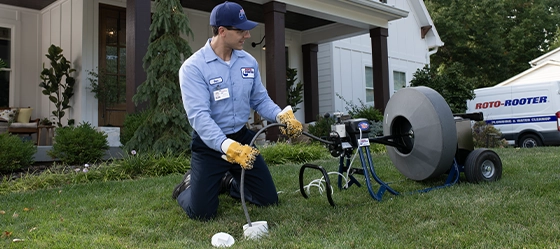
Sewer work in Charlottesville starts with a question that sounds administrative and decides everything: where can a camera be put into the line. The city built in layers across two centuries, and a great deal of what stands here went up before an outside cleanout at the property line was normal practice. Where no cleanout exists, the pipe running from the house to the street is a sealed length with no door in it, and every fact worth having about that pipe sits on the far side.
So a plumber who has been called out about a third backup in a year asks about access before saying a word about machines. A camera can go in through an existing cleanout, through a pulled toilet, through an interior cleanout in a crawl space, or through a new cleanout cut in at the point where the line leaves the building. Those are not equivalent. Each one starts the camera in a different place and reaches a different distance, and a partial view of a lateral produces a partial answer, which is how a household ends up paying for the same problem twice.
What the camera is hunting is the short list of conditions that cleaning cannot correct. A collapsed section. An offset joint where two lengths of pipe no longer line up and every solid catches on the lip. A belly, where a run has settled into a dish that holds standing water. Root intrusion through a broken joint, which comes back on its own schedule no matter how cleanly it is cut. In the older Charlottesville neighborhoods, where street trees are large and the clay holds moisture against the pipe through a humid summer, roots are the condition crews meet most.
How do I know a sewer line needs replacing instead of another cleaning?
By footage and by pattern. A line that clears easily and stays clear for years is doing its job, and drain cleaning in Charlottesville is the right service for it. A line that clears easily and closes again on a predictable rhythm is a line with something wrong at a fixed point, and the camera puts a distance on that point. Once there is a distance, the conversation changes from how to unblock the pipe to how much of it has to come out, which is a far better question for the property owner.
Charlottesville gives that question a local edge. Lots here roll, sit above or below the street, and carry stone walls, terraces and mature plantings that nobody wants to lose. A defect twelve feet from the wall and a defect sixty feet out are the same defect on a camera screen and two different jobs in the yard. The footage is what turns an inspection into a plan, and it is the reason a reputable crew in Virginia will not quote sewer line replacement over the phone from a description of the symptom.
Operated as an Independent Contractor - All available services, hours of operations, pricing structure, and guarantees may vary by location
Serving the entire Charlottesville metro area, Including:
Counties in the Charlottesville Metro Area
Nothing is opened until the ground has been marked
Utility locating happens before a bucket touches soil, and it is not a formality anybody is free to skip. The strip of ground between a house and the street carries the gas service, the electric feed, the water service, telecom, and on plenty of Charlottesville properties an irrigation line or a low-voltage run somebody added later with no record of it. Locating brings paint and flags onto the lawn so the crew knows what shares the corridor with the sewer lateral before the first cut.
On the older lots in Charlottesville the marks are worth studying for a second reason. Where a property has been divided, added to or replumbed across a long life, the buried services do not always run where a modern site plan would put them, and a locate that comes back cluttered is a signal to the crew about how the trench should be opened and where hand digging replaces the machine. It is slower. It is also how a sewer line replacement finishes without taking out a gas service.
Where your pipe stops being yours
The sewer lateral is private pipe serving one building. The public main is the municipality's. Between them is a handover point, and its location is set by local rule, which is why a crew confirms it for your address before writing a scope. Roto-Rooter works on the private side of that line. Municipal main work belongs to the utility that owns it, and no crew of ours will suggest otherwise.
Permits and inspection are part of this kind of work in Charlottesville and across Virginia, and Roto-Rooter handles the process on your behalf. What that involves varies by jurisdiction, and the specifics for your property are covered during the on-site estimate.
Then there is the ground itself. An excavation in Charlottesville red clay produces spoil that does not go back in the way it came out, so the trench is backfilled in lifts and compacted, and a settled strip over the run in the following season is normal ground behavior. Sod, plantings, a driveway apron or a section of walk are scoped on site and agreed before the work starts. Being straight about this at the beginning is worth more to a household than an optimistic promise about the yard.
If the line closes completely while the repair is being arranged, that is a separate and immediate problem. An emergency plumber in Charlottesville can get the household running again while the excavation is scheduled.
Request a Camera Inspection and an Excavation Estimate in Charlottesville
Call 434-244-3144 to have the line looked at properly, or schedule online at a time that suits the household. The Charlottesville team answers 24/7, 365 days a year, and you can see everything the local team covers on the Charlottesville plumbing page. Cost varies with the length of the run, the depth, the access and the method the inspection supports, and Roto-Rooter provides on-site estimates before any work begins.

Why Sewer Line Excavation Here Begins at the Cleanout
What Decides Between Open-Cut and Trenchless on a Rolling Lot
