Sewer Line Repair in Cincinnati, OH
Below the Queen City: Why Cincinnati's Sewers Carry a Heavy History
Cincinnati's underground infrastructure tells a story that stretches back to 1828, when the city began constructing its first storm sewers to channel runoff toward the Ohio River and Mill Creek. By the late 1800s, those storm lines were converted into combined sewers that carried both stormwater and sanitary waste through the same pipes. Today, roughly 40 percent of the Metropolitan Sewer District's 3,000-mile network still operates as combined sewers, and many of those original clay tile and brick lines remain in service beneath neighborhoods built during Cincinnati's industrial peak.
That aging infrastructure creates real consequences for homeowners. Clay pipe joints separate under hillside soil pressure. Brick-lined trunk sewers develop mortar erosion that allows root intrusion. Combined sewer connections overflow during heavy rainfall, pushing wastewater back toward residential laterals. Roto-Rooter has provided professional sewer line repair since 1935, and our experienced plumbing technicians understand the specific pipe materials, soil conditions, and drainage patterns that define Cincinnati's underground plumbing.
Call 513-631-2525 or schedule service online.
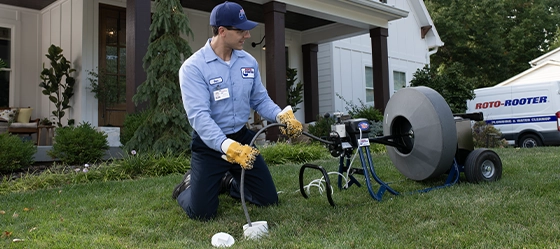
What Makes Cincinnati Sewer Lines Fail
Cincinnati's geography, soil composition, and construction history create sewer line failure patterns distinct from flat-terrain cities with modern separated systems.
- Clay tile deterioration: Homes built before the 1960s throughout Mount Lookout, Hyde Park, Clifton, and Northside often have original vitrified clay sewer laterals. After 60 to 100 years underground, clay tiles crack at the joints, develop interior erosion, and create offset connections where soil has shifted beneath them.
- Hillside soil movement: Cincinnati is built across steep hills and valleys carved by glacial activity. The clay-rich soil on slopes in neighborhoods like Mount Adams, Price Hill, and Walnut Hills shifts with moisture changes, placing lateral pressure on buried pipes that gradually pushes joints apart.
- Combined sewer surcharging: During heavy rain, combined sewers can exceed capacity and surcharge - meaning wastewater backs up through residential connections. Properties tied to the older combined system experience higher hydrostatic pressure on their sewer laterals, accelerating joint failure.
- Tree root invasion: Cincinnati's mature urban canopy sends roots deep into clay soil searching for moisture. Roots penetrate clay tile joints and hairline cracks, then expand inside the pipe, creating blockages and eventually splitting the pipe wall.
- Freeze-thaw stress on shallow pipes: Sewer laterals installed at shallow depths in the basin areas experience seasonal freeze-thaw cycles that crack rigid pipe materials and shift joint connections over decades of Ohio winters.
Cincinnati Neighborhoods and Their Sewer Line Challenges
Cincinnati's diverse construction eras and terrain create different sewer line repair needs across the city.
- Hyde Park and Mount Lookout: Established residential neighborhoods with homes dating to the early 1900s. Original clay tile laterals connect to some of the oldest combined sewer lines in the MSD system. Mature trees along Erie Avenue and Observatory Road drive persistent root intrusion into aging pipe joints.
- Clifton and Corryville: Dense residential streets near the University of Cincinnati with Victorian-era homes built on steep terrain. Hillside soil movement and century-old brick sewers create joint separation and bellied line sections that trap waste.
- Price Hill and Westwood: West side neighborhoods built on the ridge above the Mill Creek valley. Clay-heavy soils shift on the slopes, and many homes still connect through original clay tile laterals installed during the neighborhood's early 1900s development.
- Norwood and Pleasant Ridge: Mid-century homes with a mix of clay tile and early cast iron sewer connections. The flat terrain in these areas concentrates groundwater during wet seasons, increasing infiltration pressure on pipe joints.
- Mount Adams and Columbia-Tusculum: Hillside properties with steep lot grades that put constant gravitational and soil pressure on sewer laterals running downhill toward trunk sewers along the river. Pipe access on these properties often requires specialized equipment.
- Anderson Township and Western Hills: Suburban-era construction from the 1950s through 1970s with cast iron and early PVC sewer connections approaching or exceeding their expected service life.
Serving the entire Cincinnati metro area, Including:
Counties in the Cincinnati Area
Warning Signs Your Cincinnati Sewer Line Needs Repair
Sewer line damage develops gradually, and early detection prevents costly emergency repairs and property damage. Watch for these indicators.
- Slow drains across multiple fixtures: When more than one drain backs up simultaneously, the blockage is in the main sewer lateral rather than individual fixture lines.
- Sewage odors in the yard or basement: Cracked pipe joints and separated connections allow sewer gas to escape into the surrounding soil and migrate upward through the ground or basement walls.
- Wet spots or unusually green patches in the yard: A cracked sewer line leaks nutrient-rich wastewater into the soil, creating visible patches of lush growth above the break.
- Foundation cracks or settling: A leaking sewer line erodes supporting soil beneath the foundation, causing uneven settling that shows as new cracks in walls, floors, or the foundation itself.
- Gurgling sounds from toilets and drains: Air trapped in a partially blocked or collapsed sewer line creates gurgling noises when water passes through the restriction.
- Recurring backups after heavy rain: If backups correspond with rainfall, the sewer lateral likely has cracks or separated joints that allow stormwater infiltration, overwhelming the pipe's capacity.

Same-Day Sewer Line Repair in Cincinnati
Cincinnati's Sewer Line Repair Experts

SPECIAL FINANCING AVAILABLE
We have partnered with Synchrony Bank to offer financing options to make your plumbing repair expenses as convenient and stress-free as possible.