Sewer Line Excavation and Replacement in Columbus
Key Takeaways: Nobody Drew the Pipe Under Your Yard
- The path a sewer lateral takes across a property is rarely recorded anywhere the owner can look it up, so the first real question on a Columbus dig is not how to open the ground but where the line actually runs.
- Camera inspection settles whether the pipe has failed or is merely blocked, and it measures the defect as a distance from the access point.
- That distance becomes a spot on the ground only when the camera head is traced from the surface with a locator, which is how a trench gets planned across a Columbus yard instead of guessed.
- What has been built over the run since it was laid, a widened drive, a patio, a detached garage slab, a mature tree, is usually discovered at the trace rather than known beforehand.
- Utility locating is a separate step and covers a different set of lines. It marks gas, electric, water and telecom, and it does not map the private lateral for you.
- Trenchless is conditional. Depth, pipe material, how far a section has gone, and usable access at both ends decide whether pipe bursting or lining is available on that line at all.
- Backfill and compaction come with the work; final surface restoration is scoped on site rather than assumed.
- Roto-Rooter is fully licensed and insured, handles the permit and inspection process, and provides on-site estimates before any work begins.
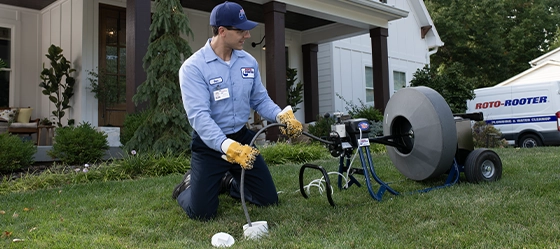
Almost nobody buys a house in Columbus with a drawing of the drain that leaves it. Plenty of property owners can point at the cleanout and stop there, which is fine until a line fails and somebody has to decide where to open the ground.
What the Footage Settles and What It Leaves Open
A camera inspection answers the question that decides everything else: has the pipe failed, or is there something in it that can come out. Those two look identical from inside the house. A run that has collapsed has no bore left to clean. A severe offset, where one length has shifted out of alignment with the next, leaves a lip that catches whatever comes past and keeps doing it. A belly holding standing water refills after every cleaning because the fall is the fault. Roots coming through a broken joint are a symptom of an opening that will let them back in.
What the footage does not tell you is where on the property any of that sits. It gives a distance, which is not the same thing. A sewer lateral does not have to run straight, and on Ohio lots that have been added to over the years it frequently does not.
Following the Head From the Surface
The camera head carries a transmitter, and a locator on the surface follows it. Walking that signal turns a reading taken indoors into a painted line across the yard, with a mark at the defect and a depth at that mark. It is an unremarkable half hour of work and it changes the whole conversation, because from that point the discussion is about a specific place in a specific Columbus yard rather than about a pipe in the abstract. It is also where a routine clog gets sent back where it belongs, to Columbus drain cleaning, without anybody opening the ground at all.
Serving the entire Columbus metro area, Including:
Counties in the Columbus Metro Area
Two Different Kinds of Marking Before a Dig
These get confused, and the difference is worth stating plainly. Utility locating is the step where gas, electric, water and telecom get marked on the ground before any excavation begins in Columbus. It is a safety obligation and a legal one, it is not optional, and nothing is opened until the marks are down. What it covers is utility-owned infrastructure. A private sewer lateral belongs to the property, so the trace of that line is separate work and it is on the contractor to do it.
A dig planned on a public locate alone knows where everybody else's lines are and only roughly where yours is. In a Columbus front yard with a water service, a gas service and a lateral inside the same few feet, roughly is not good enough.
What the Permit Process Covers, and What This Page Will Not Say
Sewer line replacement is permitted work and it is inspected, and Roto-Rooter handles that process as part of the job rather than leaving it with the property owner. What is deliberately absent here is any figure for what a permit costs or how long an approval takes. Both vary between Ohio jurisdictions and with the scope of the specific job, and a number printed on a page turns into a promise nobody authorized. It is covered against the actual work in the on-site estimate.
The Boundary Is the Municipality's to State
The general shape of it is that the property owner owns the run from the building out, and the municipality owns the main. Where one becomes the other, at the property line, at the curb, or at the connection itself, is set locally and differs from one Ohio jurisdiction to the next. Confirm it with yours instead of assuming, because it decides who pays for which length of pipe.
Roto-Rooter works on the property owner's side of that boundary. Municipal main work is not something a plumbing company takes on, and where the inspection points past the boundary, the next call is to the city rather than to a contractor.
Open Cut, Pipe Bursting and What the Route Allows
An open cut is a trench along the marked route: the failed pipe comes out, new pipe goes in, the trench is backfilled and compacted. It handles any condition, and what it costs you is the surface above the whole length. Pipe bursting pulls a new line through the path of the old one while breaking the original outward, and lining cures a new wall inside the existing pipe. Both work from pits at either end rather than along the run, which is why they are worth asking about, and neither is a tier you can simply select.
The route decides much of it. Access pits have to go somewhere, and a Columbus run that passes under a garage slab or a mature root plate may not offer a usable place to put one. Depth, the material of the existing pipe, and how far a section has collapsed do the rest. The traced line and the camera inspection together are what the answer comes from, which is the reason both happen before a method is named.
Turf, Concrete and the Months After Backfill
Straight talk beats reassurance here. A trench across a Columbus front yard disturbs the ground along its length, and where the route crosses a drive, a walk or a patio, that surface has to come up and will not look untouched afterward. Trenchless reduces the footprint a great deal where the line permits it, though the access pits are still excavations and still leave marks.
Backfill and compaction are part of the work, and compaction is the part people notice later rather than sooner. Ground that was replaced loosely keeps settling for months and leaves a shallow trough tracking the route. Final surface restoration, meaning turf, paving or hardscape, is scoped on site and agreed before the work starts rather than assumed. Ask for that in the estimate and read what it says.
When It Backs Up in the Interval
A line at the point of needing replacement does not hold still while an appointment is arranged. If it surrenders in the meantime, emergency plumbing help in Columbus can get flow back so the household keeps running. That buys time and nothing else, and it does not alter what the footage showed. For everything else Roto-Rooter handles locally, start at the Columbus plumbing page.
Have the Route Traced Before Anyone Quotes a Trench
Roto-Rooter has been working on sewer and drain lines since 1935, is fully licensed and insured, and answers across Ohio 24/7, 365 days a year. Call 614-351-0455 or schedule online to book a camera inspection and have the run located from the surface. Roto-Rooter provides on-site estimates before any work begins, so the scope is written against a marked line and real footage rather than an assumption about where the pipe goes. That is worth the plumbing peace of mind on a job that opens your yard.

What Turns Up Over a Line Nobody Recorded
A City That Grew Outward in Rings

SPECIAL FINANCING AVAILABLE
We have partnered with Synchrony Bank to offer financing options to make your plumbing repair expenses as convenient and stress-free as possible.