Hydro Jetting in Freeport
Key Takeaways: When the House Is Older Than Its Sewer Connection
- A run that fails in the same spot again and again usually has a physical reason to, and on older Freeport lots that reason is frequently the point where the original house drain was tied into a later public sewer connection.
- A step in bore, a change of material or a joint made under a lawn decades after the house was finished gives buildup somewhere to start and gives a cable something to skate past.
- Hydro jetting scours the full circumference of the pipe wall on both sides of that junction, where a cable bores a path through the middle and leaves the coating.
- Grease, mineral scale, sludge and tree roots all read differently on camera, and descaling the older cast iron is a different task from stripping root hair off a clay seam.
- A video camera inspection has to come first. It confirms the pipe can take high-pressure water, finds the junction, and afterward proves the wall is genuinely clear rather than merely open.
- Freeport lots are small and level, so a lateral has little fall to work with and very little margin once the bore starts closing.
- A collapsed section, a badly offset joint or a corroded wall rules the work out, and that answer is worth hearing before a hose is put in a New York lateral.
- Roto-Rooter is fully licensed and insured, and answers in Freeport 24/7, 365 days a year.
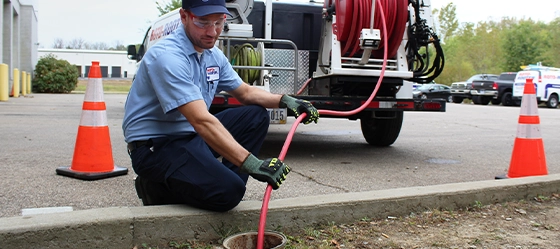
The public sewer under most Freeport blocks is younger than the houses it serves. Building came first here, in the decades when the village was growing around the water and the rail line, and public sewers arrived across Nassau County afterward, block by block. When they did, an existing house drain had to be connected to them, and that connection is a joint somebody made in a trench a long time after the house was finished.
Two Pipes, Two Eras, One Junction
That joint matters more than it sounds. The house drain is whatever was installed originally, usually cast iron and sometimes an early clay run out to a cesspool that no longer exists. The lateral toward the street is whatever the connection era used. The two rarely match in diameter exactly, they never match in interior texture, and the coupling between them sits at a depth and an angle chosen by the crew that dug it.
Anything that flows past a step in bore slows a little. Fat cools and sets on the upstream lip. Grit and paper settle where the surface changes. Fine tree roots that found the joint have something to hold. A cable pushed down that run does exactly what a cable does: it bores a path through whatever has collected and flow comes back, and the deposit stays keyed to the same feature that collected it. The interval between calls shortens, and every Freeport homeowner who has been through it twice recognizes the pattern.
Hydro Jetting Across a Two-Era Lateral
High-pressure water works the wall instead of the path. A nozzle throws water backward against the pipe while the hose is drawn along the run, so the scour covers the full circumference and continues across the junction into the older pipe behind it. Hardened grease comes off the crown. Sludge lying in a flat stretch is carried out toward the main rather than pushed further along. Mineral scale in old cast iron is cut back toward the original bore, which is the descaling half of the job. Root hair left at a joint after a cutter head is stripped with everything caught on it.
That is the difference between clearing a blockage and cleaning a sewer line, and it is why Roto-Rooter treats end-to-end cleaning as the standard rather than an extra. Getting flow back is the emergency. Taking both halves of a two-era Freeport run back to bore is what stops the same spot from collecting again next season.
Serving Freeport and surrounding communities, Including:
Counties in the Freeport Area
Why an Offset at the Junction Changes the Answer
High-pressure water cleans, and cleaning assumes a pipe able to take it. Three findings stop the job. A collapsed length has no bore left to recover. A joint badly offset, one section shifted out of line with the next, will catch the hose, and at a retrofit connection that is where an offset is most likely to be. A wall worn thin by long corrosion may not survive the work at all.
When one of those shows up under a Freeport lawn, the honest answer is that this is a repair conversation and not a cleaning one, scoped from the footage the camera has already produced. For the rest of what the local team handles, Freeport plumbers is the place to start.
Commercial Runs Have the Same Junction and More Load
A house lateral and a restaurant line differ in diameter, in daily volume and in what a failure costs. A single-family run in Freeport that has been properly cleaned can go years before it needs attention again, depending on what caused the buildup. A kitchen putting cooking waste through the same pipe every service is working against an accumulation rate it cannot talk down, and on the older commercial blocks here that kitchen is very likely sitting on the same kind of two-era connection a house has. Food service operators across New York generally put the work on a calendar rather than waiting for a Saturday night.
Can Hydro Jetting Clean Both Sides of an Old Junction?
Yes, and that is most of why it is worth doing. The hose passes through the connection and keeps scouring, so the older house drain upstream is cleaned in the same visit as the newer run toward the street. What matters is that somebody looked first, because a coupling that has shifted is exactly the condition that makes the work unsuitable. The camera is the difference between cleaning across a junction and finding out the hard way that you should not have.
If the run is backing up right now rather than slowly getting worse, start with emergency plumbing help in Freeport. Restoring flow comes first and the cleaning decision follows.
Reading Two Kinds of Pipe on One Screen
A technician locates the cleanout, runs the camera, and goes through the footage before any water goes in. On these older Freeport properties the interesting moment is usually the transition: the picture changes texture, the bore steps, and whatever has been collecting is sitting right there. If the run is a candidate, the hose is drawn through and the wall is cleaned back toward its original diameter, then the camera goes down again. Roto-Rooter provides on-site estimates before any work begins.
Access is the other practical variable. Some houses here have a cleanout in an obvious spot near the foundation, some had one finished over during a renovation, and some never had one installed. Where none exists, the inspection covers what adding one would take, since a line that has needed help twice will need it a third time and every future visit is easier with a proper access point.
Book an Inspection on Your Freeport Lateral
Roto-Rooter has cleaned sewers and drains across New York since 1935 and is fully licensed and insured. Call 516-209-2153 or schedule online to get a camera into the run and a straight account of what is sitting at the junction. Freeport crews answer 24/7, 365 days a year.

The Symptoms of a Line With a Weak Point In It
A Village That Was Built Before It Was Sewered

SPECIAL FINANCING AVAILABLE
We have partnered with Synchrony Bank to offer financing options to make your plumbing repair expenses as convenient and stress-free as possible.