Sewer and Water Line Excavation in Houston
Key Takeaways: Excavation When the Ground Itself Has Moved
- A Houston run that drains slowly everywhere rather than blocking at one point has usually lost the slope it was built with, and cleaning does not give slope back.
- A sewer lateral is a gravity line. It works because it falls, and it stops working when the ground under it stops holding that fall.
- The Houston area has been settling broadly and unevenly for decades, so the two ends of one run have not necessarily moved by the same amount.
- The camera is the only way to see it. Standing water at more than one point along a line is a grade reading, not a blockage reading.
- Fewer joints is the practical answer. Pipe bursting pulls in a continuous fused line with no hubs to pull apart as the ground carries on moving.
- Utility locating comes before any excavation, and gas, electric, water and telecom are all marked before the ground is opened.
- The job is permitted and inspected and Roto-Rooter runs that process. Roto-Rooter is fully licensed and insured.
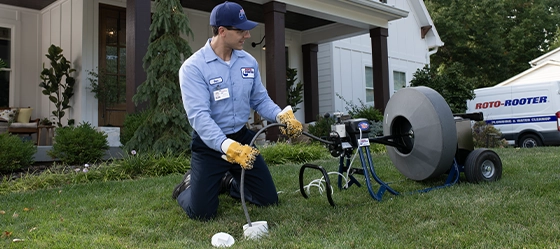
A sewer lateral has one job and it does it without any moving parts: everything inside it goes downhill. On a Houston lot that is a smaller margin than most people realize, because the ground is close to level to begin with and it has not stayed still.
Why Would a Sewer Line Stop Draining if Nothing Is Blocking It?
Because the fall it was built with is no longer there. A Houston gravity run is laid to a slope, and that slope is what carries solids along. Take part of it away and the line still looks open on camera while behaving like a partially blocked one, with waste moving slowly, settling out along the way, and building an obstruction that returns after every cleaning.
The classic structural findings still apply and still decide things. A collapse leaves no bore. A severe offset, where one section stands out of line with the next, catches solids permanently. Roots or soil arriving through a break mean an opening. And a belly, a sag holding standing water, is the specifically Texas-coastal reading here, because on ground with very little slope to spare it takes a small amount of settlement to create one and no amount of cleaning to fix it.
Pipe Bursting and the Case for a Line Without Hubs
Open-cut is the direct method: a trench along the run, the old sewer lateral out, new pipe bedded and set to grade, then backfill and compaction. On a run whose problem is grade rather than a single defect, resetting the fall is the repair, and that is the point of a Houston replacement rather than a side effect of one.
Trenchless deserves a serious look for a reason particular to ground that moves. Pipe bursting pulls a continuous fused line along the path of the old one from a pit at each end, and a fused pipe has no hubs along its length. The old clay and cast iron runs under older Houston property fail at their joints, one at a time, as the ground works them, so removing the joints removes the failure mode rather than resetting the clock on it. Cured-in-place lining does something similar from the inside where the host pipe has kept its shape. Neither is automatic: depth, degree of collapse, pipe material and usable access at both ends decide it, and where the run has genuinely lost its grade a method that follows the existing path will follow the existing sag too. That is a real limitation and it belongs in the conversation before the work is agreed, not after.
Serving the entire Houston metro area, Including:
Counties in the Houston Metro Area
Every Line Marked Before the Excavation Begins
Utility locating comes first and there is no version of this job without it. Gas, electric, water and telecom share the corridor a Houston sewer lateral crosses, and all of them are marked before anything is opened. Nothing is dug until the marks are down, and anyone offering to save a day by working around them is offering to take a risk with a live service and with your property.
The work is permitted and inspected, and Roto-Rooter handles that process rather than leaving it with the property owner. What is deliberately not printed here is a permit fee or an approval timeline, because both vary between jurisdictions in Texas and with the scope of the specific job, and a number published on a page becomes a promise nobody authorized. It is covered in the on-site estimate against the actual work.
Where Your Fall Ends and the City's Main Begins
The general rule is that the property owner owns the lateral running out to the municipal main and the municipality owns the main itself. Where exactly that changes hands, at the property line, at the curb or at the connection, is set locally and it varies across Texas, so confirm it with your municipality rather than assuming. It decides who pays, and on a grade problem it also decides how much of the run can actually be re-established.
Roto-Rooter works on the property owner's side of that boundary. Municipal main work is not something a plumbing company undertakes, and if the survey points past the boundary the next call is to the city rather than to a contractor.
Driveways, Walks and a Yard Put Back Flat
Straight talk beats reassurance. An open cut in Houston disturbs the ground along its whole length, and where the run passes under a drive, a walk or a patio those surfaces have to come up and will not look untouched afterward. Pipe bursting reduces the footprint to the two entry pits, which is the strongest practical argument for it on a property where hard surfaces cover much of the front.
Backfill and compaction are part of the work and they carry extra weight in Houston, because a trench closed carelessly settles on top of ground that is already low and leaves a channel where water stands after every rain. Final surface restoration, meaning turf, paving or hardscape, is scoped on site and agreed before the work begins rather than assumed either way. Ask for it in writing before the estimate is signed.
Why One New Joint Does Not Restore the Grade
A single failed length in an otherwise sound Houston pipe is a spot repair, and where the camera shows that, opening one stretch is the correct and much smaller job. It is the right answer more often than people expect and it should be offered where it applies.
It is the wrong answer when the problem is fall. Replacing a few feet of a run that has settled unevenly along its length puts new pipe at the same wrong grade as the pipe beside it, and the water stands in the same place a month later. That is the judgment the footage supports: one defect with sound pipe on both sides is a spot repair, while water lying at several points along a Texas coastal-plain run is a line that needs resetting rather than patching.
Keeping It Moving Until Then
A line this far along does not wait for a convenient date. If it backs up while the work is being scheduled, emergency plumbing help in Houston can restore flow so the household keeps running. That is a holding action rather than a repair and it changes nothing about what the camera found. For everything else handled locally, start at the Houston plumbers page.
Schedule a Camera Inspection That Measures the Fall
Roto-Rooter has been diagnosing and replacing sewer lines since 1935 and is fully licensed and insured. Call 713-472-5554 or schedule online to get a camera into the Houston lateral and find out whether this is a blockage or a grade problem, because the two lead to completely different work. Roto-Rooter provides on-site estimates before any work begins, so the footage and the scope arrive together. On a repair this size that is the plumbing peace of mind worth having, and Roto-Rooter answers 24/7, 365 days a year.

Flat Ground That Has Been Settling for Decades
Readings From a Line That Was Set Right Once

SPECIAL FINANCING AVAILABLE
We have partnered with Synchrony Bank to offer financing options to make your plumbing repair expenses as convenient and stress-free as possible.