Sewer and Water Line Excavation in Jacksonville
Key Takeaways: Why the Pumps Arrive Before the Excavator
- On the low ground across much of Jacksonville, a trench dug below the water table fills as fast as it is opened, so the water has to be managed before anybody can work at the bottom of it.
- That is normal, planned work rather than a complication. Dewatering equipment and shoring are part of how a deep run gets replaced in coastal soil.
- A camera survey still comes first, because ground conditions never decide whether a line is blocked or broken. Only the footage does that.
- The findings that end the cleaning argument are structural: a crushed length, a separated joint, a stretch holding water, or roots through an opening.
- Trenchless methods are attractive in wet Florida ground because they open far less of it, and they are still conditional on depth, host-pipe condition and access at both ends.
- Utility locating precedes every dig, and in sandy soil the marks matter more, not less, because the ground gives no warning before a bucket reaches something.
- Where an owner's responsibility for the run ends is set locally, so it is a question to put to the municipality rather than an assumption to make.
- Roto-Rooter is fully licensed and insured, and permitting and inspection are carried as part of the job.
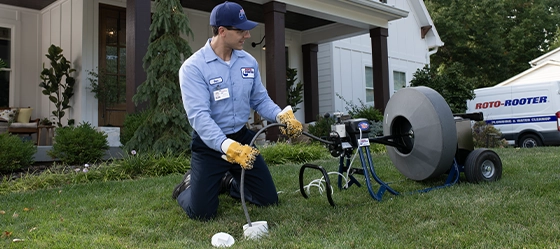
There is a moment on a sewer replacement in Jacksonville that surprises people who have only seen this work done somewhere drier. The trench goes down, and before it reaches the pipe, water starts arriving through the walls of the hole. Not from a broken line. From the ground itself. On coastal soil with the water table sitting close to the surface, that is the ordinary condition across a great deal of Jacksonville, and how a crew handles it is most of what separates a straightforward job from a bad one.
The Trench Is Half of a Wet-Ground Excavation
Sand saturated with water behaves nothing like sand that is merely damp. It loses cohesion, it will not stand at a face, and it flows toward any opening. That is why the work below a certain depth is done with dewatering in place: wellpoints or pumps lower the water in the immediate area so the excavation stays workable, and shoring keeps the sides where they belong while people are in the hole. Crews doing this work in Jacksonville plan for it as a matter of course.
None of that is exotic. It is standard practice for buried utility work across low-lying Florida, and it is the reason an estimate here reads differently from one written for a market where the same length of pipe sits in dry clay. What the customer is paying for is not simply the pipe. It is safe, controlled access to a pipe that is sitting in water.
Can a Sewer Line Replacement Be Done Below the Water Table?
Yes, routinely, and the technique is well established. What changes is the planning. The depth of the run gets checked before anything else, because depth decides whether dewatering is a small pump in the corner of the trench or a proper wellpoint system, and that in turn shapes the working area, the spoil handling and how long the ground stays open. On the flatter parts of Jacksonville the run is shallow enough that a trench pump is plenty; closer to the river it is frequently not.
It also strengthens the case for looking hard at a trenchless option. Pipe bursting and lining open two small pits instead of a continuous trench, which in saturated ground means a great deal less water to control and a great deal less surface to put back. Whether either is available in Jacksonville still comes down to the footage: the host pipe has to be intact enough to follow or to line, and there has to be somewhere workable to put a pit at each end.
Serving the entire Jacksonville metro area, Including:
Counties in the Jacksonville Metro Area
Locating, Permits and Pumps Before Any Excavation
Gas, electric, water and telecom all get located and marked before ground opens anywhere in Jacksonville. That is a legal and safety requirement, it is arranged ahead of the crew, and near a marked service the digging is done by hand. Sandy ground makes it more important rather than less: there is no resistance to warn an operator that a bucket has reached something it should not have. A contractor offering to skip the locate to save half a day is offering to gamble with a gas line on your property.
The work is permitted and inspected, and Roto-Rooter handles that process as part of the job, including the parts specific to working below grade in wet ground. What this page will not tell you is what a permit costs or how long an approval takes. Both are set locally and both change with the scope of the specific work, and a figure published here would become a promise nobody authorized. Your on-site estimate deals with it against the real job.
Your Side of the Connection, and the City's
The general division is that the lateral from the building out belongs to the property owner and the main belongs to the municipality. Exactly where one becomes the other, whether at the property line, the curb, or the connection itself, is set by local rule and differs between jurisdictions. Jacksonville covers an unusually large area for a single city, so it is worth asking rather than assuming, because that boundary decides who pays for which length of pipe.
Roto-Rooter works on the property owner's side of that line. Municipal main work is not something a plumbing company undertakes, and where the survey puts the fault beyond the connection, the next call goes to the city rather than to a contractor.
Sod, Sand and What Settles Later
Plain talk serves better than reassurance here. An open cut across a Florida yard disturbs the ground along its whole length, and where the run crosses a driveway, a walk or a patio slab, that surface has to come up and a saw cut in concrete stays visible afterwards. Trenchless reduces the footprint substantially, which is worth asking about in wet ground for reasons beyond appearance, though the pits at each end are still excavations.
Backfill and compaction carry extra weight in sandy soil that has been saturated and then dewatered. Material replaced loose will consolidate for months and leave a trough along the trench, and on a flat lot a trough is also a place for water to collect. Work is compacted in lifts and inspected against Florida plumbing code before the ground is closed. Final surface restoration, meaning sod, planting or paving, is scoped on site and agreed in advance rather than assumed, so get it written into the estimate.
How Much Pipe Has to Come Out of Wet Ground?
Where the footage shows one failed joint with sound pipe either side, a spot repair opens a short section rather than the whole run, and in ground that has to be dewatered that difference is significant. What settles the question is the condition of the pipe on both sides of the defect.
The consideration specific to saturated sand is what has already been lost. A joint that has been drawing soil in for a long time leaves a void around and above the pipe, and that void is a reason to look carefully at the neighboring lengths before committing to the smaller repair. Opening the ground twice in a market like Jacksonville, where opening it once involves pumps, is an expensive way to save money.
If It Backs Up Before the Dewatering Starts
A line waiting on a scheduled replacement does not always behave. If it backs up in the meantime, emergency plumbing help in Jacksonville can restore flow so the household keeps running. It is a holding action rather than a repair, and it changes nothing about what the camera found. For everything else handled locally, start at Jacksonville plumbers.
Request an Estimate While the Ground Is Dry
Roto-Rooter has been surveying and replacing sewer lines since 1935, answers 24/7, 365 days a year across Florida, and is fully licensed and insured. Call 904-396-4679 or schedule online to get a camera down the run and find out what you are dealing with before the wet months make the same job larger. Roto-Rooter provides on-site estimates before any work begins, so the scope and the method follow the footage. On a repair that involves pumping water out of your yard, that is the plumbing peace of mind worth arranging early.

The River Is Tidal, and So Is the Ground Beside It
Reading a Run That Sits in Wet Sand

SPECIAL FINANCING AVAILABLE
We have partnered with Synchrony Bank to offer financing options to make your plumbing repair expenses as convenient and stress-free as possible.