Sewer and Water Line Excavation in Kansas City
Key Takeaways: Why an Old Repair Decides the Next Excavation
- A line that fails a second time in roughly the same place is usually failing at a connection rather than along the pipe, and that changes the repair being considered.
- The camera inspection comes first and it maps the whole run, including anywhere a previous repair was spliced into the original material.
- Older Kansas City runs are clay in short jointed lengths, and clay carries a seam at every joint that ground movement can open.
- Missouri swings hard between deep winter frost and hot humid summers, so the soil around a buried line rises, drops and dries on an annual cycle.
- Pipe bursting is conditional and a previous point repair is one of the conditions that can rule it out, because a rigid collar or a stub of different material sits in the path the head has to travel.
- Utility locating precedes any excavation and is not optional. Gas, electric, water and telecom all get marked before anything opens.
- The work is permitted and inspected and Roto-Rooter handles that process. Roto-Rooter is fully licensed and insured.
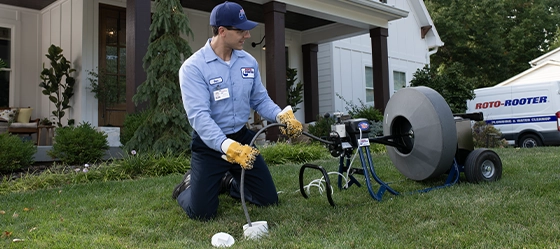
Ask how many times a sewer line has been dug up before and you learn more than the age of the house will tell you. Plenty of runs under the older half of Kansas City carry at least one earlier repair: a length replaced after a collapse, a section opened for a root problem, a stub swapped where a driveway went in. Each of those left behind two connections between materials that were never designed to meet, and those connections behave differently from the pipe on either side of them.
Why Does a Sewer Line Fail Again Right Where It Was Repaired?
Because a transition is a discontinuity, and buried pipe does not like discontinuities. New pipe and old pipe have different stiffness and different weight. The bedding under a section replaced twenty seasons ago was disturbed and rebuilt, while the ground either side of it never was. When soil around the run moves, the two halves respond at different rates, and the coupling in between takes the difference as a shear load. Give that enough annual cycles and it steps, opens or drops.
Camera footage reads it clearly once you know to look. A step at a coupling shows as a visible lip. A repair length that has settled shows as a dip beginning and ending at defined points rather than as a gradual sag. Roots frequently mark the spot, because a coupling that has opened is the easiest entry on the whole run. The other findings that end the cleaning conversation are the familiar ones: outright collapse, a severe offset, a belly holding standing water, and root intrusion through a broken joint.
What a Previous Repair Does to Pipe Bursting
Bursting works by pushing a head along the existing bore, fracturing the old pipe outward and drawing a new line in behind it. That process assumes the old pipe will break in a predictable way for its whole length. A short section of a different material, a rigid repair collar or a concrete encasement left from an earlier job does not behave like the clay either side of it, and the head can stall or deflect when it arrives.
It is not automatically disqualifying. It is a reason the survey has to locate every previous repair before anyone commits to a method, and a reason to be wary of a trenchless quote given before the line has been seen end to end. Lining runs into the same issue from another direction, since a step at a coupling is a step the new wall has to be cured over. Open-cut works on anything and remains the baseline the other two are measured against.
Serving the entire Kansas City metro area, Including:
Counties in the Kansas City Metro Area
The Ticket That Has to Come Back Before the Machine Does
Locates are requested and marked before an excavator touches ground anywhere in Kansas City. Gas, electric, water and telecom occupy the same corridor a sewer lateral runs through, and on a lot that has been opened before, the depths recorded on a drawing and the depths actually out there are not always the same thing. That is an argument for the marks rather than against them. Anyone offering to skip the step to gain a day is proposing to gamble with a gas line.
The work is permitted and inspected and Roto-Rooter handles that process as part of the job. This page carries no permit figure and no approval timeline, because both vary by jurisdiction across the metro and by the scope of the individual job, and a number published here becomes a promise nobody authorized. The on-site estimate settles it against the actual work.
How Far Your Responsibility Runs
Generally the lateral from the building to the municipal main belongs to the property owner and the main belongs to the municipality. The exact point where one becomes the other, at the property line, the curb or the connection, is set locally and it differs between jurisdictions in Missouri as it does everywhere. Confirm it with your municipality rather than assuming, because it decides who pays for which length of pipe.
Roto-Rooter works the property owner's side of that boundary. Municipal main work is not something a plumbing company undertakes, so when the survey points past the connection the next call is to the city.
Turf, Drive and What a Second Trench Costs the Yard
Backfill placed once and placed badly is easy to spot years later, and it is worth knowing that before agreeing to open it again. Spoil returned loosely settles for seasons afterward and leaves a line across the lawn. Compaction in lifts on prepared bedding is what prevents that, and it is a reasonable thing to ask about specifically, particularly where the last crew clearly did not bother.
On the surface, expect a straight answer rather than a comforting one. A trench across turf shows for a season. A cut through a drive or a walk is patched and stays visible. Trenchless reduces it to access pits at each end where the line and its history allow. Final surface restoration, meaning turf, paving or hardscape, is scoped on site and written into the estimate rather than assumed.
Patching Again Against Replacing Once
A spot repair, rather than a full sewer line replacement, is genuinely the right answer where the camera finds a single failure in a run that is otherwise continuous and sound. That is a smaller trench, a shorter day and less of the yard disturbed, and it should be offered rather than waited for.
The calculation changes when the footage shows a line that is already a chain of repairs. Every splice added is another pair of transitions for Missouri ground to work on, so the next failure gets more likely rather than less as the count goes up. Ask the technician how many transitions the run contains and where they sit. That number, more than the age of the pipe, is what separates a worthwhile patch from a line that should be replaced in one piece.
Between the Survey and the Repair
Nothing about a diagnosis stops a line backing up in the meantime. When it does, Kansas City emergency plumbing help can restore flow so the household keeps functioning, on the understanding that clearing it is a holding action and changes nothing the camera found. For everything else handled locally, start with Roto-Rooter in Kansas City.
Call for a Survey Before Committing to Another Repair
If this is not the first time the ground has been opened over this line, that history is the most useful information available and it belongs in the decision. Call 816-412-2103 or schedule online for a camera survey that maps every transition along the run and puts a distance on each one. Roto-Rooter provides on-site estimates before any work begins, so scope and footage arrive together. Roto-Rooter is fully licensed and insured, has worked on Missouri drain and sewer lines since 1935, and answers 24/7, 365 days a year, which is most of the plumbing peace of mind available on a repair this size.

A Pre-War Core, Patched Across Decades
Reading a Line That Has Been Opened Before

SPECIAL FINANCING AVAILABLE
We have partnered with Synchrony Bank to offer financing options to make your plumbing repair expenses as convenient and stress-free as possible.