Hydro Jetting in Los Angeles
Key Takeaways: Less Water Moving Through the Same Old Pipe
- A drain line clears itself only when enough water goes down it fast enough to carry solids along, and a household in Los Angeles today sends a fraction of what the same fixtures used to send.
- The pipe did not change. Low-flow toilets, efficient washers and short showers are good for the reservoir and hard on a long, shallow-pitched run.
- Hydro jetting supplies the volume and velocity the household no longer does, scouring the full circumference of the pipe wall rather than boring a channel through the middle.
- What accumulates is the ordinary mix: grease from a kitchen, soap and paper, grit washed in through a defect, mineral scale where the run is old cast iron.
- Tree roots are the complication. Where the pipe runs under a mature parkway tree, root hair at a seam catches everything the flow was already struggling to move.
- A video camera inspection has to come first, to confirm the pipe can take high-pressure water and to show what is on the wall, then again afterward to prove the wall is clear.
- Some lines are not candidates. A collapsed run, a badly offset joint or a corroded wall needs a repair conversation, and descaling a fragile pipe is not a favor to anybody.
- Roto-Rooter is fully licensed and insured, and answers across Los Angeles 24/7, 365 days a year.
Drain lines were designed around an assumption that has quietly stopped being true. The pitch of a sewer line, its diameter and the amount of water expected to move through it were worked out together, in an era when a single flush sent several gallons down the pipe at once. Los Angeles has spent a very long time getting that number down, and it worked. The reservoirs are better for it. The pipe under the house is not.
A Pipe Sized for Water Nobody Sends Down It Anymore
Waste does not float to the street. It is carried, and carrying takes a slug of water moving fast enough to keep solids in suspension across the whole length of the run. Cut the volume of that slug and it runs out of energy partway along, especially on the shallow pitch a flat lot gives you. Solids settle. Grease lands on top of them. The next flush arrives smaller than the last and pushes the pile a little further rather than clearing it, and the wall builds inward from there.
This is why a house in California that never had a drain problem for decades can start having one without anything visible having changed. Nobody put anything unusual down the drain. The fixtures were replaced with better ones, the residents got sensible about water, and the pipe stopped being self-cleaning.
What Hydro Jetting Does When Flow Cannot Do It
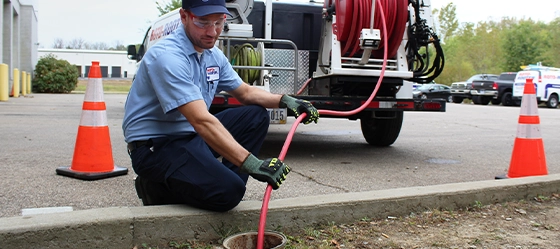
High-pressure water puts the missing energy back into the line on purpose. A nozzle throws water backward against the pipe wall while the hose is drawn along the run, and the scour covers the full circumference instead of the middle. Grease that cooled and set along the crown comes off. Sludge settled in a flat stretch is carried out toward the main rather than nudged along it. Mineral scale in old cast iron is cut back toward the original bore, the descaling half of the work. Root hair remaining at a seam after a cutter head is stripped away with everything caught on it.
A cable does something different and useful. It bores an opening through a blockage and gets a household working again tonight, which is the right answer at the moment the kitchen is backing up. It leaves the coating on the wall. That is the whole distinction between clearing a clog and cleaning a sewer line, and it is why Roto-Rooter treats end-to-end cleaning as the standard rather than an upgrade.
The order matters more than people assume. Opening a run and then cleaning it a week later is a normal sequence in Los Angeles, because the emergency and the underlying condition are two separate pieces of work with two separate answers. What should not happen is the third or fourth cable visit to the same run with nobody ever putting a camera in it. At that point the household is paying repeatedly to postpone a question rather than once to settle it, and the pipe is quietly getting narrower the whole time.
Serving the entire Los Angeles metro area, Including:
Counties in the Los Angeles Metro Area
What Takes High-Pressure Water Off the Table
Cleaning assumes a pipe able to be cleaned. Three findings end it. A collapsed length has no bore left to recover. A joint badly offset, one section shifted out of line with the next, will catch the hose and points at a structural fault that cleaning does not address. A wall worn thin by long corrosion may not survive the work at all.
Any of those and the honest answer is that this is a repair question. What follows is scoped from the footage the camera already recorded, and on a slab-built Los Angeles property the options and the access are worth talking through carefully rather than quickly. Everything else the local team handles sits on the Los Angeles plumbers page.
Restaurants Have the Opposite Problem
Everything above describes a line starved of flow. A commercial kitchen is the reverse: plenty of water, plenty of velocity, and a fat load arriving hot and liquid every service that sets the moment it reaches a cooler stretch of pipe. Larger diameter, heavier volume and a predictable accumulation rate mean food service operators across California generally put line cleaning on a calendar instead of waiting for the night it stops. Roto-Rooter handles both kinds of work, and the reasoning behind each is genuinely different.
Will Hydro Jetting Help If My Drain Is Only Slow?
That is the case it suits best. A blockage needs opening and a cable does that quickly. Slowness that has crept up over years is not a blockage at all, it is bore lost to the wall, and the only way to get that diameter back is to take the deposit off. The practical test is whether the same run keeps needing attention. One-off obstruction, one-off answer. A pattern means the wall.
If the line is backing up right now instead of slowly declining, start with emergency plumbing help in Los Angeles. Getting the water moving comes first and the cleaning decision follows.
What Happens on the Day, Start to Finish
A technician locates the cleanout, runs the camera, and goes through what is on the screen before any water goes in. If the run is a candidate, the hose is drawn through it and the wall is cleaned back toward its original diameter, then the camera goes down a second time so you can see the difference rather than take it on trust. Roto-Rooter provides on-site estimates before any work begins.
Access is the practical variable. Plenty of properties here have a cleanout in an obvious spot near the foundation; others had one landscaped over, finished around during a remodel, or never installed. Where none exists, the inspection covers what adding one would take, because a run that has needed help twice will need it again and each later visit is easier with a proper access point.
Book a Camera Run on Your Los Angeles Lateral
Roto-Rooter has cleaned drains and sewers since 1935 and is fully licensed and insured. Call 661-257-9200 or schedule online to find out how much of your pipe you are still using. Los Angeles crews answer 24/7, 365 days a year.

Six Reasons a Line Stops Clearing Itself
Where the Water Went, and What Stayed Behind

SPECIAL FINANCING AVAILABLE
We have partnered with Synchrony Bank to offer financing options to make your plumbing repair expenses as convenient and stress-free as possible.