Sewer and Water Line Excavation in Miami
Key Takeaways: What Sits On Top of the Line Decides the Job
- The pipe is rarely the expensive part of a sewer replacement on a Miami lot. The paver drive, the pool deck and the tiled terrace over the run usually are.
- A camera goes in first, always. A collapse, a severe offset, a belly holding water or roots entering through a broken joint are the findings that rule out cleaning and put a dig on the table.
- Once the line is understood, the surface gets walked and inventoried, because where the run passes decides which method is even practical.
- Trenchless opens far less ground, and it is conditional rather than automatic. Depth, pipe material, the degree of collapse and usable access at both ends decide it, and a walled lot with no side setback can rule it out on access alone.
- Utility locating precedes any excavation in Miami. Gas, electric, water and telecom all get marked, and that step is never skipped.
- Backfill and compaction come with the work. Final surface restoration, meaning pavers, decking, tile or turf, is scoped on site and written into the estimate rather than assumed.
- Responsibility for the lateral running toward the street varies by jurisdiction across Florida, and Roto-Rooter, which is fully licensed and insured, handles the permit and inspection process on the owner's side of that boundary.
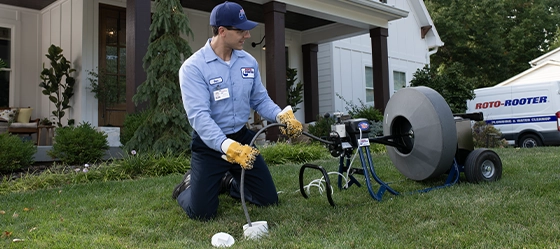
Take the pipe out of the picture for a moment and look at what is lying over it. On a great many Miami properties the sewer lateral runs beneath a paver driveway, a pool deck, a tiled walk or a planted bed inside a walled frontage, and almost none of its length crosses plain open ground. That is unusual, and it changes the shape of this job more than any other local fact does, because the surface is the part that is expensive to open and difficult to put back.
Establishing That the Line Has to Come Out at All
None of that matters until the pipe has actually been ruled unrecoverable, and the only honest way to establish that is a camera inspection. Recurring backups, several fixtures going slow together and water surfacing in a bed all point outside the building, but none of them explains why. The footage does. It shows whether the bore is obstructed by something that can be removed or whether the pipe itself has given up.
Four findings move a line out of the cleaning category. A collapsed section has no bore left to work with. A severe offset, where one length has shifted out of line with the next, leaves a permanent catch point. A belly that holds standing water refills after every cleaning because the problem is the shape of the run. Root intrusion through a broken joint means the opening, not the growth, is the finding. Anybody proposing a dig in Miami without that footage is proposing it from a description.
Walking the Surface Before Choosing a Method
With the failure located along the run, the next step on a Miami job happens above ground. The path gets marked out on the surface and the crew reads what it crosses: a poured or paver drive, a pool surround, a tiled terrace, a mature planted bed, a wall footing, an electric gate track. Each of those has a different cost of entry and a different honest answer about how it will look afterward.
Access gets read at the same time. Setbacks between neighboring structures in the denser Miami stock are narrow, front walls and gates limit what can be brought in, and a corner lot behaves differently from an interior one. That inventory, not a preference, is what decides between opening the run and working from pits at either end.
Open Cut and the Trenchless Options, Measured Against That Surface
An open cut trenches along the line, takes the failed pipe out, beds and lays new pipe, then backfills and compacts. It works on any condition of line and it is the approach that can re-set a run's depth or slope. Its cost on this lot type is the surface it has to travel through.
Trenchless reduces that footprint substantially. Cured-in-place lining forms a new pipe wall inside the existing one and needs a continuous host to form against. Pipe bursting pulls new pipe along the path of the old line while breaking the original outward, working from access pits rather than along the whole length. Both are genuinely less invasive and neither is universally available: a badly collapsed run rules them out, and so does a site with nowhere to put the pits. That is a real constraint on a walled Miami lot, and it is why trenchless is presented here as an option with conditions rather than as a better tier of the same product.
Serving the entire Miami metro area, Including:
Counties in the Miami Metro Area
Scoping the Surface Before the Estimate Is Signed
The complaints this service generates are almost never about the pipe. They are about what the yard looked like afterward, and they come from a restoration expectation that was assumed rather than agreed. So it is worth being blunt about a Miami excavation: an open cut disturbs the ground along the whole run, and where the line passes under a driveway, a deck or a walkway, that surface has to be opened.
The work includes backfill and compaction, which matters more than it sounds. Poorly compacted backfill keeps settling and leaves a depression along the trench line, and under pavers that shows up as a dip you can feel underfoot. Final surface restoration, meaning replacing pavers, re-laying tile, patching a pool deck or putting turf back, is scoped on site and written into the estimate rather than assumed in either direction. Ask for it to be spelled out, and expect an opened concrete drive to remain visible after repair even when the patch is done well.
Marking the Utilities First
Nothing gets opened until locating is complete. Gas, electric, water and telecom share the ground a Miami sewer lateral crosses on its way toward the street, and utility locating is a legal and safety requirement rather than a courtesy step. Anybody offering to skip it to start sooner is offering to take a risk with a gas line and with the property.
Permits, Inspection and the Numbers Not Printed Here
Sewer line replacement is permitted work and it is inspected, and Roto-Rooter handles that process as part of the job. What is deliberately absent from this page is what a permit costs or how long approval takes, because both vary by jurisdiction and by the scope of the specific job, and a figure published on a page becomes a promise nobody authorized. Your on-site estimate covers it against the actual work in front of it.
Your Pipe, the City's Pipe
The lateral running from the building to the municipal main is generally the property owner's, and the main is generally the municipality's. Where exactly that line falls, at the property boundary, at the curb, or at the connection itself, is set locally and it differs across Florida. Confirm it with your municipality rather than assuming, because it determines who pays for which length of pipe.
Roto-Rooter works on the owner's side of that boundary. Municipal main work is not something a plumbing company undertakes, and where the footage points past the connection, the next call is to the city.
A Single Bad Joint Against the Whole Run
Not every finding means replacing the whole length. Where the camera shows one failed joint or a single crushed section on a Miami lateral with sound pipe on either side, a spot repair opens only that length, and on a surface like this that difference is substantial: one small opening in a bed instead of a trench across a deck. What decides it is the condition of the rest of the line. Replacing a few feet of a run that is failing along its whole length buys a short reprieve and a second excavation through the same surface, which is the worst of both outcomes here.
If the Line Gives Out Before the Work Starts
A run bad enough to need replacing rarely waits for the appointment. If it backs up meanwhile, emergency plumbing help in Miami can restore flow temporarily so the household or the tenants keep going. That is a holding action rather than a repair and it does not change what the footage showed. For everything else Roto-Rooter does locally, start at the Miami plumbers page.
Get the Line Looked At, Then Price the Surface
Roto-Rooter has been in this business since 1935 and is fully licensed and insured. Call 305-535-2373 or schedule online to book a camera inspection. Roto-Rooter provides on-site estimates before any work begins, so the footage, the method and the restoration scope are settled together instead of sequentially. On a Miami property where the finish is worth more than the pipe, that is the plumbing peace of mind worth having, and Roto-Rooter answers 24/7, 365 days a year across South Florida.

What the Inspection and the Walk-Round Have to Settle
A Lot That Is Mostly Finished Surface

SPECIAL FINANCING AVAILABLE
We have partnered with Synchrony Bank to offer financing options to make your plumbing repair expenses as convenient and stress-free as possible.