Hydro Jetting in New Orleans
Key Takeaways: The Coating That Grows Back on Its Own
- A drain that turns slow again a few months after it was cleared is usually telling you about the surface of the pipe rather than about a blockage.
- Every sewer line carries a biological film on its wall. In a climate where the ground stays warm and damp all year, that layer is thicker, more active and quicker to rebuild than it would be anywhere with a real winter.
- The film is what gives cooking fat and solids something to hold, so grease and the layer under it reinforce each other rather than acting separately.
- Hydro jetting scours the full circumference of the pipe with high-pressure water, which is the only practical way to take a coating off a wall. A cable bores a channel through the middle and leaves the surface untouched.
- A video camera inspection comes first, to identify what is actually on the wall and to establish that the pipe is sound enough to clean under pressure.
- Mineral scale in older cast iron and root hair left after a cutter head are different findings again, and the footage is what separates all of them.
- Not every line is a candidate. A collapsed length, a badly offset joint or a wall thinned by long corrosion needs a repair conversation instead of a hose.
- Roto-Rooter is fully licensed and insured, and answers in New Orleans 24/7, 365 days a year.
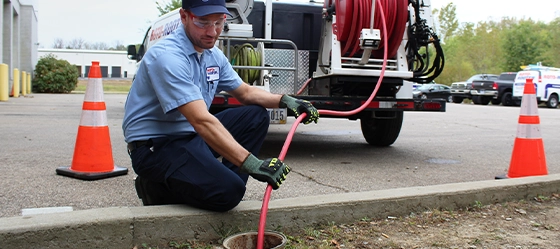
Cut open a length of sewer pipe anywhere in the country and the inside is not clean. It carries a film, a soft biological layer that lives on what passes through and coats the wall the way it coats the inside of a neglected vase. That is normal and mostly harmless. What is different in New Orleans is how much of it there is and how fast it comes back, because the two things that hold it in check elsewhere, cold and dryness, are absent here in every month of the year.
A line under this city sits in warm, permanently damp ground. Nothing slows the layer down in January. Nothing dries it out in August. It thickens, it holds everything sticky that comes past, and the bore closes gradually enough that the household never notices a day when things changed. Then the fixtures start complaining, a cable is run, flow returns, and within a few months the whole thing is back, which is the point at which most people go looking for an explanation. That sequence is close to universal in older New Orleans housing.
Why the Pipe Wall Is Never Bare Here
A cable is a boring tool. Driven into a restriction it cuts and pushes until there is a path, and the path is real: flow comes back immediately and the emergency is over. What a cable has no mechanism for is taking a soft layer off a curved surface it slides along. It passes through the middle of the pipe, the film closes behind it, and the surviving layer starts rebuilding from every square inch that was left, which in a warm line is most of them. A New Orleans lateral gets no seasonal reprieve from that.
This is why the interval matters more than the incident. A household that has the line cabled once a year has not solved anything; it has scheduled the problem. The question worth asking after the second visit is not what blocked the pipe but what is coating it, and that question needs a camera rather than a cable to answer. Louisiana gives a coating conditions most of the country does not.
Hydro Jetting Against a Layer That Rebuilds Itself
A jetting hose carries a nozzle that directs water backward against the pipe wall at high pressure while the hose is drawn through the run. The scour covers the whole circumference rather than a channel through the middle of the obstruction, and because the jets face behind the nozzle they drive what they lift toward the main instead of packing it further in. The film is carried out with the grease it was holding. Sludge settled in a flat stretch is flushed rather than pushed along. Mineral scale in older cast iron is cut back toward the original bore, which is the descaling half of the work, and root hair left in a joint after a cutter head is stripped away.
That end-to-end difference is the whole argument for the method, and it is why Roto-Rooter treats cleaning a pipe back to the wall as the standard rather than an upgrade. The layer will start again, because in this climate it always does. It starts from bare pipe instead of from most of a coating, and that is the difference between a line that gives trouble annually and one that does not.
Serving the entire New Orleans metro area, Including:
Counties in the New Orleans Metro Area
A Clean Wall Assumes There Is a Wall
A film can only be scoured off something solid, and three findings mean there is no longer anything solid to scour. A section that has collapsed offers nothing to clean. A joint that has dropped out of line with the next will catch a hose, and what is wrong at that point is structural rather than a matter of what is coating it. A wall thinned by long corrosion may not take pressure, and in permanently wet Louisiana ground that possibility deserves a look rather than an assumption.
Where one of those appears, the honest answer is that cleaning is not the fix. High-pressure water cleans a pipe; it does not restore one, and a technician who has watched the footage will say so rather than run a hose down a line that needs repair. What follows is a conversation about the options for that particular defect, starting from a recording that already exists rather than from a fresh diagnosis.
Will Hydro Jetting Get Rid of the Smell as Well?
Frequently, yes, and that surprises people who assumed the odor was coming from somewhere else. A heavily coated line smells because the coating is biologically active, and taking the coating off removes the source rather than covering it. Where a smell survives a proper cleaning, the cause is usually a dry trap, a failed seal at a fixture, or a vent problem, and those are quick things to check once the line itself has been ruled out.
The second camera pass is what makes that a conclusion rather than a hope. Seeing the wall after the work is the only honest way to know a line was actually cleaned, and it is worth asking any company for it.
Kitchens, Where the Layer Has a Constant Supply
A house lateral and a restaurant waste run carry different diameters, different daily loads and very different consequences when they close. A cleaned residential line in New Orleans can go a long time before it needs attention again, depending entirely on what fouled it. A commercial kitchen putting cooking waste through the same run every service is feeding the layer directly, which is why food service operators here settle on a planned interval rather than wait for a failure in the middle of a busy night.
Roto-Rooter handles both. For the wider set of plumbing work across a property, the New Orleans plumbers page is the place to start.
What Has to Happen Before the Hose Goes In
A technician locates the cleanout, runs the camera and talks through what is on the screen before anything else happens. If the run is a candidate, the hose goes in, the pipe is cleaned back through the affected stretch, and the camera goes down a second time. Roto-Rooter provides on-site estimates before any work begins, so nothing proceeds until the scope has been agreed.
Access is the practical variable on an older property here. A cleanout in a reachable spot makes for a straightforward visit, while one that has been paved over, built around during a renovation, or never fitted at all changes the approach, and it is worth raising when you call rather than discovering on the day. If a line is actively backing up rather than slowly closing, start with emergency plumbing help in New Orleans, because restoring flow comes first and the cleaning conversation follows.
Request Hydro Jetting for a New Orleans Sewer Line
Roto-Rooter has been cleaning sewer lines since 1935 and is fully licensed and insured. Call 504-455-7799 or schedule online to book an inspection, and get the plumbing peace of mind that comes from starting the next few years with a clean pipe. Roto-Rooter answers 24/7, 365 days a year.

The Runs That Foul Fastest in a Warm Climate
A City Where the Ground Never Cools and the Pipe Never Dries

SPECIAL FINANCING AVAILABLE
We have partnered with Synchrony Bank to offer financing options to make your plumbing repair expenses as convenient and stress-free as possible.