Hydro Jetting in New York
Key Takeaways: The Pipe You Own Does Not Stop at the Property Line
- A house connection here belongs to the property owner all the way out to the city main, which sits under the middle of the roadway rather than at the curb.
- That single fact changes the arithmetic of every slow drain, because the alternative to cleaning a sound pipe is opening a public street under permit rather than digging a private yard.
- Hydro jetting scours the full circumference of the pipe wall, where a cable bores an opening through the blockage and leaves the coating exactly where it was.
- A video camera inspection has to come first, both to confirm the line can take high-pressure water and to establish whether the trouble is a deposit or a defect. The difference decides everything that follows.
- Grease, mineral scale, sludge and tree roots each have their own signature on that footage, and descaling old cast iron is a different task from clearing a fouled clay seam.
- Street trees standing directly over a house connection are a New York fact of life, and their roots go for the one reliable source of water on the block.
- A collapsed section, a badly offset joint or a wall thinned by corrosion rules cleaning out, and knowing that early is what keeps the decision in your hands.
- Roto-Rooter is fully licensed and insured and answers across New York 24/7, 365 days a year.
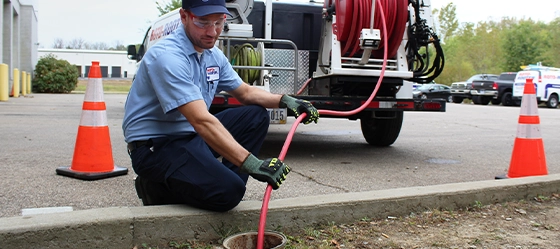
Most homeowners find out where their pipe ends at the worst possible moment. In New York the line leaving the building is yours across the yard, under the sidewalk, past the curb and out to a sewer main buried in the middle of the street. Nothing about that matters while the water is going the right way. It matters enormously on the day somebody has to decide between cleaning that pipe and replacing part of it.
The House Connection Runs Under the Roadway
Replacing a length of pipe under a private lawn is a day of digging and a repaired lawn. Replacing the same length under a New York City sidewalk and roadbed is a different order of undertaking: permits, traffic control, a licensed contractor able to work in the street, restoration of the surface afterward, and a schedule that is not entirely yours. None of that is a reason to avoid a repair the pipe genuinely needs. It is a very good reason to find out precisely what the pipe needs before anybody starts quoting one.
Which is where cleaning comes in. A great many house connections that get written off as failing are structurally sound and simply full. Years of grease, soap and grit have narrowed the bore, a cable has been through it two or three times and opened a channel each time, and nobody has ever taken the wall back to where it started. That pipe does not need a street opening. It needs to be cleaned properly and looked at afterward.
Hydro Jetting Buys Time on a Pipe You Cannot Easily Reach
The hose carries a nozzle that throws water backward against the pipe wall while it is drawn along the run, so the scour covers the whole circumference instead of the middle. Congealed grease comes off the crown. Sludge in a flat stretch is carried out toward the main rather than pushed along it. Mineral scale in old cast iron is cut back toward the original bore, which is the descaling half of the work. Root hair left after a cutter head is stripped from the seam it grew through, along with everything caught on it.
That is the difference between clearing a clog and cleaning a sewer line, and it is why Roto-Rooter treats end-to-end cleaning as the standard rather than an upgrade. Restoring flow is the emergency. Restoring bore is what postpones the conversation nobody in New York wants to have about the street.
Serving the entire New York metro area, Including:
Counties in the New York Metro Area
The Findings That Force the Street Open
Cleaning assumes a pipe that can be cleaned. Three findings take it off the table. A collapsed length has no bore left to recover. A joint badly offset, one section shifted out of line with the next, will catch the hose and points at a structural fault that high-pressure water would not solve. A wall worn thin by long corrosion may not survive the work.
Any of those and the honest answer is a repair, and in New York that means a conversation about scope, permits and access before anything else. It is a worse answer than cleaning, which is exactly why it is worth having the camera settle it rather than a guess. Everything the local team handles is on the New York plumbers page.
Why a Corner Store and a Two-Family Get Different Advice
Line size and daily volume separate a house connection from a commercial run. A two-family that has had its connection properly cleaned can go a long while before it needs attention again, and what it needs next depends on what caused the buildup in the first place. A ground-floor restaurant or a busy deli putting cooking waste through the same pipe every day is working against an accumulation rate it cannot argue down, which is why food service operators across New York City tend to put the work on a calendar. Roto-Rooter handles both, and the reasoning behind each one is genuinely different.
How Often Should Hydro Jetting Be Done on a House Connection?
Start from evidence rather than from a rule. The first inspection shows how much is on the wall, where it is collecting and why, which gives a sensible starting interval. The next visit shows how quickly that particular run comes back, and after two data points you are no longer guessing. A connection fouled by one household's habits behaves differently from one taking root hair through an open seam, and the second is not really a cleaning schedule at all. It is a repair on a timer.
If the line is backing up right now rather than slowly declining, start with emergency plumbing help in New York. Getting the water moving comes first and the cleaning decision follows.
What Gets Recorded, and Why You Want It
A technician locates the cleanout, runs the camera and goes through the footage with you before any water goes in. If the run is a candidate, the hose is drawn through it and the wall is cleaned back toward the original diameter, then the camera goes down a second time. Roto-Rooter provides on-site estimates before any work begins.
Keep what comes out of that visit. In a city where the expensive repair is a street opening, a recorded picture of your own house connection is genuinely valuable: it settles arguments with contractors, it gives you a baseline to compare against in a few years instead of starting the diagnosis over, and it is the difference between deciding on a repair and being told you need one.
Schedule a House Connection Survey in New York
Roto-Rooter has cleaned drains and sewers since 1935 and is fully licensed and insured. Call 212-687-1726 or schedule online to get a camera into the line and a straight account of whether it is dirty or damaged. New York crews answer 24/7, 365 days a year, which is the plumbing peace of mind of knowing instead of hoping.

When a House Connection Is Worth Cleaning Rather Than Cutting Open
Attached Houses, Street Trees and a Main in the Middle of the Road

SPECIAL FINANCING AVAILABLE
We have partnered with Synchrony Bank to offer financing options to make your plumbing repair expenses as convenient and stress-free as possible.