Hydro Jetting in Norfolk
Key Takeaways: When the Ground Under a Line Never Firms Up
- A lateral in Norfolk is bedded in soft ground that stays saturated, so it keeps settling for decades rather than settling once, and the fall it was laid with is not the fall it has now.
- Where the run has dropped into a shallow dish, flow slows and everything heavier than water stops there. A cable bores an opening through that deposit and leaves the deposit either side of the hole.
- Hydro jetting scours the full circumference of the pipe back to the wall, which is the answer to a line that refills rather than to one slow fixture.
- A video camera inspection goes first, and on Norfolk ground it is measuring as much as it is looking: how much fall is left in the sewer line, and which joints have worked out of line.
- Grease, corrosion scale inside old cast iron, and tree roots still anchored after a cutter head are three separate problems. Descaling a narrowed stack is not the same work as emptying a low run.
- One slow bathroom sink is a shorter visit. That is ordinary Norfolk drain cleaning, and it belongs on that page rather than this one.
- Not every line should be jetted. A collapse, a joint badly out of line, or a wall thinned by decades in wet ground is a repair conversation, not a cleaning.
- Roto-Rooter is fully licensed and insured, and answers in Norfolk 24/7, 365 days a year.
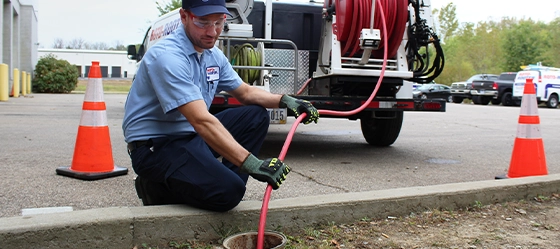
A lateral does its work on the fall it was given, and in Norfolk it was never given much to begin with. What it was given, it does not necessarily keep. The trench it sits in was backfilled into soft, wet ground that never packs down the way dry dense soil does, so the pipe goes on finding slightly new positions for decades. The result is not a dramatic failure. It is a run that has quietly gone shallow in one or two places, and a household that has been calling somebody out every couple of years without ever being told why.
Hydro Jetting on a Line With No Fall to Help It
A cable is a boring tool. It opens a passage through whatever is obstructing the pipe and gets the fixtures draining, which is the right response at midnight. What it cannot do is lift a bed of settled material out of a low stretch or take a coating off the pipe wall. It goes through the deposit and leaves it in place, and in a dish with no fall behind it the flow will not carry that material away afterward either.
A jetting hose works on the wall instead. The nozzle drives high-pressure water backward against the pipe while the hose is drawn upstream, so the effect is a scour across the whole circumference rather than an opening through the middle, and the loosened material is flushed back toward the cleanout ahead of the nozzle rather than pushed farther down a run that cannot move it. Grease that cooled and hardened along the crown comes off. Sludge and grit lying in the invert are lifted out. Corrosion scale in older cast iron is cut back toward the original bore, which is the descaling half of the work, and root hair still anchored in a seam is stripped from it.
That distinction is the whole argument for the service. Clearing a blockage is the emergency. Cleaning the sewer line is what stops the emergency from becoming a standing appointment.
The Camera Is Also Measuring the Fall
A video camera inspection comes before the hose, always. Part of that is diagnostic, because grease, scale and roots each call for different handling and only the footage separates them. Part of it is a structural check, since high-pressure water assumes the pipe can take it.
On soft Norfolk ground the inspection carries a third job that matters more here than in most places, which is reading the shape of the run. A stretch that has dropped will hold standing water long after the rest of the line has drained, and standing water is obvious on camera in a way it is not from a cleanout with a flashlight. A joint that has worked out of alignment shows as a lip. Both facts change the recommendation, because they say whether the line will foul again in two years or in ten. The camera goes back down when the work is finished, since a before and after on the same run is the only honest way to show a pipe wall is actually clear.
Serving the entire Norfolk metro area, Including:
Counties in the Norfolk Metro Area
Is Hydro Jetting Safe on a Line That Has Already Settled?
Mostly yes, and the exceptions are specific. Three conditions rule the method out. A collapsed section has no bore left to clean. A joint badly out of line, where one length has shifted clear of the next, will catch the hose and is a structural problem regardless. A pipe walled thin by long corrosion may not have the material left to take the pressure, and the inspection is what reveals that before anyone finds out the costly way.
A shallow dish is a different case and the common one on Norfolk's ground. It can be cleaned and it should be, because restoring the bore restores what flow there is. What cleaning cannot do is put the grade back, so the run will start collecting again and the footage is what tells you whether that means a sensible maintenance interval or a repair worth planning for. The same holds for an opened seam: high-pressure water takes out what came through it and does not close it. Nobody in Norfolk should be sold cleaning as a substitute for a repair, and when the camera says the pipe is past cleaning, the honest answer is that cleaning is not the fix. That conversation starts from footage that already exists rather than from a second inspection.
Restaurant Lines Where Grease Lands in the Low Spot
A house lateral and a commercial kitchen line differ in diameter, in how fast they foul, and in what a backup costs when it happens. A residential run that has been properly cleaned may go years before it needs attention again, depending entirely on what put the buildup there. A kitchen sending cooking waste through the same pipe every service is working against a known accumulation rate, and where the run has gone shallow it is working against a second one underneath, because the low spot is exactly where cooled grease stops moving. Operators along Norfolk's downtown blocks and the waterfront tend to land on a planned interval for that reason, set from what the first inspection actually found rather than from a rule somebody quoted them.
Roto-Rooter handles both kinds of line. For the rest of what a property might need, the Norfolk plumbers page is the place to start.
Where the Cleanout Sits When the Ground Stays Wet
Access decides how a visit goes more than anything else does. A cleanout in the open makes for a straightforward morning. One planted over, decked around during a renovation, or never installed at all changes the approach, and it is worth mentioning on the phone rather than discovering in the yard. On the lowest Norfolk lots a cleanout can sit in ground that stays soft most of the year, which affects how the crew stages the work but not whether it can be done.
A technician locates the cleanout, runs the camera, and walks through what is on the screen before anything else happens. Roto-Rooter provides on-site estimates before any work begins, so the scope and the figure arrive together and nothing proceeds until you have agreed to it. Where no cleanout exists, the inspection covers what adding one would involve, since a line that has needed attention twice will need it again.
Why the Footage Matters More Where the Ground Moves
The immediate change is bore. A pipe brought back to something near its original diameter carries what it was built to carry, which is why the gurgle, the slow tub and the fixture that backs up when the washing machine empties tend to resolve together rather than one at a time. The longer change is that you now hold a recorded baseline, and on coastal Virginia ground that keeps shifting under the pipe that record is worth as much as the cleaning. Compared against new footage in a few years, it shows whether a shallow spot is deepening or holding steady, which is the difference between scheduling a visit and planning a repair.
If a line is backing up right now rather than slowly getting worse, start with emergency plumbing help in Norfolk. Getting flow back comes first, and the cleaning conversation follows once the immediate mess is under control.
Book Hydro Jetting in Norfolk
Every visit starts with a camera rather than a guess, so you learn what is in the sewer line and what shape the run is in before anyone quotes work on it. Roto-Rooter has cleaned and repaired lines for homeowners and businesses since 1935, and is fully licensed and insured. Call 757-671-7686 or schedule online to arrange an inspection in Norfolk, and get the plumbing peace of mind that comes from a line you have actually seen. Roto-Rooter answers 24/7, 365 days a year.

Signs the Line Is Holding Buildup, Not Just a Blockage
Soft Bedding, a High Water Table and Joints That Move

SPECIAL FINANCING AVAILABLE
We have partnered with Synchrony Bank to offer financing options to make your plumbing repair expenses as convenient and stress-free as possible.