Sewer and Water Line Excavation in Oakland
Key Takeaways: Working Room Decides Half of an Excavation
- Two properties across Oakland with identical camera footage can face very different jobs, because what a crew can physically reach is a separate question from what the pipe needs.
- Pipe bursting and lining need a working pit at each end of the run. On a narrow parcel the far pit lands in a driveway, a path, or ground that belongs to somebody else.
- A camera survey still comes first. Nothing about access changes whether the line is blocked or broken, and only the footage answers that.
- The findings that rule out cleaning are structural: a crushed length, a joint out of alignment, a sag holding water, or roots arriving through an opening.
- Utility locating precedes every dig, and it is a legal requirement in California. Gas, electric, water and telecom get marked, and on a tight parcel they are all sharing the same few feet of ground as the sewer.
- Where the property owner's responsibility ends is a local rule rather than a national one, so it is a question for the municipality rather than an assumption.
- Hand work near a marked service is slower than machine work and it is the correct trade. The alternative is a bucket finding a gas line.
- Roto-Rooter is fully licensed and insured, and handles permitting and inspection as part of the job.
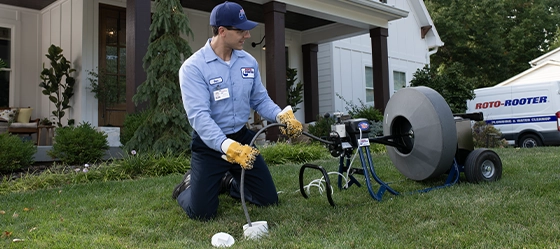
Most of what gets written about sewer replacement treats the property as an open field with a pipe under it. Anyone who has stood in the side yard of an older Oakland home knows how far that is from the truth. The house sits close to one property line, a drive runs the depth of the parcel toward a structure at the back, and the sewer lateral travels the long way to the street underneath whichever of those the builder found convenient. Before any method can be discussed, somebody has to work out what a machine can reach and what has to be done by hand.
What a Camera Survey Settles Before Anyone Measures the Yard
Access shapes the job, but it never decides whether there is a job. That comes from the footage, and the footage sorts every line into one of two categories: a pipe with something in it, or a pipe that has failed. Those two look the same from the fixtures inside and lead to completely different work.
- Crushed or caved length: the bore is gone, so there is nothing left for a cable or a jetter to clear through.
- Joint out of alignment: two sections no longer meeting square, leaving an edge that catches solids every time they pass.
- Water standing mid-run: a length that has settled below its neighbors, so material drops out there and rebuilds the blockage after every cleaning.
- Roots at an opening: the roots came in through something, and cutting them back leaves that something exactly as it was.
- Corrosion through the wall: older material thinned from the inside until the question becomes how much pipe is actually holding.
- Deposits over sound wall: the outcome worth hoping for, and the one that keeps the yard closed.
Where the wall is intact, the answer is cleaning. Oakland drain cleaning handles that, and it leaves the ground alone.
Can Trenchless Work With No Room at the Far End?
This is the question that a tight parcel actually turns on. Pipe bursting pulls a new line along the path of the old one from a pit at each end, and lining cures a new wall inside the existing pipe from an access point. Both need somewhere to put those access points, and both need the equipment close enough to use them. Where the far end of the run is under a shared drive, a set of steps, or a neighbor's paving, the pit either cannot go there or cannot go there without a conversation nobody has had yet.
When that is the situation, open-cut is not a failure of imagination. It is what the property allows. The honest version of this conversation happens at the estimate, with the footage on one side and the parcel on the other, rather than with a method promised in advance and quietly withdrawn on the morning of the work.
Serving the entire Oakland metro area, Including:
Counties in the Oakland Metro Area
Marked Utilities on a Parcel With No Spare Ground
Gas, electric, water and telecom all have to be located and marked before ground is opened, and that requirement does not soften because the property is small. If anything a constrained parcel makes it more serious, since everything buried on it is crowded into the same corridor and the margins are measured in inches rather than feet. Marks go down first, work starts after, and near a marked service the digging is done by hand. That sequence is set by California law rather than by the contractor. A contractor who offers to skip that step to save half a day is offering to gamble on your behalf.
The job is permitted and inspected, and Roto-Rooter carries that process. This page does not state a permit fee or an approval timeline, because both are set locally and change with the scope of the specific work, and a figure published here would become a promise nobody authorized. Your on-site estimate deals with it against the real job.
The Half of the Run You Do Not Own
As a general matter the lateral belongs to the property owner and the main belongs to the municipality. The exact point where one becomes the other, whether that is the property line, the curb or the connection itself, is decided locally and varies between jurisdictions, so it is worth confirming rather than assuming. It settles who pays, and it is the most common misunderstanding on this kind of work.
Roto-Rooter works on the property owner's side of that boundary. Municipal main work is not something a plumbing company undertakes, and where the footage places the fault past the connection, the next call is to the city.
What a Narrow Side Yard Looks Like Afterwards
Straight talk beats reassurance here. A trench along a side yard takes out whatever is growing in it, and where the run passes under a drive or a path, that surface has to be cut. Concrete does not heal, and a saw cut stays visible after the repair. Where a fence sits over the line it comes out and goes back, and where a rear structure is served by the same drive, expect that access to be interrupted while the trench is open.
Backfill and compaction are part of the work and they matter more than they sound. Material pushed back in loose keeps settling for months and leaves a trough along the line, and against a foundation or under a slab that is not a cosmetic problem. The replacement itself is inspected against California plumbing code before the trench is signed off. Final surface restoration, meaning paving, hardscape or planting, is scoped on site and agreed before the work starts rather than assumed. Get it written into the estimate.
Is a Sewer Line Replacement Worth It on a Parcel This Tight?
Usually the question underneath that one is whether a shorter repair would do. Where the camera shows one failed joint with sound pipe either side, a spot repair opens a few feet instead of the whole run, and on a constrained property that difference is enormous. What decides it is the condition of everything either side of the defect.
The trap is spending the disruption twice. Opening a drive to repair eight feet of a line that is failing along its length buys a season and guarantees a second dig through the same concrete. On stock of this age the footage is worth reading carefully for that pattern before committing to the smaller job, because the surfaces above the run are the expensive part and you only want to disturb them once. On the older Oakland stock, where a lateral may have been patched more than once already, that pattern turns up regularly enough to look for deliberately.
If the Line Fails While You Wait for Access
Oakland has a great deal of tenanted and multi-unit stock on exactly these parcels, and scheduling a replacement around a shared drive or a household sometimes takes longer than the line is willing to hold out. If it backs up in the meantime, emergency plumbing help in Oakland can restore flow so the household or the building keeps running. It is a holding action, not a repair, and it changes nothing about the footage. For everything else handled locally, start at Oakland plumbers.
Contact Roto-Rooter Before You Plan Around the Dig
Roto-Rooter has been clearing and replacing sewer lines since 1935, works across California 24/7, 365 days a year, and is fully licensed and insured. Call 510-488-9295 or schedule online to get the line surveyed and the property walked at the same visit, anywhere in the Oakland service area. Roto-Rooter provides on-site estimates before any work begins, so you find out what your parcel actually allows before anyone commits to a method. That is the plumbing peace of mind worth having on a job that touches your driveway.

Deep Lots, Rear Structures and a Run That Crosses Everything
Where the Excavation Pits Go, and What That Costs the Yard

SPECIAL FINANCING AVAILABLE
We have partnered with Synchrony Bank to offer financing options to make your plumbing repair expenses as convenient and stress-free as possible.