Sewer and Water Line Excavation in Omaha
Key Takeaways: Reading the Footage Before You Agree to a Dig
- Nobody in Omaha should be asked to approve an excavation from a description. Ask to watch the camera footage, and ask the technician to stop on the defect.
- Buildup and damage look nothing alike on screen once you know what separates them: buildup narrows the pipe, damage changes its shape.
- Scale from hard Nebraska water is the finding most likely to look worse than it is. It is a cleaning problem until the wall behind it is gone.
- Four readings genuinely end the cleaning conversation: a crushed length, a joint dropped out of line, standing water partway along, and roots entering through a fracture, which on older Omaha clay is the commonest of the four.
- Trenchless is conditional. Depth, existing material, how far the pipe has failed and access at both ends decide whether pipe bursting or lining is even available on your line.
- Utility locating happens before any dig and is not optional. Gas, electric, water and telecom all get marked first.
- Where the private run ends and the municipal main begins is set locally, so the boundary is worth confirming rather than assuming.
- The work is permitted and inspected, and Roto-Rooter handles that process. Roto-Rooter is fully licensed and insured.
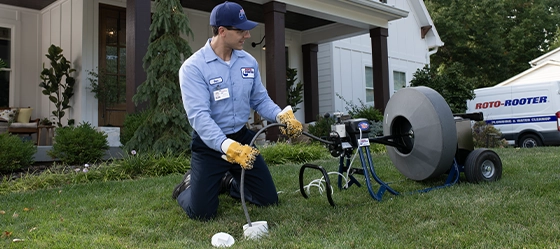
This is the one plumbing decision where the customer is furthest from the evidence. A water heater can be looked at. A dripping valve can be heard. A sewer lateral is buried across a yard in Omaha and the only person who has seen inside it is the person recommending the work. That asymmetry is uncomfortable, and it is fixable, because the footage exists and it is not hard to read once somebody explains what is on it.
How Do You Tell a Sewer Line Replacement From a Sales Pitch?
You ask to see the pipe. A camera inspection produces a continuous recording from the access point out toward the connection, with a footage counter running, and a genuine structural finding is a specific thing at a specific distance. Ask what distance the defect sits at. Ask what the counter reads where the picture changes. A recommendation that cannot be tied to a place in the pipe is not a recommendation, it is an impression.
Then ask what the rest of the run looks like. The single most useful question on this page is whether the wall either side of the defect is sound, because that is the difference between a short repair and a full replacement, and it is visible on the same recording. A technician who is confident in the finding will be glad to scroll back to it.
Buildup and Damage Do Not Look Alike on Screen
Buildup sits on a pipe that still has its shape. Grease, soap residue and mineral scale narrow the opening from all sides while the circle stays a circle, and the wall behind them is intact. That is a cleaning job, and in a hard-water market a heavy scale layer photographs alarmingly while being exactly the condition a cable or a jetting nozzle is designed for.
Damage changes the geometry. A crushed section is no longer round. A dropped joint shows one edge standing proud of the next. A run that has lost its fall puts the camera into water and keeps it there. Roots come through a visible break and the break is still there after they are cut. None of those improve with cleaning, and all of them are recognizable to somebody seeing footage for the first time.
Pipe Bursting, Lining and Open Cut Come Off the Same Footage
Method follows evidence in Omaha too. Pipe bursting pulls a new line through the route of the old one from pits at each end, and it needs existing material that will fracture and displace, ground that will take the displaced pipe, workable depth and somewhere to put a pit at the far end. Lining cures a new wall inside the existing pipe and needs enough of that pipe left to line.
An open cut works on any condition and disturbs the surface in proportion to what is above the run. Neither trenchless method is an upgrade tier and neither is always available, so a quote that names the method before the camera has been in the line is describing a preference rather than a plan.
Serving the entire Omaha metro area, Including:
Counties in the Omaha Metro Area
Evidence an Excavation Estimate Has to Show
An estimate for work of this size is a description of a plan, and a plan has parts an Omaha household can check. It should say where the crew intends to open the ground and why that location, what method the footage supports, how much pipe is coming out, and what happens to the surface above it afterward. Roto-Rooter provides on-site estimates before any work begins, which is what makes those questions answerable in the yard rather than over the phone.
It should also be honest about what is not settled. Ground conditions turn up surprises, and an estimate that pretends otherwise is worth less than one that names the unknowns and says how they would be handled. Nothing on this page will give you a duration or a figure, because both belong to the specific job and a number published in advance becomes a promise nobody authorized.
Locating Every Buried Service, and Putting It on the Record
Utility locating comes before any excavation and it is a legal and safety requirement rather than a courtesy. Gas, electric, water and telecom share the ground a sewer lateral occupies on any Omaha parcel, and nothing is opened until they are marked on the surface. Anyone offering to skip that step to save a day is offering to take a risk with your property and with a gas line.
The replacement is also permitted and inspected, and Roto-Rooter handles that process. That matters to this page for a reason beyond compliance: it means somebody outside the transaction looks at the work. What is deliberately not printed here is a permit figure or an approval timeline, because both are set by the jurisdiction and by the scope of the job.
The Part of the Run the City Answers For
The line from the building out to the municipal main is generally the property owner's, and the main itself is generally the municipality's. The exact point where responsibility changes, at the property line, at the curb or at the connection, is decided locally and differs between jurisdictions across Nebraska. Confirm it with your own municipality rather than assuming, because it settles who pays for what.
Roto-Rooter works on the property owner's side of that boundary and does not take on municipal main work. This is another argument for a survey that reaches the far end rather than stopping at the first defect: if the trouble is past your boundary, the correct next call is to the city and the correct cost to you is nothing.
What the Yard Looks Like When the Machine Leaves
An open cut across a lot in Omaha disturbs the ground along the whole length of the run, and where the line passes under a drive, a walk or a patio, that surface has to come up. Trenchless reduces the footprint substantially, though the pits at each end are still excavations. Being plain about this is better than being reassuring, because the complaint on this service almost always comes from the surface rather than the pipe.
The work includes backfill and compaction, and in fine-grained Nebraska soil that is worth watching, because loosely replaced material settles for months and leaves a depression tracing the trench. Final surface restoration, meaning turf, paving or hardscape, is scoped on site and agreed before the work starts rather than assumed either way. Get it written into the estimate.
When a Spot Repair Is the Honest Answer
Where the recording shows one failed joint or a single crushed length with sound wall on both sides, opening only that section is the proportionate repair and a substantially smaller job. That is a finding the customer can verify on the footage rather than take on trust, which is the whole argument of this page.
Where the same recording shows several separations and thinning along the run, replacing eight feet buys a short reprieve and a second excavation through the same ground. On older Omaha laterals assembled in short lengths, the second pattern turns up frequently enough that it is worth looking for before agreeing to a patch.
Water Still Has to Leave the House Meanwhile
A line bad enough to need replacing does not wait politely for the appointment. If it backs up before the crew arrives, emergency plumbing help in Omaha can restore flow long enough to keep the household functioning. It is a holding action rather than a repair and it changes nothing on the recording. For everything else Roto-Rooter handles locally, start at the Omaha plumbing page.
Call Roto-Rooter and Ask to See the Footage
Roto-Rooter has served Nebraska property owners since 1935 and is fully licensed and insured. Call 402-592-2700 or schedule online to book a camera inspection in Omaha, and expect to watch it. Roto-Rooter provides on-site estimates before any work begins, so the recommendation and the evidence for it arrive together. On a repair this size that is the plumbing peace of mind worth having, and Roto-Rooter answers 24/7, 365 days a year.

What an Excavation Recommendation Should Be Able to Show
Deep Soil, Hard Water and Two Generations of Lateral

SPECIAL FINANCING AVAILABLE
We have partnered with Synchrony Bank to offer financing options to make your plumbing repair expenses as convenient and stress-free as possible.