Hydro Jetting in Omaha
Key Takeaways: What a Disposer Actually Sends Down the Drain
- A kitchen line that has been getting slower for years is usually holding food solids, not a blockage. A disposal grinds waste small enough to leave the sink and no smaller than that.
- Those particles do not dissolve and they do not float. They settle in the first level stretch of the run and combine with cooking fat into a dense deposit that sets in place.
- A cable bores a channel through a deposit like that and leaves the rest of it sitting on the pipe, which is why the line runs well for a while and then does not again.
- Hydro jetting scours the full circumference of the pipe with high-pressure water, so the deposit is carried out toward the main rather than perforated.
- A video camera inspection comes first, to identify what is actually in the run and to establish the pipe is sound enough to clean under pressure.
- Mineral scale in older cast iron and root hair left after a cutter head are different findings again, and the footage is what separates them.
- Not every line is a candidate. A collapsed length, a badly offset joint, or a wall thinned by long corrosion needs a repair conversation instead of a hose.
- Roto-Rooter is fully licensed and insured, and answers in Omaha 24/7, 365 days a year.
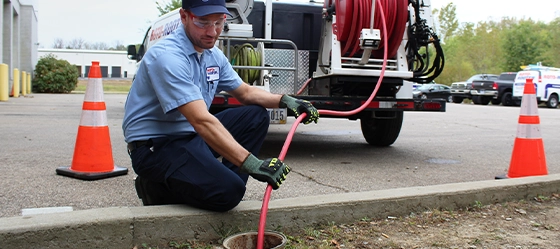
A garbage disposal is one of the most useful appliances in a kitchen and one of the most misunderstood. It does not dispose of anything. It reduces food waste to particles fine enough to pass a sink drain, and at that point the appliance's job is finished and the plumbing's job begins. Coffee grounds, rice, potato peel, eggshell and everything else arrive in the sewer line as a wet inert slurry, and none of it is going to break down on the way to the street.
What happens next depends on how much water is behind it and how flat the pipe is. A kitchen sink produces a modest amount of flow, the run under a typical Omaha lot is long, and any stretch that has lost its fall is a place where solids stop traveling. They settle, cooking fat cools and binds them together, and over years the deposit gets denser and harder rather than washing away. That is the material behind most of the slow kitchen lines across Omaha.
Small Enough to Leave the Sink, Not Small Enough to Leave the Line
The distinction matters because it explains why cabling gives such short-lived results here. A cable is a boring tool. Driven into a packed deposit it cuts an opening and flow returns immediately, which is exactly what a household needs when the sink is full. The deposit itself is untouched. The channel closes at whatever rate the kitchen refills it, and on a busy Omaha household that is not long.
It also explains why the problem is invisible until it is not. A pipe filling from the bottom up loses capacity gradually, and a sink that drains a little slower each year never gives anybody a day to point at. The line is generally still perfectly sound. It is simply carrying a load it was never designed to store, and Nebraska kitchens are not shy about supplying it.
What Hydro Jetting Does to a Packed Food Deposit
A jetting hose carries a nozzle that directs high-pressure water backward against the pipe wall while the hose is drawn through the run. The scour covers the whole circumference rather than a hole through the middle of the obstruction, and because the jets face behind the nozzle they drive what they lift toward the main instead of packing it further in. A settled food-and-fat deposit is broken up and carried out, which is the outcome a cable cannot produce. The same pass takes grease off the crown, flushes sludge from a low stretch, cuts mineral scale in older cast iron back toward the original bore, which is the descaling half of the work, and strips root hair left in a joint after a cutter head.
That end-to-end difference is the whole argument for the method, and it is why Roto-Rooter treats cleaning the pipe back to the wall as the standard rather than an upgrade. Restoring flow is the emergency. Emptying the run is what stops the emergency from being an annual event on an Omaha kitchen run.
Serving the entire Omaha metro area, Including:
Counties in the Omaha Metro Area
When the Pipe Is the Problem After All
Forgiving ground is not a guarantee. Three things a camera can find here mean the run should not be cleaned at all, however much is sitting in it. A section that has collapsed has no diameter to recover. A joint sitting out of line with the next will catch a hose, and the fault there is structural rather than a matter of what has settled against it. A wall corroded thin may not take pressure. None of those are common in Nebraska loess, which is exactly why they get ruled out by looking rather than by assuming.
Where one of those appears, the honest answer is that cleaning is not the fix. High-pressure water cleans a pipe; it does not restore one, and a technician who has watched the footage will say so rather than run a hose down a line that needs repair. What follows is a conversation about the options for that particular defect, starting from a recording that already exists rather than from a fresh diagnosis.
Does Hydro Jetting Clear Ground Food Waste and Grease Together?
Yes, and in practice they arrive together, because the fat is what binds the solids into something solid enough to stay put. Water at pressure breaks the bond and carries both out of the line in the same pass. It is one of the clearer cases where the method matches the problem exactly: the material is heavy rather than adhesive, so what it needs is energy behind it rather than a hole through it. Most Omaha kitchen runs respond to exactly that.
The second camera pass is what turns that into a conclusion. Seeing the invert of the pipe afterward is the only honest way to know a run was emptied rather than opened, and it is worth asking any company for it.
Restaurant Kitchens Are the Same Problem at Ten Times the Rate
A house lateral and a commercial kitchen run carry different diameters, different daily loads, and very different consequences when they close. A cleaned residential line in Omaha can go years before it needs attention again, depending on what the kitchen sends down it. A commercial operation putting food waste and cooking fat through the same pipe every service is working against a known accumulation rate, which is why food service operators across Nebraska settle on a planned interval rather than waiting for a failure in the middle of dinner.
Roto-Rooter handles both. For the wider set of plumbing work across a property, the Omaha plumbers page is the place to start.
What the Visit Involves on a Deep Lot
A technician locates the cleanout, runs the camera, and talks through what is on the screen before anything else happens. If the run is a candidate, the hose goes in, the pipe is cleaned back through the affected stretch, and the camera goes down a second time so the wall can be seen rather than described. Roto-Rooter provides on-site estimates before any work begins, so nothing proceeds until the scope has been agreed.
Length is the practical variable on an Omaha property, because a long run takes longer to work and the cleanout may not be near the kitchen that caused the trouble. A cleanout in a reachable spot makes for a straightforward appointment, while one landscaped over, finished around during a remodel, or never fitted at all changes the approach, and it is worth raising when you call. If a line is actively backing up rather than slowly closing, start with emergency plumbing help in Omaha, because restoring flow comes first and the cleaning conversation follows.
Schedule Hydro Jetting on an Omaha Sewer Line
Roto-Rooter has been cleaning sewer lines since 1935 and is fully licensed and insured. Call 402-592-2700 or schedule online to book an inspection, and get the plumbing peace of mind that comes from an empty pipe rather than an open channel through a full one, anywhere in the Omaha area. Roto-Rooter answers 24/7, 365 days a year.

The Kitchen Habits That Show Up on a Camera
Deep Loess, Long Lots and a Pipe That Is Usually Sound

SPECIAL FINANCING AVAILABLE
We have partnered with Synchrony Bank to offer financing options to make your plumbing repair expenses as convenient and stress-free as possible.