Sewer and Water Line Excavation in Orange County
Key Takeaways: Why a Newer Lateral Can Still Need Excavation
- Plastic pipe does not rust and roots do not eat through it, so when a newer line fails the cause is nearly always the ground it was laid in rather than the pipe itself.
- Graded building pads across Orange County mean a run can cross from firm original ground into compacted fill, and the two settle at different rates for years after the house is finished.
- That produces a step at the seam rather than a gentle sag, which is why the failure shows up as one sharp catch point on the footage instead of a long low stretch.
- A camera survey is still the first step, because a step, a separation and a plain blockage all feel identical at the fixtures inside the house.
- Trenchless methods are conditional. Depth, the state of the host pipe and usable access at both ends decide whether pipe bursting or lining is available on your run.
- Public locate services mark public utilities. Irrigation mains, landscape lighting and pool lines are private and have to be identified separately before ground opens.
- Where the property owner's responsibility ends is set by the local jurisdiction, so it is a question to ask rather than a rule to assume.
- Roto-Rooter is fully licensed and insured, and permitting and inspection are carried as part of the work.
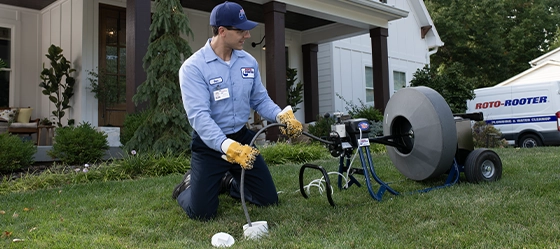
There is a comfortable assumption behind a lot of sewer advice, which is that a structural failure means an old pipe. Across much of Orange County that assumption falls apart. A great deal of this housing stock is newer than the markets where clay and cast iron dominate, the laterals under it are plastic, and plastic does not corrode, soften or give way to roots the way older material does. When one of these lines fails anyway, the explanation is almost always underneath it.
The Step in the Line Nobody Designed
A subdivision is not built on the landscape that was there. High ground gets cut down, low ground gets filled and compacted, and the result is a set of level pads engineered into what used to be a rolling surface. That work is done properly and to specification, and it still leaves a boundary underground: on one side, ground that has been sitting undisturbed for a very long time, and on the other, material placed and compacted within living memory.
Compacted fill continues to consolidate after construction. Undisturbed ground does not. A sewer lateral running from the house out toward the street frequently crosses that boundary, and when the two sides move by different amounts the pipe has to absorb the difference at a single point. What the camera then finds is a step: an abrupt change in level at one joint, with sound pipe running away from it in both directions. That is a very different picture from a long shallow dip, and it points at a different cause and a different repair, and it turns up across Orange County regularly enough that a crew should be looking for it specifically.
Can Pipe Bursting Replace a Plastic Lateral?
Frequently yes, and the material helps rather than hinders, because a plastic host pipe gives way cleanly as the bursting head passes through it. What decides availability is the usual set: depth, whether the path of the old line can still be followed, whether the failure is a separation rather than a full collapse, and whether there is somewhere to put a working pit at each end.
There is one caveat worth stating on a graded lot, and it is the same caveat that applies anywhere the ground is the culprit. A trenchless method follows the line the old pipe took. Where the fault is a step created by settlement, pulling a new pipe along the same path reproduces the step unless the bedding at that point is addressed, so an open cut at the seam is sometimes the repair that actually holds. The footage is what tells your crew which of those two situations you are in.
Serving Orange County and surrounding communities, Including:
Counties in the Orange County Area
Marking Irrigation, Gas and Fiber on a Planned Street
Utility locating comes before any ground opens, and it covers gas, electric, water and telecom. That part is a legal and safety requirement in California and it is arranged ahead of the crew rather than on the day. The part that catches people out on a master-planned property is everything the public locate does not cover. Irrigation mains, valve wiring, low-voltage lighting runs and pool equipment lines are private, they are usually undocumented, and they sit in exactly the band of shallow ground a trench passes through. Walking the property and identifying them is part of a competent estimate.
The work is permitted and inspected, and Roto-Rooter handles that process as part of the job. This page states no permit fee and no approval timeline, because both are set locally and both change with the scope of the specific work, and a number published here would turn into a promise nobody authorized. Your on-site estimate addresses it against the real job.
Ask the City Where Your Responsibility Ends
The broad rule is that the lateral belongs to the property owner and the main belongs to the municipality. The precise handover point, whether it sits at the property line, at the curb, or at the connection itself, is decided locally. That matters more than usual across Orange County, because the service area covers a long list of separately incorporated cities and they do not all draw it in the same place. Ask before you assume, since it determines who pays for which part of the run.
Roto-Rooter works on the property owner's side of that boundary. Municipal main work is not something a plumbing company takes on, and where the camera puts the fault past the connection, the next call goes to the city rather than to a contractor.
Turf, Pavers and the Line That Keeps Showing
An open cut disturbs the ground along its whole length, and where the run passes under a driveway, a walk or a paved patio, that surface has to come up. Pavers can usually be lifted and reset, which is one of the few genuine advantages of the hardscape common in newer California landscaping, while poured concrete has to be cut and the cut stays visible. Trenchless shrinks the disturbed area considerably, though the pits at each end are still excavations.
Backfill and compaction are part of the work, and on a property where settlement was the original problem they are not a detail. Loose backfill keeps consolidating for months and leaves a visible trough along the trench, which on a graded lot can also redirect surface water somewhere nobody intended. Final surface restoration, meaning turf, planting or hardscape, is scoped on site and agreed before work starts rather than assumed. Ask for it in the estimate.
How Far Does the Repair Have to Reach?
Where settlement has produced a single defect with sound pipe either side, opening that one section and rebedding it is a real option and a much smaller job than replacing the run. That is the good news about a failure caused by ground rather than by age: the rest of the pipe usually has plenty of service left in it.
The judgment call is whether the ground has finished moving. A pad that is still consolidating can produce a second defect a few feet from the first, and a spot repair made without looking at the whole run buys a season. The footage either side of the fault, and whether there are early signs of deflection elsewhere, is what a crew should be reading before recommending the smaller job.
Living With the Line Until the Work Is Booked
A lateral scheduled for repair does not always cooperate in the meantime. If it backs up before the crew arrives, emergency plumbing help in Orange County can restore flow so the household keeps functioning. That is a holding action rather than a fix and it changes nothing about the footage. For everything else handled locally, start at Orange County plumbers.
Call Before You Assume It Is a Cleaning Problem
Roto-Rooter has been diagnosing and replacing sewer lines since 1935, answers 24/7, 365 days a year across Southern California, and is fully licensed and insured. Call 714-913-6142 or schedule online to get a camera down the line and find out whether you are looking at debris or at ground movement. Roto-Rooter provides on-site estimates before any work begins, so the scope follows the evidence. On newer pipe that has failed early, that is the plumbing peace of mind worth having before anyone opens the yard.

Cut, Fill and Where Excavation Gets Complicated
Reading a Line That Was Laid in a Single Season

SPECIAL FINANCING AVAILABLE
We have partnered with Synchrony Bank to offer financing options to make your plumbing repair expenses as convenient and stress-free as possible.