Sewer and Water Line Excavation in Philadelphia
Key Takeaways: When the Dig Is Inside the House
- A drain that keeps failing after cleaning has a structural fault somewhere along the run, and the first useful question is not how to fix it but where along the run it sits.
- In a Philadelphia row house with a cellar, a good part of the private drain lies under the cellar floor. A defect on that stretch is repaired from inside the building, not from the front.
- The camera settles it. Comparing the footage reading at the defect against the distance from the entry point to the front wall tells you which side of the wall the work belongs on.
- An indoor excavation in Philadelphia is concrete saw-cut and broken out, a hand-dug trench, spoil carried out by hand, and dust control while it happens. No machine fits down there.
- Lining is worth asking about specifically when the defect is under a finished floor, though it stays conditional: the host pipe, the degree of collapse and access at both ends still decide.
- Utility locating is mandatory before anything outside the wall is opened, and the same care is taken by hand under the floor, where the water service and conduit enter the building.
- Where the owner's line ends and the municipal main begins is set locally, so it is a question for your municipality rather than an assumption.
- Roto-Rooter is fully licensed and insured, handles the permit and inspection process, and puts the floor back as part of the work with final surface finishes scoped on site.
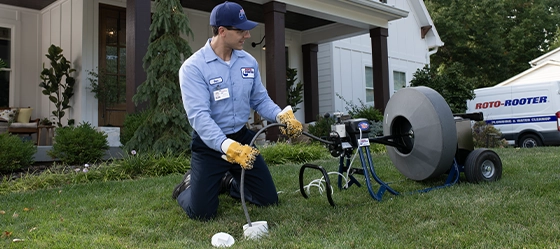
A drain in a Philadelphia row house does not leave the building as soon as it leaves the fixtures. It drops to the cellar, turns, and runs the length of the floor slab before it passes through the front wall and becomes the buried lateral everyone pictures. Two properties can have the identical fault and two completely different jobs, and the thing that separates them is which side of that wall the fault sits on.
The Number That Decides Whether This Is an Indoor Job
A camera survey comes first, every time, and on Philadelphia stock it earns its keep twice. The first job is the ordinary one: telling a bore blocked by something removable from a pipe that has failed structurally. Repeat backups, several fixtures slowing together, or water rising at the lowest opening all point at the main run without saying why.
The second job is measurement. A survey reports distance from where the camera entered, and a technician who knows how far it is from that cleanout to the front wall can say whether a defect at, say, twenty feet is under your floor or out under the front of the property. That single number changes the trade involved, the access, the restoration and the scope of the estimate, which is why nobody should be quoting a Philadelphia dig from a description of symptoms.
Four findings take a line past cleaning wherever they sit. A collapse leaves no bore to restore. A severe offset, one length shifted out of line with the next, leaves a lip that keeps catching solids. A belly holds standing water and refills after every cleaning because grade is the fault. Roots at a broken joint are structural, since the opening remains once the mass is cut.
What Opening a Cellar Floor Actually Involves
An indoor excavation is slower and quieter work than the outdoor version, and it is worth knowing what it looks like before agreeing to it. The slab is saw-cut along the line of the run and broken out. The trench below it is dug largely by hand, because a cellar has no headroom for a machine and no door a machine could get through. Spoil comes out in buckets or a small buggy, up the same stairs everyone else uses.
The pipe is replaced on a properly prepared bed, the Philadelphia trench is backfilled and compacted in lifts, and new concrete goes back over it. Dust control and ventilation are part of the job rather than a courtesy, because the work is happening inside occupied space. None of this is exotic. It is simply a different set of constraints from a trench across a yard, and it is the normal case in a great deal of Philadelphia housing.
Which Repairs Work Under a Finished Floor
Open cut is the direct method and it works in either setting on a Philadelphia property: the failed pipe comes out, new pipe goes in, and the surface above is restored. Outside the wall that surface is turf, walk or paving. Inside it is the cellar slab.
Trenchless methods change the arithmetic indoors more than they do outdoors. Cured-in-place lining forms a new pipe wall inside the existing one and is worth raising early when the defect sits under a floor somebody has just finished, because it can spare that floor entirely. Pipe bursting pulls a new line along the path of the old one while breaking the original outward, and it works from access points at each end, which indoors means an opening in the slab rather than a pit in the ground. Neither is an upgrade tier and neither is universally available. Depth, the material and condition of the host pipe, the degree of any collapse, the number of hard direction changes and usable access at both ends decide it, and the footage is what those decisions are made from.
Serving the entire Philadelphia metro area, Including:
Counties in the Philadelphia Metro Area
Containment, Hand Work and a Floor That Has to Go Back
A cellar floor is a slab poured over the ground, and everything that makes an outdoor excavation careful applies underneath it in a smaller space. Outside the wall, utility locating comes first and is not optional: gas, electric, water and telecom all share the ground the lateral crosses, marking them is a legal and safety requirement, and nothing is opened until the marks are down. Under your own floor there is no ticket to raise, so the protection is hand work and knowing where the water service and any conduit come into the building.
Inside a Philadelphia cellar, containment does the job that barricades do outside. Cutting concrete makes dust, and dust in an occupied building goes everywhere unless somebody has planned for it, so sheeting, extraction and ventilation are part of the scope rather than an afterthought.
An Inspection That Happens Before the Slab Goes Back
The work is permitted and inspected, and Roto-Rooter handles that process as part of the job. Indoors that has one practical consequence worth planning around: the new pipe is looked at while it is still open, so the concrete goes back after that step and not before it. What this page will not say is what a permit costs or how long an approval runs, because both vary by jurisdiction and by scope, and a number printed on a web page turns into a promise nobody authorized. The on-site estimate covers it against the actual work.
The Length Beyond the Front Wall
Past the wall the run becomes the buried lateral, and the ordinary rule applies: the line from the building to the municipal main is generally the property owner's and the main is generally the municipality's. Where exactly that boundary falls, at the property line, at the curb or at the connection, is set locally and varies between Pennsylvania municipalities, so confirm it with your municipality rather than assuming. It decides who pays, and it is the single most common misunderstanding on work of this size.
Roto-Rooter works on the property owner's side of that line. Municipal main work is not something a plumbing company undertakes, and where the survey points past the connection the next call belongs to the city rather than to a contractor.
How Much Floor Comes Up, and How Much Stays Down
Not every structural finding on a Philadelphia run means replacing all of it. Where the camera shows one failed length with sound pipe either side of it, a spot repair opens only that section, and indoors that is the difference between a few feet of saw-cut and a slab opened across the length of the cellar.
What decides between them is the condition of the pipe either side of the defect, read off the continuous recording rather than a single still. Clean wall and square joints on both sides point one way. Two more separations and corrosion running through the footage point the other, and opening a floor twice in one year is the outcome everybody wants to avoid. On a Philadelphia property the indoor stretch is worth settling in one visit for exactly that reason.
Between the Footage and the Floor Coming Up
A run this far gone rarely waits for its appointment. If it backs up before the repair, emergency plumbing help in Philadelphia can restore flow temporarily so the building stays usable. That is a holding action rather than a fix, and it changes nothing the camera found. For the rest of what Roto-Rooter handles locally, start at the Philadelphia plumbing page.
Find Out Which Side of the Wall the Problem Is On
Roto-Rooter has served Pennsylvania property owners since 1935 and is fully licensed and insured. Call 215-446-9067 or schedule online to book a camera survey with a distance reading rather than an opinion. Roto-Rooter provides on-site estimates before any work begins, so the footage and the scope are on the table together and you decide from evidence. Roto-Rooter answers 24/7, 365 days a year.

Defects That Turn Up Inside the Wall Line
Cellars, Party Walls and a Drain Under the Floor

SPECIAL FINANCING AVAILABLE
We have partnered with Synchrony Bank to offer financing options to make your plumbing repair expenses as convenient and stress-free as possible.