Hydro Jetting in Philadelphia
Key Takeaways: Telling Your Own Line Apart From the Main
- Two very different problems produce the same symptom at a floor drain, and only one of them is yours to fix.
- A lateral narrowed by grease, scale or roots fails on its own schedule, in dry weather as readily as wet. A line tied into a system running full during a downpour fails when it rains and rarely otherwise.
- Cleaning your own pipe does nothing for the second case, and anybody selling it to you for that reason has skipped the diagnosis.
- Hydro jetting scours the full circumference of the pipe back to the wall, which is the right answer when the buildup is genuinely in your own run.
- A video camera inspection is what separates the two, because it shows both the condition of the pipe and how it behaves at the connection.
- Much of Philadelphia is served by some of the oldest sewer infrastructure in the country, and a good deal of it carries stormwater and sewage in the same pipe.
- A single slow fixture inside the house is a smaller job. That is Philadelphia drain cleaning.
- Roto-Rooter is fully licensed and insured and answers 24/7, 365 days a year.
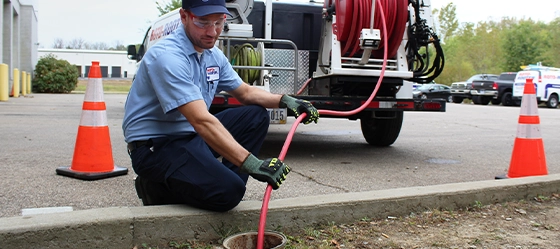
Water coming up a basement floor drain in Philadelphia tells you almost nothing on its own. It is the lowest opening in the building, so it is where every downstream problem announces itself, and at least two unrelated causes announce themselves there in exactly the same way. Getting that distinction right before anybody spends money is the whole point of an inspection.
Two Problems That Look Identical From a Floor Drain
The first is a lateral that has been narrowing for years. Grease that cooled along the crown, mineral scale in older cast iron, root hair that came in at a joint: the bore shrinks, capacity runs out, and the line backs up whenever demand exceeds what is left. That happens on a dry Tuesday as readily as during a storm, and it is entirely a problem in your own pipe.
The second is a connection into a system that is running full. A combined sewer carries sanitary flow and street runoff in the same pipe, which was an entirely sensible design when it was laid and remains in service across a great deal of Philadelphia. During heavy rain those pipes fill, and a lateral tied into a full main cannot discharge into it. The lateral may be spotless. It has nowhere to put anything.
Will Hydro Jetting Help If the Main Is the Problem?
No, and that is worth saying plainly on a page that exists to sell the service. High-pressure water cleans the inside of your pipe. If your pipe is clean and the system it drains into is surcharged during a storm, cleaning it again changes nothing, and the honest recommendation in that case is a conversation about backflow protection rather than a jetting truck.
Where jetting is exactly right is the first case, and it is the more common one. A hose carries a nozzle that drives high-pressure water backward against the pipe wall as it is pulled along the sewer line, so the cleaning covers the full circumference instead of boring a passage through the middle. Hardened grease comes off the crown. Sludge in a stretch with little fall is carried out. Where cast iron has corroded inward, descaling takes the deposit back toward the original bore, and root hair surviving a cutting head is stripped from the joint it entered by.
Serving the entire Philadelphia metro area, Including:
Counties in the Philadelphia Metro Area
One consequence of that much age deserves stating outright. Nobody should assume what is under a Philadelphia property without looking at it. A row that went up before anybody living was born may have been partly re-laid, tapped for a rear addition, or repaired under the pavement, and no drawing of any of that survives. Pennsylvania has plenty of housing in the same position, and the only reliable record is the one a camera makes on the day.
Where Hydro Jetting Is the Wrong Purchase
Beyond the surcharge case, three findings rule out pressure on the pipe itself. A collapsed section has no bore left to clean. A joint offset far enough that one length no longer meets the next will catch a hose, and the misalignment is the fault whatever is sitting on it. A wall thinned by long corrosion may not survive the work. In each case cleaning is not the remedy, because jetting cleans pipe and has never repaired any.
What follows is a repair conversation scoped from footage. Under a Philadelphia rowhouse that may mean a trenchless repair rather than an open cut through a pavement, which is a different job with a different estimate, quoted from what the camera already recorded rather than from an assumption about what is down there.
Kitchens on a Block Where the Line Is Shared
A house lateral and a working kitchen line differ in diameter, in daily loading and in what a failure costs. A residential run cleaned back to the wall may go years before it needs anything again, depending on what put the deposit there. An operator putting service volume down the same pipe every day is working against a measurable rate, and where a ground-floor kitchen shares a run with flats above it, the operator is not the only person affected by how that goes. Across Philadelphia that is the usual reason a ground-floor operator moves onto a planned interval instead of waiting.
Roto-Rooter handles both. For anything else a property here needs, start with Philadelphia plumbers.
Finding the Trap and the Cleanout in an Old Row
The visit begins at the access point. A technician locates it, runs the camera and talks through what is on the screen before anything is decided. If the line is a candidate the hose goes in, the affected stretch is cleaned, and the camera goes back down so you can look at the wall rather than take a description of it. Roto-Rooter provides on-site estimates before any work begins.
In older Philadelphia housing that access point takes some finding. It may be a house trap in the front, a fitting in a rear yard, or nothing usable at all on a building that predates the expectation. Mentioning what you know on the phone saves time on the doorstep. Where nothing suitable exists, the inspection covers what adding a proper cleanout to Pennsylvania plumbing code would involve.
What the Inspection Leaves You With
Two things. Bore, so the slow drain, the gurgle and the fixture that backs up when a washer empties tend to clear together rather than one at a time. And an answer to the question this page opened with, which is whether the problem was ever in your pipe at all. An owner in Philadelphia holding footage of a clean, sound lateral has something worth having the next time water comes up during a storm, because it moves the conversation somewhere useful immediately.
If a line is backing up as you read this, that is a different call. Start with emergency plumbing help in Philadelphia, and take up the rest once the flow is back.
Schedule a Sewer Camera Inspection in Philadelphia
Roto-Rooter has served Pennsylvania households and businesses since 1935, and is fully licensed and insured. Call 215-446-9067 or schedule online to find out which pipe is actually causing the trouble before anyone cleans anything, and get the plumbing peace of mind that comes with a straight answer. Roto-Rooter answers 24/7, 365 days a year.

What Points at the Lateral Rather Than the System
Some of the Oldest Sewers in the Country

SPECIAL FINANCING AVAILABLE
We have partnered with Synchrony Bank to offer financing options to make your plumbing repair expenses as convenient and stress-free as possible.