Sewer and Water Line Excavation in Pittsburgh
Key Takeaways: Every Turn in the Line Is a Decision
- A line that blocks in the same place every time is telling you something about where it changes direction, not just about what went down the drain.
- A private run in older Pittsburgh housing is rarely straight. It turns at the building, again where an addition was added, and again to reach a connection that is not directly ahead.
- Every turn in a Pittsburgh run is a fitting, and a fitting is an extra joint, a point where flow slows and changes direction, and a limit on what can be pulled along the run.
- A camera survey is what settles a repair, and on a run with turns in it the trace matters as much as the picture, because a trench line planned off a guess opens ground in the wrong place.
- Trenchless is conditional, never an upgrade tier. A gentle sweep is workable for bursting or lining; a hard elbow can force an access pit at the turn or rule the method out entirely.
- Utility locating comes before any Pittsburgh excavation and is not optional, and on a line that turns twice it has to cover every stretch that might be opened.
- Where the owner's line ends and the municipal main begins is set locally, so treat it as a question for your municipality rather than an assumption.
- Roto-Rooter is fully licensed and insured, handles the permit and inspection process, and includes backfill and compaction, with final surface restoration scoped on site.
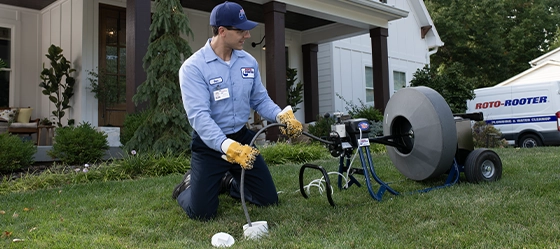
Most people picture a sewer lateral as a straight pipe from the house to the street. Under a lot of Pittsburgh housing it is nothing of the sort. It leaves the building at one corner, runs a short distance, turns to clear a porch footing or a rear addition, and turns again to reach a connection that sits off to one side. Those turns are the part of the run that decides how a repair can be done.
Where a Private Run Changes Direction
A Pittsburgh camera survey comes first, every time. It separates a bore holding something removable from a pipe that has failed structurally, and those two look identical from inside the house. Four findings end the cleaning conversation: a collapse with no bore left, a severe offset where one length has shifted against the next, a belly that holds standing water and refills after every cleaning, and roots entering at a broken joint, where the opening survives the cutting.
On a Pittsburgh run with turns in it the survey carries a second obligation, which is to establish the alignment. A locator follows the camera head from the surface and the path gets marked out as it goes, so what comes back is not only what is wrong but where the pipe actually lies. That matters more than it sounds. A trench cut along the line somebody assumed the pipe took is an excavation that finds nothing, and then a second excavation that does.
What a Fitting Does That a Straight Length Does Not
A change of direction is not a bent pipe. It is a fitting with a joint at each end, so a run with three turns carries six more joints than a straight one, and joints are where a rigid line reports the ground moving. That is why so many single-point failures in older Pittsburgh stock turn up at a fitting rather than in the middle of a length.
The second effect is hydraulic and it explains the symptom people describe. Flow slows where it changes direction, so anything the water is carrying has its best chance of dropping out there. On a sound run that is a nuisance the next cleaning clears. On a run where the fitting has cracked or pulled apart, the same spot blocks again on a schedule, and repeat blockages at one measured distance are worth taking seriously rather than cleaning indefinitely.
Pulling New Pipe Along a Path That Turns
Open cut is the direct method on any Pittsburgh alignment. A trench follows the run, the failed pipe comes out, new pipe goes in on a prepared bed, and the excavation is backfilled and compacted. It works on any alignment and on any condition, and how disruptive it is comes down to what sits on the surface above the line.
The trenchless methods are where geometry starts to bite. Pipe bursting pulls a head and a new length of pipe along the path of the old one, which assumes the path can be followed: a gentle sweep is workable, and a hard elbow is where a head can catch or the new pipe cannot make the turn. Cured-in-place lining forms a new wall inside the existing pipe and negotiates a sweep well, while a tight turn is where a liner is at risk of wrinkling and losing bore. Neither method is an upgrade tier and neither is universally available. Depth, the material and condition of the host pipe, the degree of any collapse, usable access at both ends and the number and severity of the direction changes all decide it.
Sometimes the answer on a Pittsburgh run sits in between: open the fitting itself, replace the turn, and line or burst the straight stretches either side of it. That call comes out of the footage and the trace together, which is exactly why both are done before a method goes on an estimate.
Serving the entire Pittsburgh metro area, Including:
Counties in the Pittsburgh Metro Area
Marking a Trench Line That Is Not a Straight Line
Gas, electric, water and telecom all run through the same ground a sewer lateral occupies, and a run that turns twice crosses more of that ground than a straight one does. Utility locating comes before any excavation in Pittsburgh, it is a legal and safety requirement rather than a courtesy, and nothing is opened until the marks are down. Anyone offering to skip it to save a day is offering to take a risk with your property and with a live gas line.
The traced Pittsburgh alignment and the utility marks then get read against each other, because the useful question is not only where your pipe is but where it comes close to something else. Where the two run near each other, the ground is opened by hand rather than by machine.
The work is permitted and inspected, and Roto-Rooter handles that process as part of the job. What is deliberately not stated here is what a permit costs or how long an approval takes, because both vary by jurisdiction and by scope, and a number printed on a page becomes a promise nobody authorized. Your on-site estimate covers it against the actual work.
The Last Turn Before the Connection
The run from the building to the municipal main is generally the property owner's, and the main itself is generally the municipality's. Where that boundary falls, at the property line, at the curb or at the connection, is set locally and varies between Pennsylvania municipalities, so confirm it with yours rather than assuming. It decides who pays for what, and it is the most common misunderstanding on a job of this size.
Roto-Rooter works on the property owner's side of that boundary. Municipal main work is not something a plumbing company undertakes, and where the survey points past the connection the next call belongs to the city rather than to a contractor.
Digging at a Turn Rather Than Along a Length
Not every structural finding means replacing a whole Pittsburgh run. Where the camera and the trace agree that one fitting has failed with sound pipe either side of it, the excavation is a small opening at a known point rather than a trench along the alignment. That is a substantially smaller job, and it is one of the better arguments for tracing carefully before quoting.
What decides between a spot repair and a full replacement is the condition of the rest of the pipe, read off the continuous recording rather than a single frame. One broken fitting in a run with square joints and clean wall either side is a different proposition from a run showing separations at two turns and a low spot between them. Replacing one fitting in a line that is failing at every fitting buys a season and a second excavation.
Two Small Openings Instead of One Long One
Being straight about the surface beats being reassuring about it. An open cut along the alignment disturbs the ground the whole way, and where the run passes under a walk, a drive or a paved side passage that surface has to come up. The compensation on a turning run is that the work can sometimes be concentrated: an access pit at each end for a trenchless repair, or a single opening at the failed fitting, instead of one continuous trench across a Pittsburgh front lot.
Backfill and compaction are part of the Pittsburgh work, and compaction is the part you notice later: material dropped back loose keeps settling for months and leaves a trough that collects water. Final surface restoration, meaning turf, paving or hardscape, is scoped on site and agreed before work starts rather than assumed. Ask for it to be written into the estimate.
When the Turn Blocks Completely
A fitting that has been catching solids for years rarely waits politely for the repair date. If the run blocks in the meantime, emergency plumbing help in Pittsburgh can restore flow temporarily so the household keeps working. That is a holding action and not a repair, and it changes nothing the footage established. For everything else Roto-Rooter handles locally, start at the Pittsburgh plumbing page.
Find Out Where Your Line Turns
Roto-Rooter has served Pennsylvania property owners since 1935 and is fully licensed and insured. Call 412-793-9200 or schedule online to book a camera survey that records the alignment as well as the defect. Roto-Rooter provides on-site estimates before any work begins, so the footage, the traced route and the scope arrive together. On a repair this size that is the plumbing peace of mind worth having, and Roto-Rooter answers 24/7, 365 days a year.

What Shows Up at the Fittings
Lots That Never Sat on a Grid

SPECIAL FINANCING AVAILABLE
We have partnered with Synchrony Bank to offer financing options to make your plumbing repair expenses as convenient and stress-free as possible.