Hydro Jetting in Salt Lake City
Key Takeaways: Why the Same Pipe Fouls Faster Here
- A sewer line wears on what goes through it, not on how old it is, and a busy household puts several times the daily load through the same pipe that a small one does.
- Utah runs the largest average household in the country, which means a standard lateral under a standard house here is doing more work every day than the same lateral would almost anywhere else.
- The practical consequence is that general advice about how long a line should last between cleanings reads low in this valley, and the useful interval has to come from what a camera actually finds.
- Hydro jetting scours the full circumference of the pipe with high-pressure water and returns the bore. A cable opens a channel through a blockage and leaves the coating either side of it untouched.
- A video camera inspection comes first, to measure how much pipe is left and to establish that the wall is sound enough to clean under pressure.
- Grease, mineral scale in older cast iron, and root hair remaining after a cutter head are three separate findings with three different answers.
- Not every line is a candidate. A collapsed length, a badly offset joint, or a wall thinned by long corrosion needs a repair conversation instead of a hose.
- Roto-Rooter is fully licensed and insured, and answers in Salt Lake City 24/7, 365 days a year.
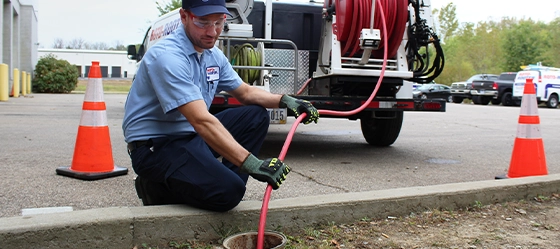
Two houses built the same year on the same street, with the same pipe under the same yard, can be in completely different condition underground. The one that has housed two people for twenty years and the one that has housed seven have not been running the same experiment. Everything that fouls a sewer line arrives through the fixtures, so the pipe that has carried three times as many showers, loads of laundry and evening meals is three times further along.
That is worth saying plainly in this valley, because Utah households are the largest in the country by a clear margin and most published advice about drains was not written with them in mind. A guideline that assumes a modest household will understate what a busy Salt Lake City home should expect, which is why people here keep being told their line is unusually bad when what it actually is, is unusually well used.
Age Is the Wrong Number to Go On
The instinct is to reach for the age of the house, and it is not useless, but it is the weaker of the two variables. Age tells you what the pipe is made of and roughly how many freeze cycles the ground above it has been through. Throughput tells you how much has passed along the inside of it. Only one of those is what builds a coating.
Which is why the honest answer to how often a line needs attention is that nobody can say from the outside. A camera pass gives a number that is specific to that household and that pipe: how much bore is left, what is occupying the rest, and how far the buildup runs. Everything after that is a decision based on evidence rather than a rule of thumb borrowed from a different kind of house.
What Hydro Jetting Resets, and What It Does Not
A jetting hose carries a nozzle that directs high-pressure water backward against the pipe wall while the hose is drawn through the run. The scour covers the whole circumference rather than a hole through the middle of the obstruction, and because the jets face behind the nozzle they drive what they lift toward the main instead of packing it further in. Grease that cooled and set along the crown comes away. Sludge settled in a flat stretch is flushed rather than pushed along. Mineral scale in older cast iron is cut back toward the original bore, which is the descaling half of the work. Root hair left in a joint after a cutter head is stripped off.
What it resets is the coating, back to bare pipe, and that is a genuine reset rather than a repair of anything. What it does not do is slow the rate at which the household refills it. A busy house will build a new coating faster than a quiet one, which is not a reason to skip the cleaning. It is the reason to have the interval written down.
Serving the entire Salt Lake City metro area, Including:
Counties in the Salt Lake City Metro Area
A Line Can Be Past the Point of Cleaning
Throughput explains how a line reached the state it is in. It does not decide whether cleaning is the right response, and three findings on the footage do. A section that has collapsed has nothing left to restore. A joint standing out of line with the next will catch a hose, and the fault at that point is structural. A wall corroded thin may not take the pressure at all, no matter how little is coating it. Volume is a reason to inspect more regularly in Utah, not a reason to skip the part where somebody looks.
Where one of those appears, the honest answer is that cleaning is not the fix. High-pressure water cleans a pipe; it does not restore one, and a technician who has watched the footage will say so rather than run a hose down a line that needs repair. What follows is a conversation about the options for that particular defect, which under a front yard here may mean a trenchless repair rather than a full open dig. That is a different job with a different estimate, and it starts from footage that already exists.
How Often Should Hydro Jetting Be Repeated on a Busy House?
From evidence rather than from a calendar. The sensible method is to take the condition found on the first inspection as a starting point, clean the line, then use the next camera pass to see how much of the coating actually came back and how quickly. Two visits produce a rate, and a rate is what an interval should be built on.
For most households that lands a good deal further apart than people fear. A run cleaned back to the wall, with no structural defect feeding material into it, holds its bore for years. What shortens it is volume, which is exactly the variable a large Salt Lake City household has more of, and that is a reason to measure rather than a reason to worry.
What Changes on a Commercial Run
A house lateral and a commercial kitchen run carry different diameters, different daily loads, and very different consequences when they close. A cleaned residential line can go years before it needs attention again, depending on what fouled it. A kitchen putting cooking waste through the same pipe every service is working against a known accumulation rate, which is why food service operators across Utah settle on a planned interval instead of waiting for a failure in the middle of a dinner rush.
Roto-Rooter handles both. For the wider set of plumbing work across a property, the Salt Lake City plumbers page is the place to start.
Getting to the Line on a Wide Block
A technician locates the cleanout, runs the camera, and talks through what is on the screen before anything else happens. If the run is a candidate, the hose goes in, the pipe is cleaned back through the affected stretch, and the camera goes down a second time so the wall can be seen rather than described. Roto-Rooter provides on-site estimates before any work begins, so nothing proceeds until the scope has been agreed.
Distance is the practical variable on a long lot, because a lengthy run takes longer to work and the cleanout may sit some way from the fixtures giving trouble. A cleanout in a reachable spot makes for a straightforward appointment, while one landscaped over, finished around during a remodel, or never fitted at all changes the approach, and it is worth raising when you call. If a line is actively backing up rather than slowly closing, start with emergency plumbing help in Salt Lake City, because restoring flow comes first and the cleaning conversation follows.
Call Roto-Rooter About Hydro Jetting in Salt Lake City
Roto-Rooter has been cleaning sewer lines since 1935 and is fully licensed and insured. Call 385-200-3053 or schedule online to book an inspection, and get the plumbing peace of mind that comes from an interval built on your own line rather than on somebody else's. Roto-Rooter answers 24/7, 365 days a year.

The Signs a Run Is Loading Faster Than It Should
Big Households, Wide Blocks and Water Off the Wasatch

SPECIAL FINANCING AVAILABLE
We have partnered with Synchrony Bank to offer financing options to make your plumbing repair expenses as convenient and stress-free as possible.