Sewer Line Excavation in San Antonio
Key Takeaways: When the Yard Never Shows You the Break
- A dry yard proves nothing about the pipe under it. Over the fractured rock that sits close to the surface across much of San Antonio, water leaving a broken line travels down instead of collecting where you would notice it.
- That makes the indoor symptoms the whole story: several fixtures draining slowly at once, a cleanout that has to be pulled, backups that return after each clearing.
- A camera survey is the only way to see which it is. Here it is closer to discovery than to confirmation, because there was no outdoor evidence to confirm.
- Ground varies sharply across San Antonio. On the deep prairie soil to the south the same failure surfaces within weeks, so where a property sits changes how much the absence of a wet patch is worth.
- Utility locating precedes any excavation. Gas, electric, water and telecom all share the corridor a sewer lateral runs through.
- Shallow rock is a real constraint on both methods. It raises the effort of an open cut and it can make the access pit a trenchless pull needs impractical at the depth wanted.
- Responsibility for the lateral running out toward the main is set by your municipality, not by a rule that holds everywhere, so it is worth confirming rather than assuming.
- Roto-Rooter is fully licensed and insured, and the permit and inspection process is handled as part of the job.
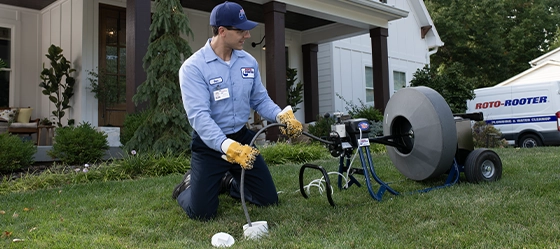
Most sewer failures give themselves away outdoors before anyone reaches for the phone. A patch of lawn stays soft through dry weather, a stripe of grass grows greener than everything around it, the ground sinks a little along a line, and the smell finishes the sentence. Over a large part of San Antonio, none of that happens. Water that escapes a broken lateral here meets rock with cracks in it and goes down, and a line can be losing its contents for a long time without leaving a single mark on the ground above it.
Everything You Can Observe Is Indoors
So the symptoms that matter are the ones inside the building. Two or three fixtures draining slowly at the same time points at the shared line rather than at any one of them. A cleanout that has to be opened to relieve pressure says the same thing. A backup that clears cleanly and comes back weeks later says it loudest of all, because a line that keeps failing after being cleaned properly is telling you the trouble is the pipe rather than what was in it.
The practical consequence of ground that gives no outdoor warning is that San Antonio households call later. By the time a survey goes in, the line has usually been running compromised for a while. That is not a reason for alarm, but it is a reason to look rather than to clean again and hope. A camera head pushed the length of the private run with a distance counter turning beside the picture turns guesswork into measurement: what has failed, how far out it sits, how deep, and what is above it. If the footage shows sound pipe carrying buildup, the answer is drain cleaning in San Antonio and nothing more.
Two Kinds of Ground in One Service Area
The northern and central reaches of San Antonio sit on limestone with thin soil over it, ground that is fissured enough to carry water away quickly and sideways. Out to the south and east the ground turns to deep prairie soil that holds water near the surface. The same broken joint behaves completely differently in those two places. On the clay it shows up as a soft, sour patch within weeks. On the rock it shows up as nothing at all.
That is why an experienced technician asks where the property sits before interpreting anything, and it is also why a line over the rock deserves to be taken seriously the moment the indoor symptoms start. Ground that moves water this readily carries whatever is in the water with it, which is a reason to fix a failing lateral rather than to keep it limping along, quite apart from what it is doing to the household.
Serving the entire San Antonio metro area, Including:
Counties in the San Antonio Metro Area
What a Dig Here Actually Involves
Once the footage says the pipe on a San Antonio property has failed, the conversation moves to the ground above it and to the paperwork around it. Both are worth understanding before the estimate is signed.
Marked Utilities Before the First Cut
Utility locating happens before any excavation and it is an obligation rather than a nicety. Gas, electric, water and telecom occupy the same corridor a San Antonio sewer lateral runs through, and marks go down before anything is opened. Anyone offering to skip the wait is offering to take a chance with a gas line on your property.
Open Cut, Pipe Bursting and What the Rock Allows
An open cut is the direct route: a trench along the failed length, the old pipe out, new pipe bedded and set, then backfill and compaction. It works on any condition of pipe. Trenchless methods reduce the footprint where the line will take them. Pipe bursting draws a new pipe along the old path while splitting the original outward, and lining cures a new wall inside the existing one. Neither is an upgrade tier, and neither is available everywhere. Depth, the material and condition of the existing run, how far it has collapsed, and whether pits can actually be dug at both ends all decide it. In ground with rock near the surface that last one carries more weight than people expect, so the honest answer before the survey is that both are on the table and the footage will say which.
Where the Owner's Length of Pipe Stops
As a general pattern the property owner owns the lateral and the municipality owns the main. Where one ends and the other begins, at the property line, at the curb, at the connection, is decided locally and it is not uniform across Texas. Confirm it with your municipality instead of assuming, because it settles who is responsible for which length of pipe. Roto-Rooter works on the owner's side of that boundary. Municipal main work is not something a plumbing company undertakes, and if the survey points past the boundary the next call is to the city.
The Part of This Job That Leaves a Record
Sewer excavation is permitted and inspected work, and Roto-Rooter handles that process rather than leaving it with you. What this page deliberately does not carry is a figure for a permit or a timeline for approval, because both vary by jurisdiction and by the scope of the individual job, and a number published here would become a promise nobody authorized. The on-site estimate covers it against the work in front of you.
Backfill, Compaction and the Surface Above
Backfill and compaction are part of the excavation, not tidying afterward. Fill goes back in layers and is compacted so the ground does not settle onto the new pipe over the following months. Above that, expect a straight answer rather than a comfortable one. A trench across a yard disturbs the ground along its whole length, and where the run crosses a driveway, a walkway or a patio slab, that surface has to be opened and it will not look untouched afterward. Trenchless shrinks the footprint where it is available, though the access pits are still excavations. Final surface restoration, meaning turf, paving or hardscape, is scoped on site and agreed before work starts. Ask for it to be written into the estimate.
One Length or the Whole Run
Where the camera shows a single failed section with sound pipe either side of it, a spot repair opens only that length and the difference in disruption is large. What decides it is the condition of everything else on the footage, which is why the whole run is worth watching rather than the worst still frame. Replacing a few feet of a line that is giving out along its length buys a short reprieve and a second excavation in the same yard.
If It Backs Up Before the Crew Gets There
A line bad enough to justify replacing does not wait for the calendar. If it backs up while the work is being scheduled, emergency plumbing help in San Antonio can restore flow temporarily so the household keeps functioning. That is a holding action rather than a repair. For everything else handled locally, start at the San Antonio plumbing page.
Find Out What Is Actually Down There
Roto-Rooter has served Texas property owners since 1935 and is fully licensed and insured. Call 210-810-3111 or schedule online to book a camera inspection. Roto-Rooter provides on-site estimates before any work begins, so the footage and the scope arrive together and the decision is made from evidence. In a market where the ground hides the problem, that is the plumbing peace of mind worth having, and Roto-Rooter answers 24/7, 365 days a year.

Ground That Gives Nothing Away
What the Survey Establishes Before Anyone Digs

SPECIAL FINANCING AVAILABLE
We have partnered with Synchrony Bank to offer financing options to make your plumbing repair expenses as convenient and stress-free as possible.