Hydro Jetting in San Antonio
Key Takeaways: In Dry Country the Sewer Line Is the Wettest Thing Around
- A sewer line carries water and a little warmth, and through a rainless summer that makes it the most attractive target in the yard for anything with roots.
- A cutter head takes the root mass and restores flow, then leaves fine growth anchored at the seam, which is what catches everything passing afterward.
- Hydro jetting scours the pipe wall around the full circumference, stripping that remaining hair along with the grease and sludge caught in it.
- The two tools work as a pair rather than as alternatives, which is why a root problem handled with cabling alone comes back sooner every time.
- A video camera inspection comes before the hose, to show where the roots entered and to confirm the pipe can take pressure, and comes back after to prove the result.
- Grease from a kitchen and mineral scale inside older cast iron are separate findings, and descaling is what gives a narrowed iron line its bore back.
- A collapsed or badly offset pipe is not a jetting candidate. Cleaning it is not an honest recommendation and no technician should make one.
- Roto-Rooter is fully licensed and insured, and answers in San Antonio 24/7, 365 days a year.
Roots go where the water is. In a wet climate that could be almost anywhere, so a sewer lateral is one option among many. Through a long dry summer in San Antonio it is not one option among many, it is the only reliable moisture within reach, and a root system that finds a hairline gap at a joint will work into it and keep going. The growth that results is not a stray tendril. It is a mass shaped like the inside of the pipe, holding paper and solids the way a net holds anything that drifts into it.
What the Blade Leaves and Hydro Jetting Takes
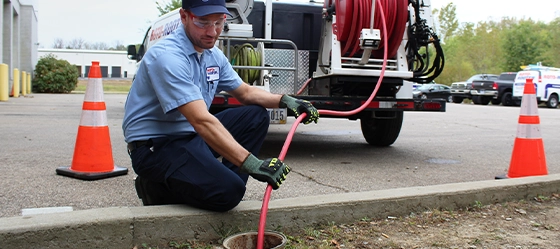
The first response to that is mechanical and correct: a cutter head on a cable, sent down to take out the mass and get the house working again. What it cannot do is finish the job. Fine root hair stays anchored where it entered, and the wall on either side keeps whatever coating it had. Hydro jetting is the second half: a nozzle carried on a hose throws high-pressure water backward against the pipe wall as the hose travels, so the scour reaches the full circumference and everything loosened moves back toward the access point rather than downstream. The remaining hair is stripped from the seam, grease that had collected on it lifts, sludge settled in a flat stretch flushes, and mineral scale inside an older cast iron run is cut back toward the original bore, which is the descaling part of the work.
Run in that order, a root job ends with a clean pipe rather than an open channel through a root ball. The difference shows up in how long the line stays clear.
Reading a Root Intrusion on the Screen
The camera goes down before the hose does. It shows where the growth entered, which is nearly always a joint or a crack rather than the pipe wall itself, and it shows how much of the run is affected. That matters because the entry point is a structural question and cleaning does not answer it. It also checks whether the pipe is sound enough for pressure, since roots and age tend to arrive together on the older laterals under San Antonio.
Afterward the camera goes back down. A before-and-after on the same length of pipe is the only honest way to show the wall is clear, and on a root job it is also the way to see whether the seam that admitted them has opened far enough to need work of a different kind.
Serving the entire San Antonio metro area, Including:
Counties in the San Antonio Metro Area
When the Joint Itself Is the Problem
Roots are a symptom of an opening, and sometimes the opening is the real story. Cleaning assumes a pipe still capable of doing its job, and three findings say otherwise: a length that has collapsed, a joint offset far enough to catch the hose, or a wall thinned so badly by age that pressure is a risk rather than a treatment. Any of those turns the conversation from cleaning to repair, and the footage recorded during the inspection is what the repair discussion should be built on.
Between those extremes sits the common case: a sound pipe with one seam that has opened slightly. That is a maintenance situation with a known rhythm. Clean it properly, note the condition, and decide whether the interval is acceptable or whether a spot repair at that one joint is the better long-term answer.
How Long Before Roots Find the Line Again?
That is set by the opening rather than by the cleaning. If the seam that admitted them is still there, growth resumes, and how fast depends on the species, the size of the tree and how dry the season is. What a proper cleaning changes is the starting point: the line goes back to full bore with nothing left for the next growth to anchor to, which usually stretches the interval rather than eliminating it. Owners in San Antonio who track that interval across a couple of visits get a genuine basis for deciding between continued maintenance and a repair.
Roots Do Not Care Whether It Is a House or a Restaurant
The line under a commercial property has the same problem with more load on top of it. A restaurant run is larger in diameter, carries fat and food solids every day, and fails at the worst moment, so a root mass in that pipe catches far more material and closes it faster. Operators across San Antonio tend to set an interval and clean on a slow morning rather than wait. A residential line cleaned back to the wall can go a long stretch before it needs attention, and what is growing into it decides how long.
For anything that is not this service, the San Antonio plumbers page is the better place to start.
What Changes When the Wall Is Actually Clean
The immediate difference is bore. A pipe returned close to its original diameter carries what it was sized to carry, so the slow tub, the gurgle and the fixture that backs up when the washing machine empties tend to resolve together rather than one at a time. The second difference is that the growth has nothing left to hold. A seam stripped back to the pipe wall gives the next root system a harder start than one still carrying last year's hair, and in a Texas summer that head start is the whole difference between a two-year interval and a six-month one.
What Happens on the Day
A technician locates the access point, runs the camera and talks through what is on the screen before any work begins. If the line is a candidate, the cutting and the cleaning happen in sequence and the camera goes back down at the end. Shallow ground and rock make the access point worth knowing about in advance, since a cleanout that has been landscaped over or was never installed changes the approach. Roto-Rooter provides on-site estimates before any work begins, so nothing proceeds until the scope is understood and agreed.
If the line is backing up right now rather than gradually slowing, begin with emergency plumbing help in San Antonio. Getting flow back comes first and the root conversation follows.
Schedule Hydro Jetting After the Root Cut
Roto-Rooter has been in business since 1935, is fully licensed and insured, and answers in San Antonio 24/7, 365 days a year. Call 210-810-3111 or schedule online to have the line cut, cleaned and filmed in one visit rather than in three, anywhere in San Antonio. Knowing what is growing into the pipe, and how far it has got, is where the plumbing peace of mind comes from in a market this dry.

Signs a Line Is Losing Ground to What Is Growing Into It
Thin Soil Over Limestone, and Summers With No Rain in Them

SPECIAL FINANCING AVAILABLE
We have partnered with Synchrony Bank to offer financing options to make your plumbing repair expenses as convenient and stress-free as possible.