Hydro Jetting in San Jose
Key Takeaways: The Half of the Lateral Nobody Has Cleaned
- A cable stops working the moment it opens the blockage it was sent to find, which means the pipe beyond that point has never been touched by any tool.
- Lots across San Jose are deep and the houses sit well back from the street, so the run out to the main is long and the untouched half of it is substantial.
- Hydro jetting works the full length and the full circumference of the pipe wall, so the far end gets the same attention as the near end.
- The far end is where trouble tends to gather anyway: the pitch is shallowest there, the joints are oldest, and it is the section furthest from anybody's attention.
- Grease, mineral scale, sludge and tree roots read differently on camera, and descaling old cast iron is a separate task from stripping root hair off a clay seam.
- A video camera inspection has to come first, to confirm the pipe can take high-pressure water and to see how far the problem extends, then again afterward.
- A collapsed length, a badly offset joint or a wall thinned by corrosion rules cleaning out, and finding that at the far end is exactly why the camera goes the whole way.
- Roto-Rooter is fully licensed and insured and answers across San Jose 24/7, 365 days a year.
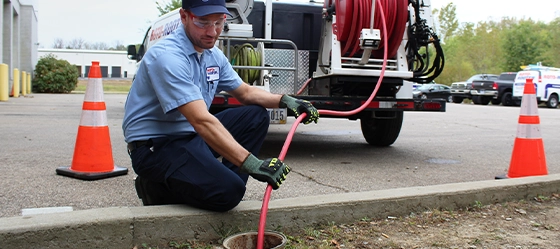
Every drain call ends when the water goes down, and that is a reasonable place for a visit to end and a poor place for a diagnosis to. The tool that restored flow found one obstruction, opened it, and came back out. Nothing beyond that point was inspected, cleaned or even reached. On a long San Jose lateral, beyond that point can be most of the pipe.
A Cable Stops at the First Success
A drum machine carries a fixed length of cable and a technician runs it until something gives. That is the correct procedure and it does the job it exists to do. The limitation is structural: the cable bores an opening through the first thing it meets, flow returns, and there is no reason to keep pushing. So the near section gets a channel driven through whatever was coating it, and the far section carries on collecting.
Which is why the second call comes. The household hears that the line was cleared and assumes the line is clear, and a few months later the same fixtures slow down again, sometimes from a different spot entirely. Nothing went wrong on the first visit. It simply answered a smaller question than the one the pipe was asking. The useful response is not to distrust the first visit but to ask what the rest of the run looks like, which is a question a camera answers in one trip.
Hydro Jetting Works the Whole Length, Not the First Obstruction
The hose is different in kind. A nozzle throws water backward against the pipe wall while the hose is drawn steadily along the run, so the scour covers the full circumference and continues for as far as the technician takes it, which on a residential lateral means out to the connection with the main. Grease that cooled and set along the crown comes off. Sludge lying in a shallow stretch is carried out rather than pushed along. Mineral scale in old cast iron is cut back toward the original bore, the descaling half of the work. Root hair left at a seam after a cutter head is stripped with everything caught on it.
That is the difference between clearing a clog and cleaning a sewer line, and it is why Roto-Rooter treats end-to-end cleaning as the standard rather than an upgrade. Getting flow back tonight is one job. Knowing the condition of the whole run in California soil that is not going to be dug up casually is a different one.
Serving the entire San Jose metro area, Including:
Counties in the San Jose Area
What the Far End Can Show That Stops the Job
Cleaning assumes a pipe able to be cleaned, and the section most likely to fail that test is the one nobody has looked at. Three findings end it. A collapsed length has no bore left to recover. A joint badly offset, one section shifted out of line with the next, will catch the hose and is a structural fault that cleaning does not address. A wall worn thin by long corrosion may not survive the work.
Any of those and the honest answer is that this is a repair conversation, scoped from footage that already exists. On a deep San Jose lot the position of the fault along the run matters a great deal to what the repair involves, which is another reason to send the camera the whole distance. For the rest of what the local team handles, San Jose plumbers is the place to start.
Commercial Runs Are Longer Still
Everything about distance gets more pronounced on a commercial property. A restaurant, a shopping center tenant or a light industrial building sits further from the main than a house does, on larger pipe, with a fat and solids load arriving every day rather than a few times an evening. The accumulation rate is predictable, which is the useful part: food service operators across California generally put line cleaning on a calendar instead of waiting for the service that ends early. The interval comes from what the first inspection found, and gets adjusted once two visits have shown how fast that particular run comes back.
How Far Does Hydro Jetting Actually Reach?
Far enough to matter, and the honest version is that the technician can tell you the distance because the camera measures it. On a normal residential lateral the work covers the run from the cleanout out to the connection with the city main. The practical limits are access and condition rather than distance: where the cleanout sits, whether the pipe can take the pressure along its whole length, and whether anything in the middle stops the hose. All three of those are answered before the work starts rather than discovered during it.
If the line is backing up right now rather than slowly declining, start with emergency plumbing help in San Jose. Restoring flow comes first, and the full-length conversation follows.
What a Full-Length Clean Involves
A technician locates the cleanout, runs the camera the whole way and goes through the footage with you before any water goes in. If the run is a candidate, the hose is drawn through it and the wall is cleaned back toward its original diameter along the length, then the camera repeats the trip. Roto-Rooter provides on-site estimates before any work begins.
Access decides how straightforward the visit is. Many properties here have a cleanout in a sensible spot near the foundation. Others had one landscaped over, finished around during a remodel, or never installed at all, which is worth mentioning on the phone rather than discovering in the driveway. Where none exists, the inspection covers what adding one would take, because on a long run a proper access point changes every future visit.
Request a Full-Length Line Survey in San Jose
Roto-Rooter has cleaned drains and sewers since 1935 and is fully licensed and insured. Call 408-572-6300 or schedule online to have the camera go the whole distance rather than as far as the last problem. San Jose crews answer 24/7, 365 days a year.

Symptoms of a Line Cleared Only as Far as the Trouble
Deep Lots and the Long Walk to the Street

SPECIAL FINANCING AVAILABLE
We have partnered with Synchrony Bank to offer financing options to make your plumbing repair expenses as convenient and stress-free as possible.