Hydro Jetting in St Louis
Key Takeaways: Buildings Plumbed for One Life and Living Another
- When a drain problem sits inside the building rather than out at the street, the usual reason is a long horizontal run with almost no fall, where solids stop moving and everything arriving afterward stops with them.
- A cable finds the plug at the end of that run and opens it. The layer coating the twenty or forty feet behind the plug is untouched, which is why the same drain closes again on a schedule.
- Hydro jetting works the full circumference of the pipe back to the wall along the whole affected stretch, not just at the point where flow finally stopped.
- Grease, mineral scale and root hair left after a cutting head are three different problems with three different answers, and a video camera inspection is what separates them.
- Old pipe is not automatically bad pipe, but it does have to be looked at. A collapsed or badly offset line is not a candidate for pressure at any price.
- Brick construction across St Louis has outlived several of the uses it was put up for, and the drain layout usually stayed put through every one of those changes.
- A single slow fixture is a smaller job. That is St Louis drain cleaning, and it is the right call for one sink.
- Roto-Rooter is fully licensed and insured and answers 24/7, 365 days a year.
A brick four-family in St Louis that began life as something else keeps the drain layout it was given, because relaying pipe means opening floors and a conversion almost never does. What gets inherited is a long horizontal run threading past footings placed for structure rather than for drainage, and a run like that has very little height to spend. Where the fall runs out the water keeps going and the solids do not.
Hydro Jetting Cleans the Pipe, a Cable Clears the Path
Cabling is a boring tool, and a good one. It reaches the obstruction, cuts an opening and gets the fixtures draining, which is exactly the right response when a floor drain is coming up. What it does not do is touch the material bonded along the run behind that opening, and on a flat interior stretch that material may be the actual problem. The opening closes again at the pace the deposit built in the first place.
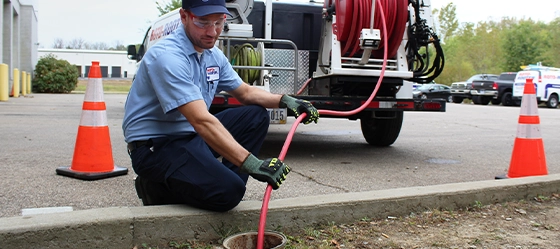
Hydro jetting reverses the geometry. A hose carries a nozzle that drives high-pressure water backward against the pipe wall as it is pulled along the sewer line, so the cleaning happens around the whole circumference and across the length rather than at one point. Hardened grease is sheared off the crown. Sludge lying in a run with no fall is flushed out instead of shoved another few feet down. Where cast iron has corroded inward, descaling takes the deposit back toward the original bore. Root hair that survived a cutting head is stripped from the joint it entered through.
Why Does a Long Interior Run Foul Before the Lateral Does?
Because the lateral usually has the better grade. A line leaving a building for the street main has a defined fall over a short distance. The run that gets there may cross most of a floor plate first, threading around footings and columns that were placed for a different purpose than plumbing, and every foot of that trip is a foot where the pipe cannot afford to lose height. Designers work to the minimum the code allows, and time, settlement and a few decades of building movement rarely improve it.
The practical result is that the first fixture to complain is the lowest one, and the actual fault is somewhere upstream of it in a stretch nobody has ever seen. That is a diagnosis a camera makes in ten minutes and a guess makes badly.
Serving the entire Saint Louis metro area, Including:
Counties in the St Louis Metro Area
Where Cleaning Stops and Repair Begins
Pressure is a cleaning tool and it assumes a sound pipe. Three findings on a camera survey rule it out. A collapsed section has no bore left to restore. A joint offset far enough that one length no longer meets the next will catch a hose, and the misalignment is a structural fault regardless of what is coating it. A wall thinned by long corrosion may not come through a cleaning, and the inspection is how that gets known in advance.
When one of those shows up, the answer is that cleaning is not the fix. Jetting cleans pipe. It has never repaired pipe, and pressurizing a failing line only buys time at somebody else's expense. What follows is a repair conversation, and it starts from footage rather than from an opinion.
Line Size Changes the Interval
A house lateral and a commercial kitchen line differ in diameter, in loading and in what it costs when they stop. A residential run in St Louis cleaned properly back to the wall may go years before it needs anything, and how long depends on what put the deposit there. A kitchen pushing service volume through the same pipe daily is working against a rate it can measure, which is why operators here generally settle on a planned interval instead of waiting for the night it matters most.
Roto-Rooter covers both. For everything else a building here needs, start with the St Louis plumbing team.
Finding the Cleanout in an Old Building
The visit starts at the cleanout. A technician locates it, runs the camera and talks through what is on the screen before anything is decided. If the line is a candidate the hose goes in, the affected stretch gets cleaned, and the camera goes back down so you can look at the wall instead of taking somebody's word for it. Roto-Rooter provides on-site estimates before any work begins.
In a building that has been remodeled more than once, finding that access point is half the job. Cleanouts get finished over, built around, and occasionally left out when a floor was redone. It is worth saying so on the phone rather than on the day. Where none exists, the inspection covers what adding one to Missouri plumbing code involves, because a run that has needed attention twice will need it again.
What a Clean Wall Actually Buys
Capacity, first. A pipe brought back to something near the diameter it was laid at carries what it was sized to carry, so the slow fixture, the gurgle and the drain that backs up when something upstairs empties tend to resolve at the same time rather than one by one. Second, and easy to undervalue, you end up holding footage of your own line. A baseline recorded after a cleaning is something a future inspection can be measured against, and an owner in St Louis holding that footage can compare rather than start the diagnosis over.
If water is coming up right now, the cleaning conversation is the wrong one to be having. Start with emergency plumbing help in St Louis and get the flow back first.
Request a Line Survey in St Louis
Roto-Rooter has been clearing and cleaning drains since 1935, and is fully licensed and insured. Call 314-925-2651 or schedule online to get a camera into the run before the next backup does the explaining, and get the plumbing peace of mind of a decision made from what is actually in the pipe. Roto-Rooter answers 24/7, 365 days a year.

What Sends a Building Drain to Hydro Jetting
Old Brick, New Uses, the Same Pipe

SPECIAL FINANCING AVAILABLE
We have partnered with Synchrony Bank to offer financing options to make your plumbing repair expenses as convenient and stress-free as possible.