Sewer Line Repair in Tempe, AZ
Desert Heat, Monsoon Pressure, and the Pipes Under Tempe
Tempe sits in the Salt River Valley where summer surface temperatures routinely exceed 110 degrees, and soil temperatures at shallow burial depth climb above 120 degrees. Beneath the desert landscape lies a mix of clay, caliche, and sand that responds to Arizona's extreme thermal cycles with constant expansion and contraction. During monsoon season, sudden downpours dump inches of rain onto baked soil, creating rapid swelling that presses hard against buried pipe walls. When the heat returns, the ground dries and shrinks, leaving air gaps beneath pipes that cause them to sag and develop bellied sections.
Many Tempe homes were built in the 1960s and 1970s when the city experienced its first major expansion. Properties connected to the city sewer between the 1940s and 1970s may have Orangeburg pipe - a tar-impregnated fiber material with an expected lifespan of about 50 years that is critically deteriorated in virtually every remaining installation. Roto-Rooter has provided professional sewer line repair since 1935. Our experienced plumbing technicians understand the soil conditions, pipe materials, and thermal challenges specific to properties in the area.
Call 480-518-9985 or schedule service online.
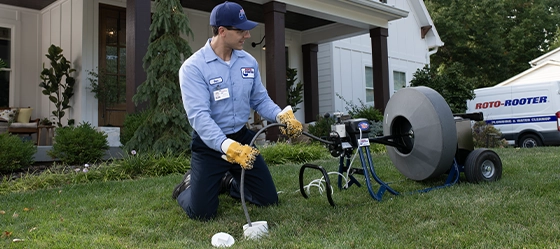
What Damages Tempe Sewer Lines
Tempe's desert environment creates sewer line failure patterns distinct from those in temperate or humid climates.
- Thermal cycling damage: The extreme temperature range between summer and winter causes pipe materials to expand and contract repeatedly. After decades of this cycling, rigid materials develop micro-cracks that grow into structural failures. The temperature differential between pipe interior and surrounding soil adds additional stress.
- Caliche layer complications: Caliche - a calcium carbonate-cemented soil layer common throughout the Valley - is as hard as concrete and creates an uneven subsurface. Pipes bridging caliche formations develop stress points at transitions between hard and soft ground as surrounding soil shifts with moisture cycles.
- Monsoon soil pressure: Monsoon storms saturate desert soil rapidly, causing sudden swelling against pipe walls. The pressure displaces pipe sections and forces joint connections apart. When the soil dries again, it pulls away and leaves the displaced pipe unsupported.
- Orangeburg pipe failure: Homes connected to city sewers between the 1940s and 1970s may have Orangeburg pipe with an average lifespan of 50 years. The material absorbs moisture, deforms under soil pressure, and collapses. Most remaining Orangeburg in Tempe requires full replacement.
- Root intrusion in irrigated areas: Desert-adapted trees and ornamental plantings near sewer line paths send roots toward the moisture escaping through damaged joints. Properties with landscape irrigation near sewer lines see accelerated root growth into pipe connections.
Serving Tempe and surrounding communities, Including:
Counties in the Tempe Area
Tempe Neighborhoods and Their Sewer Challenges
Tempe's development spans several decades, and each era of construction placed different pipe materials into the Valley's challenging ground.
- Maple-Ash and downtown Tempe: The city's oldest residential areas with homes dating to the 1950s and 1960s. Original clay tile and cast iron sewer laterals - and potentially Orangeburg installations - have absorbed decades of desert thermal cycling. The mature tree canopy along these streets drives root intrusion into aging pipe joints.
- McClintock corridor and Kyrene area: Mid-century development with cast iron sewer connections now 50 to 60 years old. The clay soil component in this area responds aggressively to monsoon moisture, creating ground movement that stresses already corroded pipe joints.
- South Tempe and Ahwatukee border: Later development with modern PVC connections on soil that includes significant caliche deposits. While pipe materials are newer, the caliche creates an uneven subsurface that stresses connections at hard-soft soil transitions.
- Tempe Town Lake area and Rio Salado: Properties near the Salt River corridor sit on alluvial soil with higher moisture variability than surrounding areas. The water table fluctuations near the lake add pipe stress that upland properties do not experience.
- Arizona State University perimeter: Dense residential neighborhoods with mixed-era construction and high demand on aging sewer infrastructure. Rental properties in this area often defer maintenance until problems become emergencies.

Same-Day Sewer Line Repair in Tempe
Tempe's Trusted Sewer Line Repair Team

SPECIAL FINANCING AVAILABLE
We have partnered with Synchrony Bank to offer financing options to make your plumbing repair expenses as convenient and stress-free as possible.