Sewer Line Excavation and Root Damage Repair in Tucson
Key Takeaways: A Buried Pipe Is the Wettest Thing in a Desert Yard
- Roots arrive where a joint has already opened: a hairline crack or a separated clay joint leaks slowly into ground that has nothing else in it, and the root system of a mature desert tree finds that moisture and stays.
- Cleaning cuts roots and leaves the opening: a cable or a jetter restores flow, and the mass regrows through the same defect, which is why the interval between clearings is worth tracking.
- Camera inspection decides everything that follows: footage plus a locator gives the defect, the depth and the distance, so a repair can be scoped to one section rather than the whole run.
- Older central stock changes the answer: vitrified clay and cast iron in the long-settled parts of the city behave differently from the plastic laid in the later growth on the east side of Tucson and toward the foothills.
- Trenchless has conditions: pipe bursting and cured-in-place lining need a host pipe with its shape and alignment intact, and heavy root intrusion through a broken wall usually closes that door.
- Utility locating comes before any dig: gas, power, water, telecom and the irrigation grid are all marked, and the marks set where the cut can open.
- The surface here is granite and drip line: backfill and compaction are part of the excavation, and rebuilding planting or paving is scoped on site before work begins.
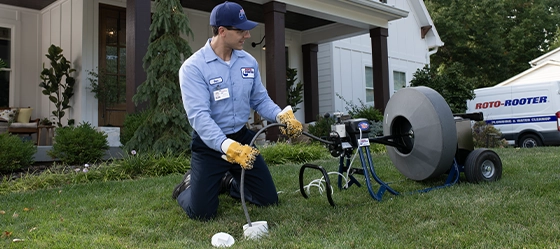
Every tree in a Sonoran Desert yard is engineered to hunt water, and a buried sewer line that has begun to weep is the most dependable moisture on the property. Mesquite and palo verde put roots down further than their canopy suggests, and a landscape tree living on a drip emitter will follow a better supply the moment it finds one. In Tucson that is the mechanism behind a large share of the lines that end up needing excavation.
What Root Mass Does to a Line, and When Excavation Becomes the Answer
A root does not open a sound pipe. It enters through something already there: a clay joint that has shifted, a hairline crack in cast iron, a bad connection left by an old repair. Once inside, it grows toward the flow, thickens into a mat that catches paper and grease, and widens the opening it came through as it expands. The pipe that was leaking a little is then leaking a lot, and the surrounding ground washes into the void, which is how a small defect becomes a section that has lost its support.
Cleaning is the right first move and it is genuinely effective. A cable or a jetter cuts the mass out and the line runs again. What it cannot do is close the opening, so the useful measurement is time: a run that needs clearing every couple of years is being maintained, and a run that needs it every few months is telling you the wall of the pipe is gone at that point. Camera footage then separates those two stories, and it is the footage that authorizes an excavation, never the symptom on its own.
Clay, Cast Iron and What Grew Up Over Them
Tucson has been continuously settled far longer than anywhere else in Arizona, so the central neighborhoods carry genuinely old buried pipe under genuinely old trees. Vitrified clay in short jointed lengths is close to ideal for root entry, because every joint is a seam. Cast iron holds up better until corrosion opens the wall from the inside. The midcentury ranch build-out across the middle of Tucson sits in between, and the newer growth toward the Rincon and Catalina sides is mostly plastic with far fewer joints. Knowing which era a property sits in is most of the diagnosis before anybody arrives.
Operated as an Independent Contractor - All available services, hours of operations, pricing structure, and guarantees may vary by location
Serving the entire Tucson metro area, Including:
Counties in the Tucson Metro Area
Responsibility Changes Somewhere Between the House and the Main
The buried run from a building to the public system is the private sewer lateral, and the owner is generally responsible for it. Where that responsibility hands over is set by the jurisdiction, and municipalities across Arizona do not all draw it in the same place: some at the property line, some at the connection to the main itself. Your municipality decides, the camera establishes where the defect actually sits, and the two together determine who does what. Roto-Rooter works on the private lateral and does not perform municipal main work.
Will Removing the Tree Fix the Sewer Line?
Usually no, and it is worth being straight about why. The roots inside the pipe are already there, and they are the visible half of a system that may reach well beyond the trunk you are looking at. Removing a mature tree in Tucson costs shade that is genuinely worth something in this climate, and it leaves the defect in the pipe untouched, so a different root system finds it later. The durable answer is to close the opening: replace the failed section, or reline a run that still has a wall to line. Where a tree sits directly over a lateral and the line is being replaced anyway, the route and the depth of the new run are worth planning around it.
Decomposed Granite, Drip Line and What the Yard Looks Like After
Most Tucson yards are xeriscape, and that changes the restoration conversation in a good way. There is no lawn to re-establish, and the surface over most trenches is granite over fabric with a low-pressure drip grid threaded through it, all of which can be taken up and put back. The parts worth protecting are the emitters, the mainline tubing and any specimen planting near the trench line, and those get identified before the machine arrives instead of discovered by it.
- Bedding first: the new pipe is set on graded material so the fall is continuous and no cobble carries a point load.
- Backfill in lifts: the trench is filled and compacted in stages, because granular spoil pushed back loose settles later.
- Granite and fabric restored to grade: the desert surface goes back over the line once the ground beneath it is compacted.
- Irrigation reconnected, then checked: cut emitters and tubing are repaired and the zone is run to confirm it.
- Paving and planting scoped separately: replacing a concrete walk or rebuilding a specimen bed is written into the estimate before work starts.
Using the Line Until the Excavation Is Booked
A household still has to live while a repair is scheduled. Keeping wipes, grease and heavy paper out of a compromised run buys real time, and the warning signs are consistent: the lowest fixture gurgles first, a shower drains slowly, and the washing machine finds trouble the rest of the house has not noticed. If it backs up before the work happens, that is an emergency plumber in Tucson call, and Roto-Rooter answers those 24/7, 365 days a year. For everything else this franchise handles locally, start on the main page for Tucson.
Schedule a Camera Run on Your Sewer Line in Tucson
If a line has been cleared more than once and the interval is getting shorter, footage is the step that turns guesswork into a scope. Call 520-518-3769 to get a camera down the line, or schedule online and pick a window. Roto-Rooter is fully licensed and insured, answers across Tucson 24/7, 365 days a year, and provides on-site estimates before any work begins.

Trenchless, Pipe Bursting and Roots Already Inside the Pipe
Locating in Alluvium, and a Trench That Wants to Slough
