Sewer Line Excavation and Root Damage Repair in Tyler
Key Takeaways: What the Canopy Does to a Sewer Line in Tyler
- A line that blocks every year or two: recurring roots in the same stretch mean an opening in the pipe that keeps letting them back in.
- Sandy ground carries roots a long way: the loose topsoil across this part of East Texas lets a tree well away from the house reach a lateral it should have nothing to do with.
- The tree is part of the decision: an open cut through a root plate means cutting structural roots, which is why trenchless deserves a serious look here before a trench line is chosen.
- Rolling ground and lost grade: a run crossing a slope that has lost bedding settles into a dip and holds water, and no cleaning method puts fall back.
- Camera inspection decides: the footage separates roots in a sound pipe from roots in a broken one, and only the second is an excavation job.
- Utility locating first: gas, electric, water and telecom get marked before any trench opens, alongside a private sweep for irrigation and low-voltage runs.
- Your lateral, the municipality's main: the buried run from the house to the connection is normally the owner's, with the jurisdiction setting the changeover point.
- Roto-Rooter is fully licensed and insured, handles the permit and the inspection, and backfills and compacts the trench in lifts.
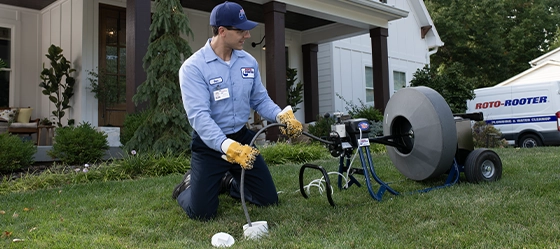
The thing that makes a sewer repair complicated in this city is standing twenty feet from the house with a trunk two feet across. Tyler grew up as a nursery and rose-growing town on rolling ground in the East Texas pine belt, and the result is a residential canopy that is old, dense and in a great many cases planted on purpose by somebody who chose where it went.
Roots follow moisture and air. A sewer lateral with a hairline crack or a slightly open hub gives off both, and a root system will find it and grow toward it. What makes the search easy here is the soil: deep sandy topsoil sitting over a clay subsoil is loose, well aerated and simple to move through, so a mature pine or hardwood can put fine roots out well past the edge of its own canopy and reach a line that seems far too distant to be its business.
Once a root reaches an opening it thickens inside the pipe, catches paper and solids on the mat it builds, and widens the crack it came through as it grows. Cutting it out restores flow for a season or two and leaves the opening exactly where it was.
The season adds to it. East Texas gets long dry stretches through late summer, and a tree under water stress sends roots further looking for moisture. A leaking joint in Tyler is at its most attractive to a root exactly when the yard is at its driest, which is why a line that behaved all spring can block in September.
Tree Roots, Sandy Ground and the Case for Excavation in Tyler
A camera inspection in Tyler tells you which of two situations you are in. The crew runs the camera from the cleanout and locates depth and position as it goes, and the footage shows whether the pipe around the roots is intact.
- Roots at a sound joint: the hub has loosened slightly and roots are entering through a small opening in an otherwise good pipe. Clearing and a repair at that joint can be enough.
- Roots through a cracked or broken length: the pipe wall has failed and the roots are a symptom. Cleaning it becomes an annual appointment.
- Bellied line: a section holding standing water at rest, which on a sloping lot usually means the bedding under the run has moved.
- Offset joint: lengths stepped out of line, catching solids on the lip every time the house drains.
- Collapse: the pipe has lost its shape and a cable stops in the same place every time.
Where the pipe is still sound in a wooded part of Tyler, clearing the roots and keeping to a schedule is the right answer and it is what drain cleaning in Tyler is for. Excavation earns its place when the footage shows the pipe itself has failed.
Operated as an Independent Contractor - All available services, hours of operations, pricing structure, and guarantees may vary by location
Serving the entire Tyler metro area, Including:
Counties in the Tyler Metro Area
When Does a Root-Damaged Line Need Sewer Line Replacement?
Roots do not create their own way into a sealed pipe. They arrive at an opening that already exists, so the real question the footage answers is how big that opening is and how much pipe is left around it. A single loosened hub in a sound run is a repairable defect. A length with roots through a split wall, or three or four hubs open along the same run, has moved past what cutting and clearing can hold on a line in Tyler.
The second trigger on the hills around Tyler is grade. Sandy soil moves under water, and on the rolling ground here a run that has lost bedding across a slope settles into a low spot that holds standing water permanently. That section will keep catching solids no matter how clean the pipe is, because the problem is the shape of the line. Restoring fall means opening the run and re-bedding it, and it is one of the few situations where an open cut is the only honest recommendation.
Costs in Texas vary with the length and depth of the run, what is above it, how much root work is involved and the method the camera inspection supports, and Roto-Rooter provides on-site estimates before any work begins. The rest of what the local team handles is on the Tyler plumbing page.
Call to Schedule a Sewer Line Inspection in Tyler
Call Roto-Rooter at 903-597-7755 to get a camera in the lateral and the finding on record, or schedule online. Crews are available 24/7, 365 days a year, Roto-Rooter is fully licensed and insured, and no excavation starts without footage you have seen and an on-site estimate you have agreed. On a line in Tyler that has been rodded for roots more than once, that inspection is where plumbing peace of mind starts.

Pipe Bursting, Lining and Open-Cut Under a Mature Canopy
Utility Locating, Permits and What the Yard Looks Like After
