Hydro Jetting in Wilmington
Key Takeaways: The Fitting That Holds Water on Purpose
- A line that closes in the same place every time is usually telling you about a feature of the plumbing rather than about anything that went down a drain.
- Older houses here carry a house trap: a U-shaped fitting set into the main drain close to the foundation, installed to block sewer gas and holding a permanent pool of water as part of how it works.
- Anything heavy that reaches that pool stops there. Grit settles out of standing water, grease collects at the surface of it, and fibrous material catches on the bend.
- Hydro jetting scours the full circumference of the pipe with high-pressure water, so a trap and the run beyond it are actually emptied rather than bored through.
- A video camera inspection has to come first, because the same fitting that collects the trouble also hides the condition of everything downstream of it.
- Cleaning is not always the recommendation. A collapsed length, a badly offset joint, or a wall thinned by corrosion needs a repair conversation, and a trap in poor condition is frequently better removed than serviced again.
- Wilmington built most of its rowhouse and twin stock before the war years, on narrow lots where the run from the foundation to a main under the street is short and the trap sits in the first few feet of it.
- Roto-Rooter is fully licensed and insured, and answers in Wilmington 24/7, 365 days a year.
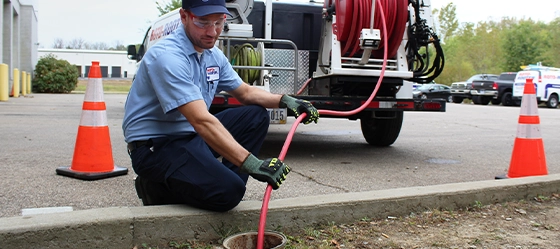
Somewhere in the first few feet of the main drain of an older Wilmington house there is a fitting that most owners have never heard of and could not point to. It is a house trap, a U-shaped bend cast into the line where the drain leaves the building, and its job was to hold a plug of water that stops sewer gas from the street main coming back up into the house. Two access plugs sit above it, one on each side of the bend, and on many properties they are the only way into the drain at all.
It did its job. What nobody accounted for is that a fitting designed to hold water permanently is also a settling basin. Everything the household sends down arrives at a pool with no current in it. Grit and coffee grounds drop out. Cooking fat cools, rises and coats the walls of the bend. Anything fibrous catches on the turn and stays there collecting the next thing that comes past. That is why a great many sewer line blockages in this city happen within arm's reach of the foundation rather than out under the yard where people picture them. On a Wilmington lot the whole run out to the street is short enough that the trap accounts for most of the trouble in it.
Why a Cable Has Trouble Past a Double Bend
A drain cable is a boring tool driven from one end, and it works by pushing. A house trap asks it to turn down, back up, and carry on, twice, inside a short distance. A skilled technician gets a cable through, and doing so opens a channel and restores flow, which is exactly what is needed when a house is backing up. What the cable cannot do is take the material out of the trap. It bores a path through what is sitting there, the water comes back, and the pool refills around a passage that closes again at whatever rate the household fills it.
That is the same limitation a cable has anywhere in a line, but the trap concentrates it. Everywhere else in the run, gravity and flow give buildup some reason to keep moving. In the trap, nothing does, and a Delaware winter slows what little movement there is.
What Hydro Jetting Does at a Trap and Beyond It
A jetting hose carries a nozzle that directs high-pressure water backward against the pipe wall while the hose is drawn through the run. The scour covers the whole circumference instead of a hole through the middle, and because the jets face behind the nozzle they drive what they lift toward the main rather than compacting it further in. In a trap, that means the standing pool and everything that has settled into it are carried out rather than displaced. Past the trap the same pass takes grease off the crown, flushes sludge from any flat stretch, cuts mineral scale in older cast iron back toward the original bore, which is the descaling half of the work, and strips root hair left in a joint after a cutter head.
That end-to-end difference is the whole argument for the method, and it is why Roto-Rooter treats cleaning a pipe back to the wall as the standard rather than as an upgrade. Opening the blockage is the emergency. Emptying the fitting that keeps creating it is the part that changes next year.
Serving the entire Wilmington metro area, Including:
Counties in the Wilmington Metro Area
A Trap Is Not the Only Thing a Camera Finds
A trap is the likeliest thing to be holding up a line in this city, and it is a long way from the only thing a camera finds. Three of the alternatives close the subject. Where a section has collapsed there is no bore left to work with. Where one length now sits well out of line with the next, a hose catches on the step and the fault underneath is structural, which on a narrow Wilmington lot becomes a repair conversation rather than a cleaning one. Where the wall has corroded thin, pressure is a risk rather than a tool, and the inspection is how that gets established rather than discovered.
Where one of those turns up, the honest answer is that cleaning is not the fix. High-pressure water cleans a pipe; it does not restore one, and a technician who has watched the footage will say so rather than run a hose down a line that needs repair. What follows is a conversation about the options for that specific defect, starting from a recording that already exists.
Can Hydro Jetting Clean Through a House Trap?
It can, and cleaning one properly is a routine part of the work in this city. The hose goes in through the access plug, the trap is emptied rather than bored through, and the pass continues out to the main so the rest of the run gets the same treatment. The second camera pass then shows both the trap and the pipe beyond it, which matters because a trap in good condition and a trap that has corroded through at the bottom look identical from above.
What the footage frequently supports is a different conversation. A trap that has been cleaned repeatedly, that is cracked, or that has been partly bypassed by earlier work is a candidate for removal rather than for another service visit, and removing it is a repair rather than a cleaning. Roto-Rooter will show you what is there and explain both paths. Nothing gets recommended off a guess about what a Wilmington house of that age probably has.
Storefronts and Kitchens on the Same Kind of Drain
Plenty of commercial space in Wilmington occupies buildings that started as housing, which means a restaurant or a corner kitchen can be putting a commercial grease load through a residential-scale drain with the same fitting in it. The consequences differ sharply. A cleaned house line here may go years before it needs attention again, depending on what fouled it. A kitchen running every service is working against a known accumulation rate, which is why food service operators across Delaware settle on a planned interval instead of waiting for a failure during a dinner rush.
Roto-Rooter covers both. For the wider set of plumbing work across a property, the Wilmington plumbers page is the place to start.
The Two Plugs, and Which One Matters
A house trap normally has an access plug on each side of the bend, and which one a technician opens depends on where the blockage is. That is worth knowing for a practical reason: on older properties one or both plugs have been paved over, tiled around during a renovation, or replaced with something that will not come out cleanly. Mentioning what you can see when you call saves time on the day.
The visit itself is straightforward. The access is opened, the camera goes down and the findings are talked through before anything else happens. If the line is a candidate, the hose goes in, the run is cleaned back through the affected stretch, and the camera goes down a second time so the wall can be seen rather than described. Roto-Rooter provides on-site estimates before any work begins. Where a line is actively backing up rather than slowly closing, start with emergency plumbing help in Wilmington, because restoring flow comes first and the cleaning conversation follows.
Schedule Hydro Jetting for a Wilmington House Drain
Roto-Rooter has been cleaning sewer lines since 1935 and is fully licensed and insured. Call 302-256-5022 or schedule online to book an inspection anywhere in the Wilmington area, and get the plumbing peace of mind that comes from seeing what is in the line rather than guessing at it. Roto-Rooter answers 24/7, 365 days a year.

What Points at the Trap Rather Than the Yard
A Rowhouse City Plumbed to a Different Rulebook

SPECIAL FINANCING AVAILABLE
We have partnered with Synchrony Bank to offer financing options to make your plumbing repair expenses as convenient and stress-free as possible.