Sewer and Water Line Excavation in Ft Myers
Key Takeaways: Opening a Trench in Wet Sand
- A line that backs up again days after it was cleared is the pattern that leads here, and a camera inspection is what separates a blockage from a broken pipe.
- Fine sand will not hold a vertical face, so an excavation in Ft Myers is shored as it is opened and the walls are supported for as long as the trench stays open.
- The water table sits close to the surface for much of the year, which means the trench has to be pumped down and kept dry while the pipe work happens.
- Season changes the job. The same repair in the middle of the wet season and in the dry months is two different amounts of water to manage.
- Age of the run tells you what to expect: cast iron and clay under the older streets near the river, plastic under the newer plats further out.
- Nothing gets dug until gas, water, electric, telecom and irrigation have been located and marked, and the path is hand-dug where it crosses them.
- Sand backfilled carelessly migrates, and a driveway or paver deck above the run shows it, so placement and compaction are done in lifts.
- Roto-Rooter is fully licensed and insured, handles the permit the work requires and arranges the inspection that signs it off.
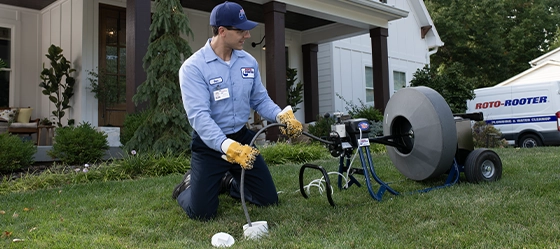
Ft Myers is built on the flat, sandy ground either side of the Caloosahatchee River, and a sewer lateral here spends much of the year sitting in soil that is already holding water. That single fact shapes every excavation on this side of Florida.
Why the Ground Decides How a Sewer Line Excavation Runs Here
Dig into the fine quartz sand that covers this part of Lee County and the sides of the hole start moving almost immediately. There is no clay in Ft Myers soil binding the grains together, so a trench wall slumps into the excavation instead of standing up on its own. Every residential dig is therefore a shored dig, with a trench box or shoring set as the excavation goes down, and the working space kept inside it.
Water is the second half of the same problem. The surficial water table under much of Ft Myers sits within a few feet of the grass, and it rises through the wet season until a trench of any depth fills from the sides as fast as the bucket empties it. Dewatering pumps run alongside the excavation to hold the level below the pipe so the bedding can be placed on solid ground.
What the camera has to show before an excavation is justified
- Collapse: a broken section of cast iron or clay that the cable rides over and the camera head cannot get past.
- Separated or offset joints, where the two lengths no longer line up and every solid catches on the edge.
- A belly holding standing water between service calls, usually where sandy bedding washed out from under the pipe.
- Heavy root intrusion at a joint that had already opened, common under the mature canopy in the older neighborhoods.
- A run that fails again within weeks of a thorough cleaning, which moves the problem from what went down the drain to the pipe carrying it.
Two building eras, two different laterals
Ft Myers did not grow evenly, and the underground plumbing records that. The older streets close to the river went in when cast iron and vitrified clay were the materials of the day, and those runs are now well past middle age: cast iron scales and thins from the inside, clay opens at the joints. A very large share of the housing further out went up during the growth that came later, on plastic laterals that fail for different reasons, usually a crushed section under a drive, a bad joint left by the original installer, or bedding that washed out and left the pipe with a sag in it.
Knowing which era a property belongs to changes the first question the crew asks. On an older run near the river the useful question is whether the pipe has any wall left to line. On a newer run the question is usually where the sag or the crush is and whether the rest of the line is worth keeping. Both answers come out of the same camera pass, and both get taken into account in the on-site estimate.
Routine clogs belong somewhere else entirely. If a single fixture is slow or a kitchen line has grease in it, drain cleaning in Ft Myers is the right service and the cheaper answer. Excavation is what is left when the camera shows the pipe itself has stopped doing its job.
Operated as an Independent Contractor - All available services, hours of operations, pricing structure, and guarantees may vary by location
Serving the entire Fort Myers metro area, Including:
Counties in the Ft Myers Metro Area
Backfill, Sod and Pavers After the Trench Is Closed
The surface is what a Ft Myers household lives with afterwards, so it is worth being clear about it before the machine arrives. An open-cut replacement means a trench across part of the property, spoil stacked beside it and turf that has been driven on. The new pipe is bedded, the trench is backfilled in lifts, and each lift is compacted before the next goes on.
Sand rewards that discipline and punishes shortcuts. Placed properly it compacts to a firm, stable fill. Dropped in loose it keeps settling for months, and a driveway, paver deck or pool surround sitting above the run telegraphs every void underneath it as a dip or a cracked joint. Where the lateral passes under concrete, pavers or an asphalt drive, the cut and its replacement are scoped on site before the work begins so the finished condition is agreed rather than assumed. Restoring the excavated surface to a workmanlike condition is part of the job. Rebuilding a landscape, replacing plantings or matching a decorative paver pattern is separate work that gets priced and agreed on its own.
Where the private lateral ends and the public system begins
The buried run between the building and the public sewer is the lateral, and the property owner is generally responsible for it. Where that responsibility stops varies by jurisdiction: some draw the boundary at the property line, some at the curb, some at the connection to the main. Your municipality decides which applies at your address, and it is worth confirming with them before work is scheduled, because it settles who handles what past the sidewalk. Roto-Rooter works on the private lateral, pulls the permit that work requires and arranges the inspection. The municipal main is the municipality's to maintain.
What the permit and the inspection actually cover
Replacing a buried sewer lateral is permitted work, and the permit exists to get the finished line looked at by somebody other than the crew that installed it. Roto-Rooter files the paperwork, keeps the trench open until the inspection has happened where that is required, and closes the permit out once the work has been signed off. The homeowner is not left chasing the process. Requirements are set by the authority having jurisdiction over the address, so they get confirmed for your property rather than assumed from the street next door.
Does the wet season change when a sewer line should be replaced?
It changes the work rather than the decision. A failing lateral does not improve by waiting, and a line that has already backed up into the house is not something to schedule around the weather. What the season changes is how much water has to be managed while the trench is open, how long the dewatering pumps run and how the sand behaves as the excavation is cut. In the drier months the same run is a simpler dig. The camera inspection and the on-site assessment take the season into account, and Roto-Rooter provides on-site estimates before any work begins.
Schedule a Sewer Line Inspection in Ft Myers
Repeat backups on the same drain are worth a look inside the pipe before anyone talks about digging. Roto-Rooter has been solving drain and sewer problems since 1935, works 24/7, 365 days a year and gives plumbing peace of mind on a repair nobody plans for. Call 239-992-3856 or schedule online, and see the rest of what the local team handles on the Ft Myers plumbing page.

Pipe Bursting, Lining and What the Water Table Allows
Locating Gas, Water and Irrigation Before the Dig
