Sewer and Water Line Excavation in Honolulu
Key Takeaways: A Run That Sits Close Under the Surface
- Nothing here has to be buried below a frost line, so cover over a Honolulu sewer run answers to other considerations and a good number of them sit closer to the surface than their cold-climate equivalents.
- On a Honolulu lot that makes the surface a cause rather than only a consequence. Posts, planting holes, landscape trenching, a vehicle standing on unpaved ground and new concrete poured over the route all reach a shallow line.
- A camera goes down the Honolulu run before anything is scoped, because damage from above and ordinary blockage produce the same symptoms indoors.
- Four findings end the cleaning conversation on a Honolulu line: a collapse, a joint out of alignment, a length holding standing water, and roots entering through a break.
- Trenchless is conditional on depth, material, degree of collapse and access at both ends, and shallow cover works against a burst head that needs ground to displace into.
- Utility locating precedes any excavation, and near the surface hand work rather than machine work is what protects everything the marks describe.
- Where the private lateral ends and the public main begins is set locally, so the boundary is a question for your municipality rather than an assumption.
- Roto-Rooter is fully licensed and insured, handles the permit and inspection process, and provides on-site estimates before any work begins.
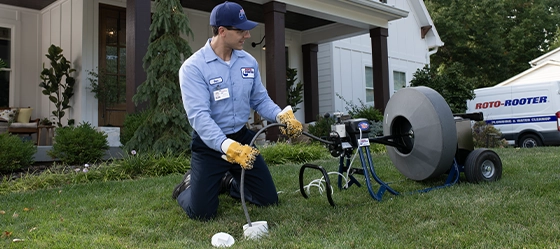
Ask most people how far down their sewer line runs and the honest answer is that they have never had a reason to think about it. In Honolulu the answer matters more than it does in most places, because there is no freezing ground here to get below, and burial depth in a market without a frost line is decided by other things entirely. A run can sit surprisingly close to whatever is walking, parking, planting or building on top of it.
What the Camera Finds on a Shallow Run
Symptoms do not distinguish causes on a Honolulu property. Repeat backups, several fixtures slowing at the same time and wet ground appearing along the route all say the main line leaving the building is involved, and a pipe crushed by something loaded onto the surface above it produces exactly the same complaints as one that closed up on its own. A camera survey separates them, and on a shallow line the shape of the damage is frequently the giveaway.
Four findings take a Honolulu run out of the cleaning category regardless of what caused them. A collapsed length has no bore left to restore. A joint that has shifted out of alignment leaves a lip that catches solids every time. A sag holds standing water, so the line reloads no matter how thoroughly it was cleaned. Roots entering through a break are attached to an opening that will keep admitting them in a climate with no dormant season to slow it down.
Open Cut, and What Shallow Ground Does to the Alternatives
An open cut across a Honolulu lot trenches along the run, lifts the failed pipe, lays the new one, then backfills and compacts. On a shallow line that trench is not deep, which sounds like good news and mostly is, though a shallow excavation across a small lot still occupies a large share of the usable ground while it is open.
The trenchless methods are conditional here for a specific reason. Pipe bursting works by displacing the old pipe outward into the surrounding material, and shallow cover gives that displacement less to push against, which can lift or disturb the surface above the run. Lining needs a host pipe with enough shape left to cure against, so a length crushed from above rules it out. Depth, material, the degree of collapse and access at both ends decide, and all four come off the footage rather than off anybody's preference.
Serving the entire Honolulu metro area, Including:
Counties in the Honolulu Metro Area
Everything Done to the Yard Happens Over the Pipe
The practical value of knowing your run is shallow is that it changes ordinary decisions. Before a post goes in, before a hedge is planted, before somebody trenches for lighting or pours a pad, the useful question is where the sewer line runs and how far down. That is answerable: the camera reads distance as it travels, and the route can be established on the surface, which turns a guess into a marked line on the ground.
It also changes what an excavation buys. While the ground is open on a Honolulu property with no accessible cleanout, adding one is a small piece of a large job, and afterward it is a separate excavation. The same goes for recording where the finished run sits, because the next person to plant, park or build over it will only know if somebody wrote it down.
Marks Go Down Before Any Ground Opens
Gas, electric, water and telecom are located and marked before a Honolulu excavation begins, and this is a legal and safety obligation rather than a courtesy. Shallow ground raises the stakes rather than lowering them, because everything buried in it is closer to the first pass of a shovel. Nothing opens until the marks are down, and near the pipe the digging slows to hand work by design.
Permitted and Inspected, With No Dates Promised
Work of this kind across Hawaii is permitted and inspected, and Roto-Rooter handles that process as part of the job. What this page will not state is a permit fee or an approval timeline, because both vary by jurisdiction and by the scope of the specific job, and a number published here turns into a promise nobody authorized. Your on-site estimate covers it against the work actually proposed.
Where the Property's Pipe Stops Being the Property's
The run from a Honolulu building to the public main is generally the property owner's, and the main is generally the municipality's. Exactly where that boundary falls, at the property line, at the curb or at the connection, is set locally and varies. Confirm it with your municipality rather than assuming, because it decides who pays for which length of pipe.
Roto-Rooter works on the property owner's side of that boundary. Municipal main work is not something a plumbing company undertakes, so a finding past the connection sends the next call to the city rather than to a contractor.
Putting Back a Surface Over a Shallow Line
Backfill and compaction come with any Honolulu job, and over a shallow run compaction matters twice: it stops the trench line settling into a visible depression, and it restores the support the pipe relies on to carry whatever ends up on top of it. Poorly filled ground over a shallow line is not only untidy, it leaves the pipe less protected than it was before anybody arrived.
Final surface restoration, meaning turf, planting, paving or concrete, is scoped on the property and agreed before work begins rather than assumed either way. Get it written down. An open cut through a concrete pad or a walk will be visible after repair, and where a run passes under hardscape on a small Honolulu lot that is worth settling before the first cut.
If the Line Gives Out Before the Repair
A run bad enough to need replacing will not wait for the schedule. If it backs up first, emergency plumbing help in Honolulu can restore flow so the household keeps functioning, which is a holding action rather than a fix and changes nothing the camera found. For everything else handled locally, start at the Honolulu service page.
Schedule a Camera Inspection and Learn Where the Run Goes
Roto-Rooter has served Hawaii property owners since 1935 and is fully licensed and insured. Call 808-842-5680 or schedule online to get a camera down the line and a reading of where it travels. Roto-Rooter provides on-site estimates before any work begins, so the scope follows the evidence. Knowing what is under the yard before anybody puts a post in it is the plumbing peace of mind worth having, and Roto-Rooter answers 24/7, 365 days a year.

Damage That Arrives From Above
Coral, Basalt and Ground That Never Freezes

SPECIAL FINANCING AVAILABLE
We have partnered with Synchrony Bank to offer financing options to make your plumbing repair expenses as convenient and stress-free as possible.