Hydro Jetting in Minneapolis
Key Takeaways: Why a Narrowed Line Is a Winter Problem Here
- A sewer line that drains acceptably in October is not necessarily a line that will get through January, because what keeps a buried pipe working in deep cold is the volume of warm water moving through it.
- A run half closed by a coating carries the same household flow more slowly. Water that lingers loses heat, and in ground frozen to the depth Minnesota reaches, that margin matters.
- Hydro jetting scours the full circumference of the pipe with high-pressure water and gives the bore back. A cable opens a channel through a blockage and leaves the coating on either side of it in place.
- A video camera inspection comes first, to measure how much pipe is actually left and to establish that the wall is sound enough to clean under pressure.
- Grease, mineral scale in older cast iron, and root hair remaining after a cutter head are three separate findings with three different answers.
- Not every line is a candidate. A collapsed length, a badly offset joint, or a wall thinned by long corrosion needs a repair conversation instead of a hose.
- The older neighborhoods of Minneapolis run clay laterals laid a century ago under a boulevard canopy, buried deep because the frost line here demands it.
- Roto-Rooter is fully licensed and insured, and answers in Minneapolis 24/7, 365 days a year.
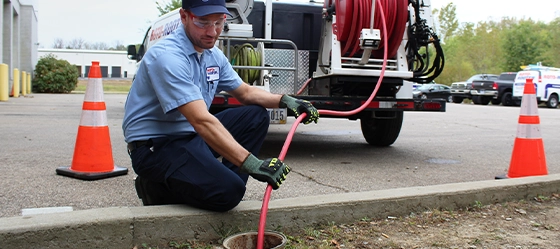
Nobody thinks of a sewer line as something that can freeze. It carries warm water from a heated house, it sits well below the surface, and for most of the country that is the end of the matter. Minnesota is the exception often enough to be worth knowing about. In a hard winter the frost drives down further than the calendar suggests, and the lines that give way are almost never the healthy ones. They are the runs that were already carrying a coating. Minneapolis sees enough of them to take seriously.
The reason is straightforward. A pipe at its full diameter moves a household's water through quickly, and moving water carries its heat with it. Narrow that pipe by half with grease or scale and the same water travels slower, spreads thinner over the wall, and spends longer in contact with ground that is taking heat out of it. In a mild market that costs nothing. Here it is the difference between a line that works in February and a line that does not.
What Actually Keeps a Buried Pipe Open in Deep Cold
Three things, and a household controls two of them. Depth of cover is fixed at installation. Frequency of use is up to the occupants, which is why a property standing empty through a cold spell is at more risk than an occupied one. The third is bore, and that is the one that changes slowly enough for nobody to notice it happening.
This is why the useful question in Minneapolis is not whether the line has ever backed up. Plenty of runs that have never once caused a problem are down to a fraction of the diameter they were laid at. The question is how much pipe is left, and only a camera answers it. A Minneapolis fixture draining at a normal speed is reporting on a single sink, not on thirty feet of clay under the front yard.
Hydro Jetting and the Difference Bore Makes
A jetting hose carries a nozzle that directs high-pressure water backward against the pipe wall while the hose is drawn through the run. The scour covers the whole circumference rather than a hole through the middle of the obstruction, and because the jets face behind the nozzle they drive what they lift toward the main instead of packing it further in. Grease that cooled and set along the crown comes away. Sludge settled in a flat stretch is flushed rather than pushed along. Mineral scale in older cast iron is cut back toward the original bore, which is the descaling half of the work. Root hair left in a joint after a cutter head is stripped off.
A cable does a different job well, and it does it fast. Turned into a blockage it opens a channel and restores flow, which is exactly right at eleven at night with a house backing up. It simply has no mechanism for lifting material off a wall, so the diameter it restores is the diameter of the channel rather than the diameter of the pipe. Through most of the year that distinction is academic. Through a Minnesota winter it is not.
Serving the entire Minneapolis metro area, Including:
Counties in the Minneapolis Metro Area
What Would Make Cleaning the Wrong Move
Bore is worth restoring only where the pipe holding it is sound, and three findings say it is not. A collapsed section has no diameter to recover. A joint that has moved badly out of line with the next will stop a hose at the step, and the fault there is structural rather than anything a cleaning reaches. A wall corroded thin may not take the pressure. Each of those is a great deal easier to deal with in Minnesota in September than during a January thaw, which is one more argument for looking early.
Where one of those appears, the honest answer is that cleaning is not the fix. High-pressure water cleans a pipe; it does not restore one, and a technician who has watched the footage will say so rather than run a hose down a line that needs repair. What follows is a conversation about the options for that specific defect, which under a Minneapolis front yard may mean a trenchless repair rather than a full open dig. That is a different job with a different estimate, and it begins from footage that already exists.
Can Hydro Jetting Be Done When the Ground Is Frozen?
Yes. The work happens inside the pipe, below the frost line, and conditions down there change far less between January and July than conditions above ground do. What winter changes is access rather than method: a cleanout under snow takes longer to find, frozen ground makes any excavation harder if the camera turns up something structural, and a line that has already stopped is a more urgent visit than a line being cleaned on a plan.
That is the practical argument for doing this work in the warmer half of the year. A line inspected and cleaned in autumn goes into the season with its full diameter and its condition documented. A line inspected in a cold snap is being assessed under the least convenient conditions available, usually because it has already failed.
Restaurants Work Against a Clock the Weather Does Not Change
A house lateral and a commercial kitchen run carry different diameters, different daily loads, and very different consequences when they close. A cleaned residential line in Minneapolis can go years before it needs attention again, depending on what fouled it. A kitchen putting cooking waste through the same pipe every service is working against a known accumulation rate regardless of the season, which is why food service operators across Minnesota settle on a planned interval instead of waiting for a failure during a dinner rush.
Roto-Rooter handles both. For the wider set of plumbing work across a property, the Minneapolis plumbers page is the place to start.
What the Visit Needs, and When to Book It
A technician locates the cleanout, runs the camera, and talks through what is on the screen before anything else happens. If the run is a candidate, the hose goes in, the pipe is cleaned back through the affected stretch, and the camera goes down a second time so the wall can be seen rather than described. Roto-Rooter provides on-site estimates before any work begins, so nothing proceeds until the scope has been agreed.
Access is the practical variable on an older lot. A cleanout in a reachable spot makes for a straightforward appointment, while one that has been landscaped over, finished around during a remodel, or never fitted at all changes the approach, and it is worth raising when you call rather than discovering on the day. If a line is actively backing up rather than slowly closing, start with emergency plumbing help in Minneapolis, because restoring flow comes first and the cleaning conversation follows.
Schedule Hydro Jetting in Minneapolis Before the Deep Cold
Roto-Rooter has been cleaning sewer lines since 1935 and is fully licensed and insured. Call 612-788-9029 or schedule online to book an inspection, and get the plumbing peace of mind that comes from going into a Minnesota winter with a known number rather than an assumption. Roto-Rooter answers 24/7, 365 days a year.

What to Look For Before the Cold Sets In
Deep Frost, Old Clay and a Long Winter Overhead

SPECIAL FINANCING AVAILABLE
We have partnered with Synchrony Bank to offer financing options to make your plumbing repair expenses as convenient and stress-free as possible.