Sewer and Water Line Excavation in Santa Rosa
Key Takeaways: Two Kinds of Ground Under One City
- A lateral that has been cleared more than once in the same place is the case worth investigating, and a camera pass is what turns a suspicion into a decision.
- Ground varies sharply across the Santa Rosa Plain. Near the creek courses the soil is coarse fan material full of gravel and cobbles; toward the lower western side it is fine silt and clay.
- Those two materials break a pipe differently. Coarse ground lets bedding wash out and a line settle into a sag; fine ground holds water against the joints and moves with the seasons.
- Nothing freezes here, so depth is set by fall and cover instead. In the older streets a raised-foundation home puts the lateral shallow where it leaves the building and gives it a long run out to the street.
- Trenchless methods are conditional: pipe bursting needs a host line straight enough to guide the head, and cobbly ground can make the pull unpredictable.
- Every dig starts with a utility locate. In Sonoma County that includes irrigation and landscape lighting sitting at shovel depth alongside the marked services.
- Compaction is what the first wet season tests, and backfill placed in lifts is the reason the ground stays level after the rains arrive.
- Roto-Rooter is fully licensed and insured, pulls the permit the work requires and arranges the inspection that closes it out.
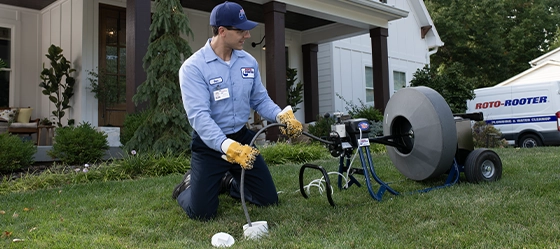
The creeks running west out of the hills dropped their gravel where the slope ran out and carried their silt on toward the lower ground, and every sewer lateral in Santa Rosa is buried in one of those deposits or the other. Which one a property sits on shapes how its line fails and what can be done about it.
Why Sewer Line Excavation Is a Different Job Across the Santa Rosa Plain
Creeks come down out of the hills on the east side and spread their load across the plain, so the ground close to those courses is alluvial fan material: gravel, sand and cobbles, loose and free draining. Further west the deposits get finer and the plain flattens into silt and clay that holds water through the winter and shrinks back through the long dry summer.
A buried lateral notices the difference. In fan material the bedding under the pipe can wash out and let a length drop, which shows up as a belly holding water between service calls, and cobbles make for uneven support along the run. In the finer western soils the story is seasonal movement: ground that swells wet and shrinks dry works at the joints of an older clay tile line until one of them opens and the roots find it.
What the camera finds in fan gravel and what it finds on the lower plain
- Collapse: a broken section of clay tile or corroded cast iron that stops the camera head and rides the cable over the top of it.
- A belly: standing water sitting in a low length, common where coarse bedding has migrated out from under the pipe.
- Offset joints, where seasonal movement has pushed one length out of line with the next and every solid coming down catches on the edge.
- Root intrusion through a joint that had already opened, following the only reliable moisture available in a Santa Rosa summer.
- A run that fails again within weeks of a thorough cleaning, which moves the problem from what went down the drain to the pipe underneath.
Routine blockages belong elsewhere. A slow fixture, a grease-loaded kitchen line or a single seasonal backup is what drain cleaning in Santa Rosa exists for, and it is the cheaper and faster answer. Excavation is the repair of last resort and it should be treated that way.
Operated as an Independent Contractor - All available services, hours of operations, pricing structure, and guarantees may vary by location
Serving the entire Santa Rosa metro area, Including:
Counties in the Santa Rosa Metro Area
Backfill, Compaction and the First Wet Season After
An open-cut replacement in Santa Rosa leaves a trench across part of the property, spoil it and turf that has been driven over. The new pipe goes in on prepared bedding, the trench is filled in lifts, and each lift gets compacted before the next one lands on it. That sequence sounds like detail and it is the difference between a repair nobody sees again and one that announces itself.
The test comes with the rain. Santa Rosa takes almost all of its water in a single winter window, so a trench backfilled loose in September gets its first real loading months later, all at once, and voids in the fill collapse as the ground saturates. What appears is a shallow trough tracing the line across the yard, or worse, a settled patch under a driveway edge. Doing the compaction properly takes longer on the day and it is why the surface is still flat the following spring. Where the run passes under concrete, pavers or asphalt, the cut and its replacement get scoped on site before the excavation starts so the finished condition is agreed rather than assumed.
Roto-Rooter is clear about the boundary here. Backfill, compaction and restoring the excavated surface to a workmanlike condition belong to the job. Rebuilding a garden, replacing mature plantings or matching decorative hardscape is separate work that gets scoped and agreed on its own terms.
Permitted work, and what the inspection is for
Replacing a buried lateral is permitted work, and the permit exists so the finished line gets looked at by somebody other than the crew that installed it. Roto-Rooter files the paperwork, holds the trench open for the inspection where that is required, and closes the permit out once the work has been signed off, so the household is not left chasing an agency. Requirements are set by the authority with jurisdiction over the address, and they get confirmed for that property rather than assumed from what applied on a job across town.
Who owns the pipe past the sidewalk
The buried run between the building and the public sewer is the lateral and the property owner is normally responsible for it. Where that responsibility stops is set locally: some jurisdictions draw the boundary at the property line, some at the curb, some at the connection to the main itself. Your municipality is the authority for your address, and it is worth confirming before work is scheduled because it decides who handles what beyond the sidewalk. Roto-Rooter works on the private lateral, files for the permit that work requires and arranges the inspection that signs it off. The public main stays with the agency that owns it.
Does trenchless sewer repair work in gravelly ground?
Sometimes, and the assessment is specific to the run. Cobbles and coarse gravel make a bursting pull harder to predict, because the head displaces material sideways and large stones resist moving cleanly. Lining is less affected by what is outside the pipe and more affected by what is left of the pipe itself, so on an older Santa Rosa lateral the question becomes whether enough wall remains to line against. The camera pass, the depth measurement and the access at each end answer it together, and the answer is given before any commitment is made.
Book a Sewer Line Assessment in Santa Rosa
If the same drain has backed up twice, the useful next step is a look inside the line rather than another cable pass. Roto-Rooter has been solving drain and sewer problems since 1935, works 24/7, 365 days a year and provides on-site estimates before any work begins. Call 707-795-7109 or schedule online, and see the rest of what the local team handles on the Santa Rosa plumbing page.

Pipe Bursting, Lining and the Ground That Decides
Marking Gas, Water and Irrigation Before Anything Opens
